Compound Interest Explained + Free Calculator Tool
If you’ve ever heard someone say, “Let your money work for you,” they were most likely talking about compound interest.
It is one of the most powerful financial concepts in the world — a simple idea that has helped millions of people grow small savings into massive wealth over time.
Whether you are:
- A student starting your financial journey
- A working professional saving for the future
- An investor aiming for long-term growth
Understanding compound interest can completely transform how you manage money.
In this detailed guide, you’ll learn everything step-by-step — in simple language.
📘 What You’ll Learn in This Guide
- What compound interest is
- How it works in real life
- The formula and calculation method
- Examples for better understanding
- How to maximize your returns
- Common mistakes to avoid
- And how to use a free compound interest calculator tool
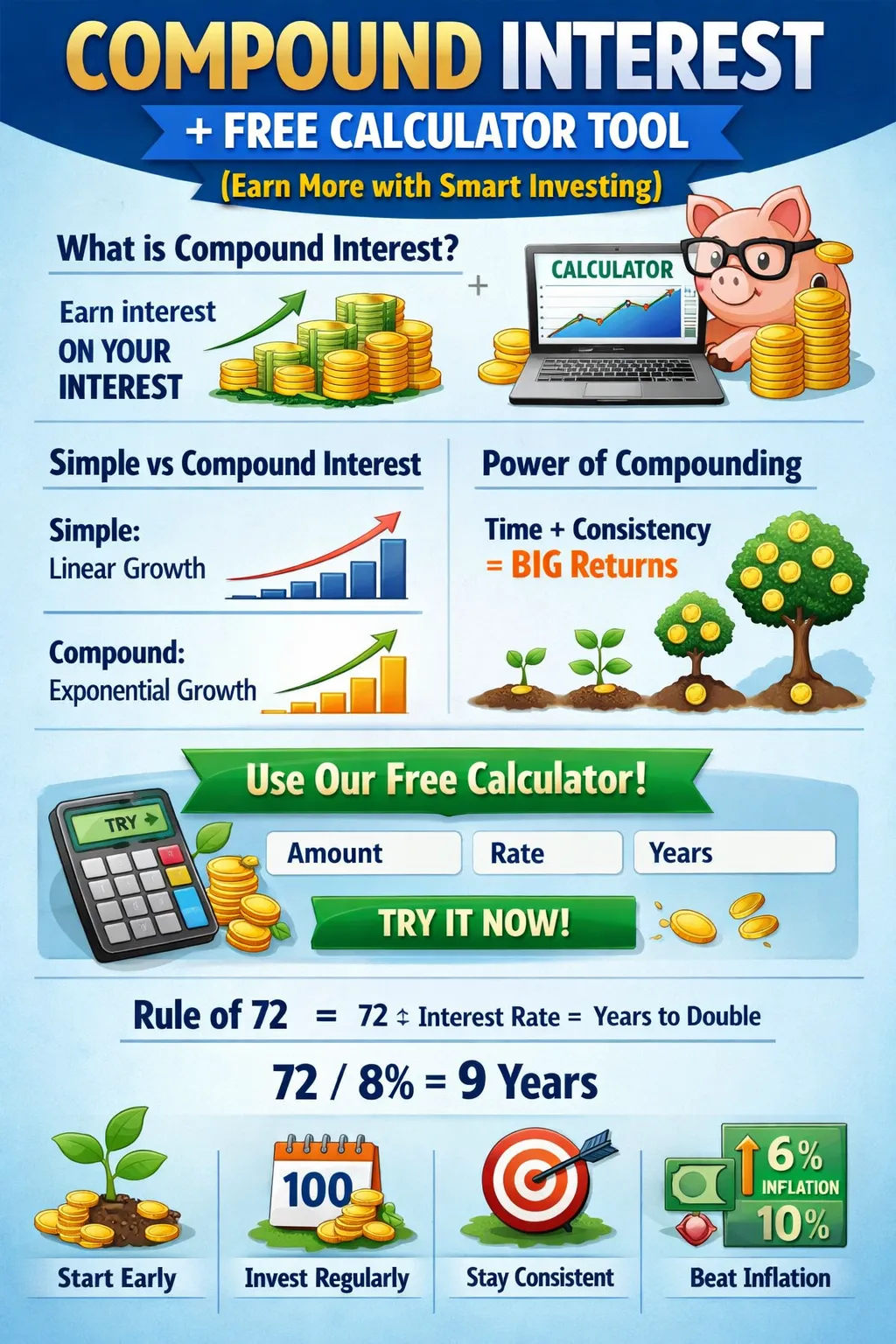
📊 What is Compound Interest?
Compound interest is the interest calculated on:
- Your original investment (principal)
- Plus the interest that gets added over time
In simple words:
👉 You earn interest not only on your money, but also on the interest it generates.
This is what makes compound interest so powerful.
🔁 How Compound Interest Works (Step-by-Step)
Let’s break it down simply:
- You invest money
- You earn interest on that money
- The interest gets added to your total amount
- Next time, interest is calculated on the new total
- This process keeps repeating
This cycle creates a snowball effect, where your money grows faster over time.
🔁 Simple Interest vs Compound Interest
Simple interest only calculates returns on the original principal amount. That means your earnings remain constant over time.
Compound interest, on the other hand, calculates returns on both the principal and accumulated interest. This leads to faster and exponential growth.
👉 That’s why compound interest is always better for long-term investing.
🧮 Compound Interest Formula (Detailed Explanation)
The standard formula is:
A = P (1 + r/n) ^ nt
Where:
- A = Final amount
- P = Initial investment (principal)
- r = Annual interest rate (in decimal)
- n = Number of times interest is compounded per year
- t = Time in years
This formula helps you calculate how much your money will grow over time.
📈 Real-Life Example of Compound Interest
Let’s understand with a simple example:
- Investment: $1,000
- Interest rate: 10% per year
- Time: 5 years
Year 1:
You earn 10% of $1,000 = $100
Total = $1,100
Year 2:
Interest on $1,100 = $110
Total = $1,210
Year 3:
Interest on $1,210 = $121
Total = $1,331
Year 4:
Total becomes approximately $1,464
Year 5:
Final amount = around $1,610
👉 Instead of earning just $500, you earn $610 due to compounding.
⚡ Why Compound Interest is So Powerful
The real power of compound interest comes from two factors:
1. Time
The longer you stay invested, the more your money grows.
2. Consistency
Regular investments increase your final returns significantly.
📊 Power of Compounding Over Time
Let’s see what happens when you stay invested longer:
If you invest $1,000 at 10% interest:
- After 10 years → around $2,593
- After 20 years → around $6,727
- After 30 years → around $17,449
👉 Notice how growth accelerates over time.
This is called exponential growth.
🚀 Free Compound Interest Calculator Tool
Manual calculations can be confusing and time-consuming.
That’s why using a compound interest calculator is the best option.
With this tool, you can:
- Instantly calculate returns
- Change interest rates
- Add monthly investments
- View total profit
- Plan your financial future
How to use:
Just enter:
- Investment amount
- Interest rate
- Time period
- Compounding frequency
And get instant results.
📅 Types of Compounding Explained
Annual Compounding
Interest is added once per year. This is the simplest form.
Monthly Compounding
Interest is added every month. This is commonly used in banks and investments.
Daily Compounding
Interest is added daily, giving slightly higher returns over time.
👉 The more frequently interest is compounded, the more money you earn.
💰 Real-Life Applications of Compound Interest
Compound interest is used everywhere in finance.
Savings Accounts
Banks use compound interest to grow your deposited money.
Fixed Deposits (FD)
In countries like India, FDs use quarterly compounding.
Mutual Funds & Investments
Long-term investments benefit the most from compounding.
Retirement Planning
Compounding helps you build a large retirement fund without needing huge investments.
🧠 Rule of 72 (Quick Financial Trick)
The Rule of 72 is a simple way to estimate how long it takes to double your money.
Formula:
👉 72 ÷ Interest Rate = Number of Years
Example:
If the interest rate is 8%, your money will double in about 9 years.
This is a quick and useful trick for investors.
📉 Common Mistakes to Avoid
Many people fail to benefit from compound interest due to simple mistakes.
Starting Late
Time is the most important factor. Delaying investments reduces your returns.
Withdrawing Early
Breaking investments stops compounding.
Ignoring Compounding Frequency
More frequent compounding gives better results.
Not Reinvesting Returns
Always reinvest your earnings for maximum growth.
🔥 Tips to Maximize Compound Interest
Start as Early as Possible
Even small investments grow big with time.
Invest Regularly
Monthly investments boost your final returns.
Choose Better Investment Options
Higher returns increase compounding power (but manage risk).
Stay Consistent
Avoid panic selling during market fluctuations.
🌍 Why Compound Interest Matters Globally
No matter where you live:
- USA
- India
- UK
- Canada
- Australia
Compound interest works the same everywhere.
It is a universal financial principle used by:
- Banks
- Investors
- Governments
- Businesses
📊 Monthly Investment Example (Powerful Insight)
Let’s say:
- You invest $100 every month
- Annual return = 10%
- Time = 20 years
Results:
- Total invested = $24,000
- Final value ≈ $76,000
- Profit ≈ $52,000
👉 More than double your investment — thanks to compounding.
📉 Compound Interest vs Inflation
Inflation reduces your money’s value over time.
Example:
- Inflation = 6%
- Investment return = 5%
👉 You are losing purchasing power.
So always aim for returns higher than inflation.
🧾 Advanced Concept: Compounding Frequency Impact
Let’s say you invest the same amount at the same interest rate:
- Annual compounding gives lower returns
- Monthly compounding gives better returns
- Daily compounding gives the highest returns
Even small differences can create big changes over long periods.
💡 Psychology Behind Compounding
Compound interest rewards:
- Patience
- Discipline
- Long-term thinking
Most people fail because they want quick results.
But wealth is built slowly and steadily through compounding.
📚 Who Should Use a Compound Interest Calculator?
This tool is useful for:
Students
To learn financial planning early
Investors
To calculate future returns
Business Owners
To plan capital growth
Freelancers
To manage savings and investments
🧾 FAQs
Is compound interest better than simple interest?
Yes, it helps your money grow faster.
Can I calculate compound interest manually?
Yes, but using a calculator is easier and faster.
What is the best compounding frequency?
Daily or monthly compounding gives better results.
Is compound interest safe?
It depends on where you invest your money.
🏁 Conclusion: Start Today, Grow Tomorrow
Compound interest is not just a mathematical formula — it is a wealth-building strategy.
It teaches you:
- The value of time
- The importance of consistency
- The power of patience
👉 Start early
👉 Invest regularly
👉 Stay consistent
And you will see your money grow beyond expectations.
🎯 Final Call to Action
👉 Try our Free Compound Interest Calculator Tool now and take control of your financial future.
Your email address will not be published. Comments are moderated.
0 Comments on This Post
Leave a Reply
Comments (0)
Spread the Word!
Join Our Developer Community!
Get weekly coding tips, tool updates, and exclusive tutorials straight to your inbox.
Request a Tool
×