What Are AI Agents? Complete Guide for Beginners (2026)
Artificial Intelligence has evolved rapidly over the last few years. While chatbots and virtual assistants have become common, a new generation of intelligent systems known as AI Agents is transforming how businesses and individuals interact with technology.
AI Agents are becoming one of the most discussed topics in the technology world because they can perform tasks independently, make decisions, learn from experiences, and interact with digital environments without requiring constant human supervision.
In this comprehensive guide, we'll explain everything beginners need to know about AI Agents in 2026, including how they work, their types, examples, advantages, challenges, and future potential.
What Is an AI Agent?
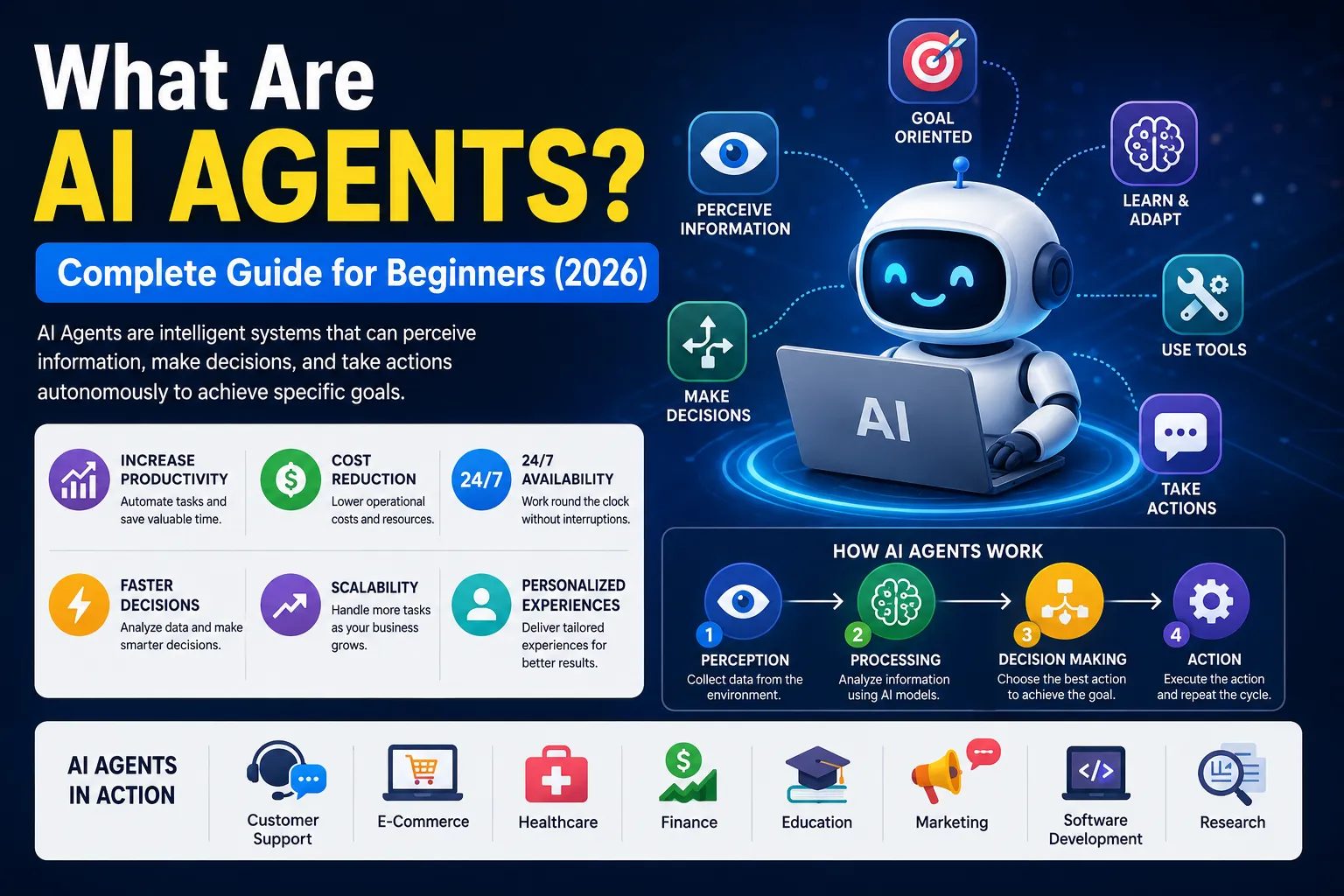
An AI Agent is a software system capable of observing its environment, processing information, making decisions, and taking actions to achieve specific goals.
Unlike traditional software that follows fixed instructions, AI agents can analyze situations, adapt to changes, and determine the best course of action.
In simple terms:
An AI Agent is a digital assistant that can think, decide, and act on behalf of a user or organization.
For example:
- A customer support AI agent can answer customer questions automatically.
- A sales AI agent can follow up with leads and schedule meetings.
- A coding AI agent can generate and debug code.
- A research AI agent can gather information and summarize findings.
How Do AI Agents Work?
AI agents typically operate through four main stages:
1. Perception
The agent collects information from its environment.
Examples:
- Reading emails
- Monitoring websites
- Accessing databases
- Analyzing user input
- Receiving sensor data
2. Processing
The collected information is analyzed using AI models, machine learning algorithms, or large language models (LLMs).
The agent determines:
- What is happening?
- What does the user want?
- What action should be taken?
3. Decision Making
The AI agent evaluates possible actions and chooses the best one based on predefined goals.
Examples:
- Reply to an email
- Recommend a product
- Generate a report
- Schedule an appointment
4. Action
The agent executes the selected action.
Actions may include:
- Sending messages
- Creating documents
- Updating databases
- Calling APIs
- Performing automated workflows
The cycle then repeats continuously.
Key Components of AI Agents
Modern AI agents are built using several components.
Goals
Every AI agent operates with a specific objective.
Examples:
- Increase sales
- Answer customer queries
- Complete research tasks
- Automate workflows
Memory
Memory allows agents to retain information.
Examples:
- User preferences
- Previous conversations
- Task history
- Learned patterns
Reasoning Engine
This component helps agents think through problems and make intelligent decisions.
Tools
AI agents often use external tools such as:
- Search engines
- Databases
- APIs
- Calculators
- Email systems
Action System
The action system performs tasks in the real world or digital environment.
Types of AI Agents
There are several types of AI agents based on their capabilities.
1. Simple Reflex Agents
These agents respond directly to specific conditions.
Example:
"If the temperature rises above 30°C, turn on the fan."
Advantages:
- Fast
- Easy to implement
Limitations:
- No memory
- Limited intelligence
2. Model-Based Reflex Agents
These agents maintain an internal model of the environment.
They can remember past events and make better decisions.
Example:
A navigation system remembering previously visited roads.
3. Goal-Based Agents
These agents focus on achieving specific objectives.
Example:
A route-planning system finding the fastest path to a destination.
Benefits:
- More flexible
- Better decision-making
4. Utility-Based Agents
These agents evaluate multiple outcomes and choose the most beneficial option.
Example:
An investment advisor selecting the best portfolio based on risk and return.
5. Learning Agents
Learning agents improve over time through experience.
Example:
Netflix recommendations becoming more accurate based on viewing habits.
Features:
- Continuous learning
- Adaptability
- Improved performance
Real-World Examples of AI Agents
AI agents are already being used in many industries.
Virtual Assistants
Examples:
- Siri
- Alexa
- Google Assistant
Tasks:
- Answer questions
- Set reminders
- Control smart devices
Customer Support Agents
Businesses use AI agents to:
- Resolve customer inquiries
- Process refunds
- Track orders
- Provide 24/7 support
AI Coding Agents
Modern coding assistants can:
- Generate code
- Debug applications
- Explain programming concepts
- Write documentation
Financial AI Agents
Used for:
- Fraud detection
- Investment analysis
- Risk assessment
- Automated trading
Healthcare AI Agents
Applications include:
- Appointment scheduling
- Medical record management
- Patient support
- Diagnostic assistance
Popular AI Agent Frameworks in 2026
Developers use specialized frameworks to build AI agents.
LangChain
Popular for creating AI workflows and multi-step reasoning systems.
Features:
- Tool integration
- Memory support
- Agent orchestration
AutoGen
Designed for multi-agent collaboration.
Benefits:
- Team-based AI systems
- Complex task automation
CrewAI
Allows multiple AI agents to work together like a human team.
Applications:
- Research
- Marketing
- Content creation
OpenAI Agents
Powerful AI agent development ecosystem supporting:
- Tool usage
- Reasoning
- Workflow automation
Benefits of AI Agents
AI agents offer numerous advantages.
Increased Productivity
Tasks that previously required hours can be completed within minutes.
Cost Reduction
Businesses can automate repetitive work and reduce operational costs.
24/7 Availability
AI agents can work continuously without breaks.
Faster Decision-Making
Agents analyze large amounts of data rapidly.
Scalability
Organizations can handle more tasks without hiring additional staff.
Personalization
AI agents can tailor experiences based on user behavior.
Challenges of AI Agents
Despite their benefits, AI agents also present challenges.
Accuracy Issues
AI agents may occasionally generate incorrect information.
Security Risks
Agents with system access could potentially cause unintended actions.
Privacy Concerns
Sensitive data requires proper protection and compliance measures.
Ethical Considerations
Questions arise regarding:
- Accountability
- Transparency
- Bias
- Responsible AI usage
Dependence on Quality Data
Poor data can lead to poor decisions.
AI Agents in Different Industries
Education
AI tutors can:
- Explain concepts
- Create quizzes
- Track student progress
E-Commerce
AI agents help with:
- Product recommendations
- Inventory management
- Customer support
Marketing
Tasks include:
- Content creation
- SEO optimization
- Campaign analysis
- Lead generation
Human Resources
Applications:
- Resume screening
- Interview scheduling
- Employee onboarding
Software Development
Developers use AI agents for:
- Code generation
- Testing
- Documentation
- Bug fixing
Multi-Agent Systems
One of the biggest trends in 2026 is multi-agent collaboration.
Instead of a single AI agent handling everything, multiple specialized agents work together.
Example:
A content creation team may include:
- Research Agent
- Writing Agent
- SEO Agent
- Editing Agent
- Publishing Agent
This structure improves efficiency and accuracy.
AI Agents and Large Language Models
Many people confuse AI Agents with LLMs.
However, they are not the same.
Large Language Models
Examples:
- GPT models
- Claude models
- Gemini models
Their primary role is generating text.
AI Agents
AI agents use LLMs as one component.
They additionally:
- Plan tasks
- Use tools
- Store memory
- Execute actions
- Achieve goals
Think of it this way:
LLM = Brain
AI Agent = Brain + Memory + Tools + Actions
Future of AI Agents
The future of AI agents looks incredibly promising.
Experts predict that AI agents will become:
- More autonomous
- More accurate
- Better at reasoning
- Capable of handling complex workflows
Future developments may include:
- Fully autonomous business operations
- Advanced personal assistants
- AI employee teams
- Self-managing software systems
By 2030, AI agents could become as common as smartphones are today.
How Businesses Can Prepare for AI Agents
Organizations should start preparing now.
Recommended steps:
Identify Repetitive Tasks
Look for processes suitable for automation.
Invest in AI Training
Educate teams about AI technologies.
Start Small
Implement pilot projects before large-scale deployment.
Monitor Performance
Track effectiveness and outcomes.
Maintain Human Oversight
Ensure critical decisions remain supervised.
Frequently Asked Questions (FAQs)
Are AI Agents the Same as Chatbots?
No. Chatbots mainly respond to conversations, while AI agents can plan, decide, and perform actions autonomously.
Can AI Agents Learn?
Yes. Learning agents improve performance through experience and data.
Are AI Agents Safe?
They can be safe when properly designed with security, monitoring, and human oversight.
Will AI Agents Replace Jobs?
AI agents will automate some tasks but are also expected to create new roles focused on AI management, development, and supervision.
Do Small Businesses Need AI Agents?
Yes. Even small businesses can benefit from customer support automation, marketing assistance, and workflow optimization.
Conclusion
AI Agents represent the next major evolution in artificial intelligence. Unlike traditional software, they can perceive information, make decisions, use tools, learn from experiences, and perform tasks autonomously.
From customer support and healthcare to software development and marketing, AI agents are already transforming industries worldwide. As AI technology continues to advance throughout 2026 and beyond, businesses and individuals who understand and adopt AI agents early will gain a significant competitive advantage.
Whether you're a student, developer, entrepreneur, or business owner, learning about AI agents today can help you stay ahead in the rapidly evolving AI-driven future.
Your email address will not be published. Comments are moderated.
0 Comments on This Post
Leave a Reply
Comments (0)
Spread the Word!
Join Our Developer Community!
Get weekly coding tips, tool updates, and exclusive tutorials straight to your inbox.
Request a Tool
×