Will AI Replace Programmers? Reality vs Myth
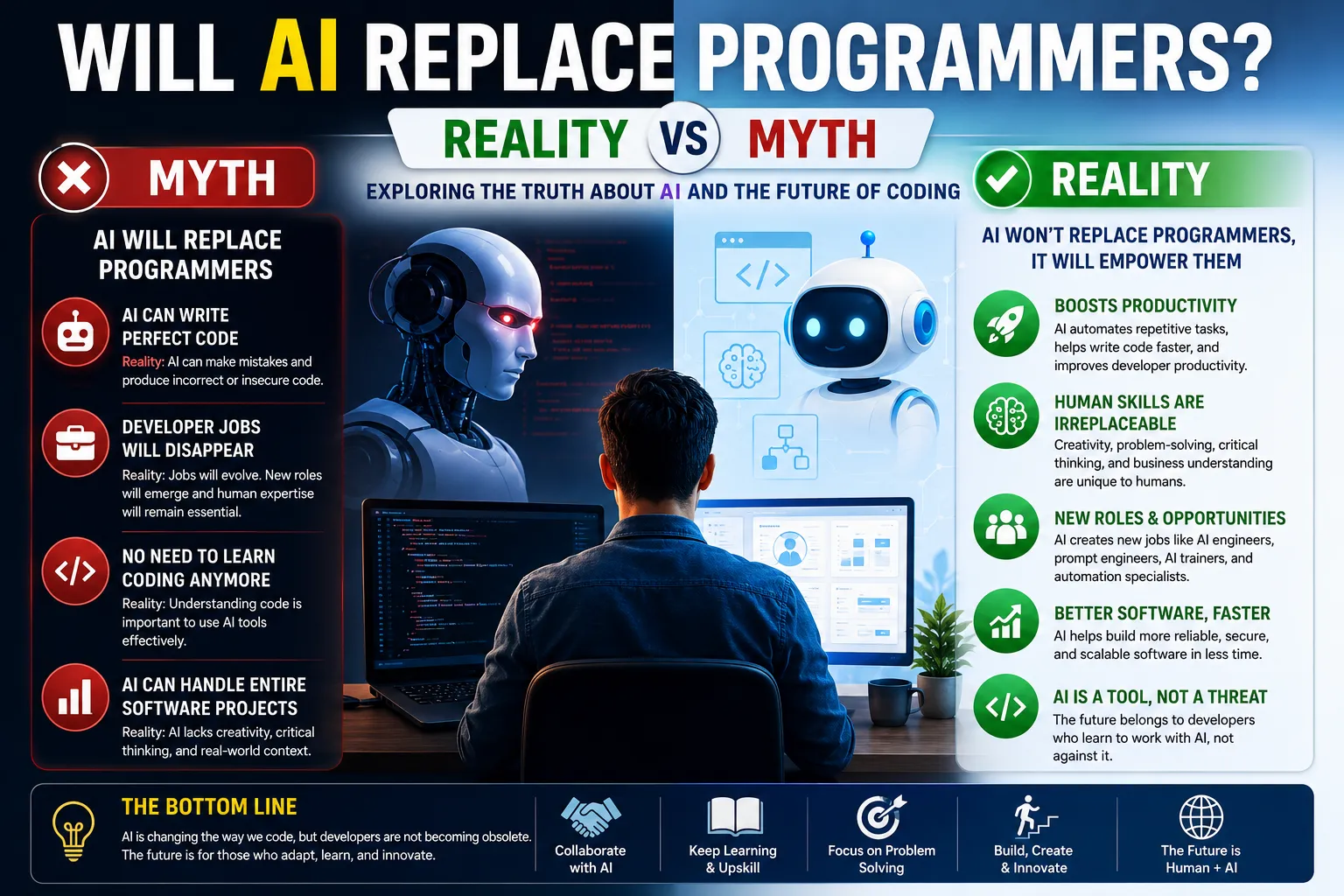
The rise of Artificial Intelligence has sparked one of the biggest debates in the technology industry:
"Will AI replace programmers?"
With tools capable of generating code, fixing bugs, writing documentation, creating websites, and even building complete applications from simple prompts, many developers fear that their jobs could become obsolete.
Social media is filled with headlines such as:
- "AI Writes Better Code Than Humans"
- "Developers Will Be Replaced by AI"
- "No Need to Learn Programming Anymore"
- "AI Can Build Entire Apps in Minutes"
These claims create excitement, fear, and confusion.
But what is the actual reality?
Will AI truly replace programmers, or is it simply changing how software development works?
This comprehensive guide explores the facts, myths, opportunities, and future of programming careers in the age of AI.
Understanding the Rise of AI in Software Development
Before answering whether AI will replace programmers, it's important to understand how AI entered software development.
In recent years, AI-powered tools have become remarkably capable.
Modern AI systems can:
- Generate code
- Explain algorithms
- Create documentation
- Suggest optimizations
- Detect bugs
- Generate test cases
- Convert code between languages
- Build user interfaces
- Write SQL queries
- Assist with deployment
What once required hours of manual effort can now be completed in minutes.
This productivity boost has led many people to assume that programmers are no longer necessary.
However, coding is only one part of software development.
The Biggest Myth: Programming Equals Writing Code
Many people believe programmers spend their entire day typing code.
In reality, coding often represents only a portion of a developer's work.
Professional developers spend significant time on:
- Understanding business requirements
- Meeting with stakeholders
- Designing software architecture
- Analyzing user needs
- Debugging complex systems
- Reviewing code
- Testing applications
- Managing infrastructure
- Planning future features
- Ensuring security
Writing code is merely the implementation phase.
Even if AI automates code generation, many critical responsibilities remain human-driven.
What AI Can Already Do
Let's be realistic.
AI has become incredibly powerful.
Generate Boilerplate Code
AI can quickly create:
- CRUD operations
- Forms
- API endpoints
- Database models
- Authentication systems
Tasks that once took hours now take minutes.
Explain Complex Code
Developers can paste code and receive:
- Line-by-line explanations
- Optimization suggestions
- Bug analysis
- Refactoring recommendations
This accelerates learning and troubleshooting.
Create Documentation
AI can automatically generate:
- API documentation
- Technical guides
- Code comments
- User manuals
Debug Common Issues
Many common programming errors can be diagnosed instantly.
Examples include:
- Syntax errors
- SQL issues
- Framework configuration problems
- Dependency conflicts
Generate Test Cases
AI can create:
- Unit tests
- Integration tests
- Edge-case scenarios
This improves software quality.
What AI Still Struggles With
Despite impressive capabilities, AI has significant limitations.
These limitations explain why programmers remain essential.
Understanding Business Requirements
Businesses rarely provide perfect requirements.
Clients often say things like:
"We want something similar to Amazon but unique."
Or:
"Make the dashboard simple but powerful."
These instructions are ambiguous.
Human developers must interpret needs, ask questions, and translate business goals into technical solutions.
AI cannot fully replace this process.
Software Architecture
Architecture decisions require experience and judgment.
Developers must determine:
- Database design
- Scalability strategy
- Security model
- System integrations
- Performance requirements
Poor architectural choices can cost millions.
Organizations are unlikely to trust critical decisions entirely to AI.
Creativity and Innovation
AI generates outputs based on existing patterns.
Human developers create entirely new ideas.
Examples include:
- Inventing unique products
- Designing new algorithms
- Creating innovative business models
- Building breakthrough technologies
Innovation remains fundamentally human.
Complex Problem Solving
Real-world software projects involve messy situations.
Examples:
- Legacy systems
- Unclear requirements
- Conflicting business needs
- Technical constraints
These problems require human judgment and trade-offs.
AI often struggles when situations fall outside familiar patterns.
Accountability
Suppose an AI-generated banking application loses customer data.
Who is responsible?
The AI?
The company?
The developer?
Businesses require human accountability.
This alone ensures developers remain necessary.
Reality vs Myth
Myth #1: AI Will Eliminate All Programming Jobs
Reality
AI will automate some tasks but not entire professions.
History shows that technology usually changes jobs rather than eliminating them completely.
Examples:
- Calculators didn't replace accountants.
- Spreadsheets didn't replace finance professionals.
- CAD software didn't replace engineers.
Instead, these tools increased productivity.
AI is likely to do the same for developers.
Myth #2: Beginners No Longer Need to Learn Coding
Reality
AI-generated code still requires understanding.
Without programming knowledge, developers cannot:
- Verify correctness
- Fix issues
- Improve performance
- Secure applications
Learning programming remains valuable.
Myth #3: AI Writes Perfect Code
Reality
AI frequently generates:
- Security vulnerabilities
- Inefficient code
- Incorrect logic
- Outdated practices
Human review remains essential.
Myth #4: AI Understands Everything
Reality
AI predicts patterns.
It does not truly understand software in the way experienced developers do.
This distinction matters greatly.
Jobs Most Likely to Change
Some programming roles will evolve significantly.
Junior Developers
Entry-level tasks are increasingly automated.
Examples:
- Simple CRUD systems
- Basic websites
- Standard APIs
Junior developers must focus on:
- Problem-solving
- Architecture
- Communication
- AI-assisted development
QA Engineers
Testing automation is improving rapidly.
However, human testers remain necessary for:
- User experience validation
- Exploratory testing
- Business scenario testing
Technical Writers
AI can generate documentation quickly.
Writers increasingly focus on reviewing and refining content.
Jobs Likely to Grow
Several technology roles may become more valuable.
AI Engineers
Demand continues to rise.
Responsibilities include:
- Training models
- Fine-tuning systems
- Building AI applications
AI Product Managers
Organizations need professionals who understand both business and AI.
AI Integration Specialists
Businesses increasingly need experts who connect AI with existing systems.
Software Architects
Strategic design decisions become even more important.
Cybersecurity Experts
AI-generated software introduces new security challenges.
Security professionals remain critical.
How Developers Can Thrive in the AI Era
Rather than fearing AI, developers should learn to work with it.
Use AI as a Productivity Tool
Treat AI like:
- An assistant
- A mentor
- A code reviewer
Not a replacement.
Strengthen Problem-Solving Skills
The ability to solve business problems remains valuable regardless of technological changes.
Learn System Design
Architecture knowledge is difficult to automate.
Topics include:
- Scalability
- Security
- Performance optimization
Improve Communication Skills
Developers increasingly collaborate with:
- Clients
- Product teams
- Designers
- AI systems
Strong communication creates career advantages.
Understand AI Technologies
Modern developers should learn:
- Machine Learning basics
- Large Language Models
- Prompt Engineering
- AI APIs
- Agent-based systems
How AI Is Changing Daily Development
Today's developers often work alongside AI.
Typical workflow:
Step 1
Developer defines requirements.
Step 2
AI generates initial code.
Step 3
Developer reviews output.
Step 4
AI helps identify issues.
Step 5
Developer refines architecture.
Step 6
AI assists with testing and documentation.
This collaboration dramatically improves productivity.
The Future: AI-Augmented Developers
The most likely future is not:
AI replacing developers.
Instead:
Developers using AI replacing developers who don't use AI.
This distinction is critical.
Organizations prefer professionals who can leverage AI effectively.
The winning combination becomes:
Human Creativity + AI Productivity
What Industry Leaders Say
Many technology leaders agree on a common theme:
AI will transform software development but not eliminate developers.
Reasons include:
- Business complexity
- Human creativity
- Accountability
- Strategic decision-making
- Innovation
Software development is much broader than code generation.
A Look Toward 2030
By 2030, developers may spend less time:
- Writing repetitive code
- Creating boilerplate structures
- Generating documentation
And more time:
- Designing systems
- Solving business problems
- Managing AI workflows
- Building innovative products
Programming careers are likely to evolve rather than disappear.
Should Students Still Learn Programming?
Absolutely.
Programming remains one of the most valuable skills in the digital economy.
Students who combine:
- Programming knowledge
- AI literacy
- Problem-solving ability
- Communication skills
will have significant career opportunities.
Learning programming in 2026 is not becoming less important—it is becoming more strategic.
Final Verdict: Will AI Replace Programmers?
The short answer is:
No, AI is unlikely to completely replace programmers.
However:
AI will replace many repetitive programming tasks.
Developers who refuse to adapt may struggle.
Developers who embrace AI will become more productive, more valuable, and more competitive.
The future belongs not to AI alone and not to humans alone—but to developers who learn how to work effectively with AI.
Conclusion
AI is transforming software development faster than any technology in recent history. While AI can generate code, automate testing, create documentation, and accelerate development, it still lacks the human creativity, judgment, business understanding, and accountability required for successful software projects.
Rather than replacing programmers, AI is reshaping the profession. Developers who learn to leverage AI tools will gain enormous advantages in productivity and efficiency. The future of programming is not human versus AI—it is human plus AI.
As we move through 2026 and beyond, the most successful developers will be those who embrace AI as a powerful collaborator while continuing to develop the uniquely human skills that technology cannot replicate.
Your email address will not be published. Comments are moderated.
0 Comments on This Post
Leave a Reply
Comments (0)
Spread the Word!
Join Our Developer Community!
Get weekly coding tips, tool updates, and exclusive tutorials straight to your inbox.
Request a Tool
×