Library vs Framework Explained
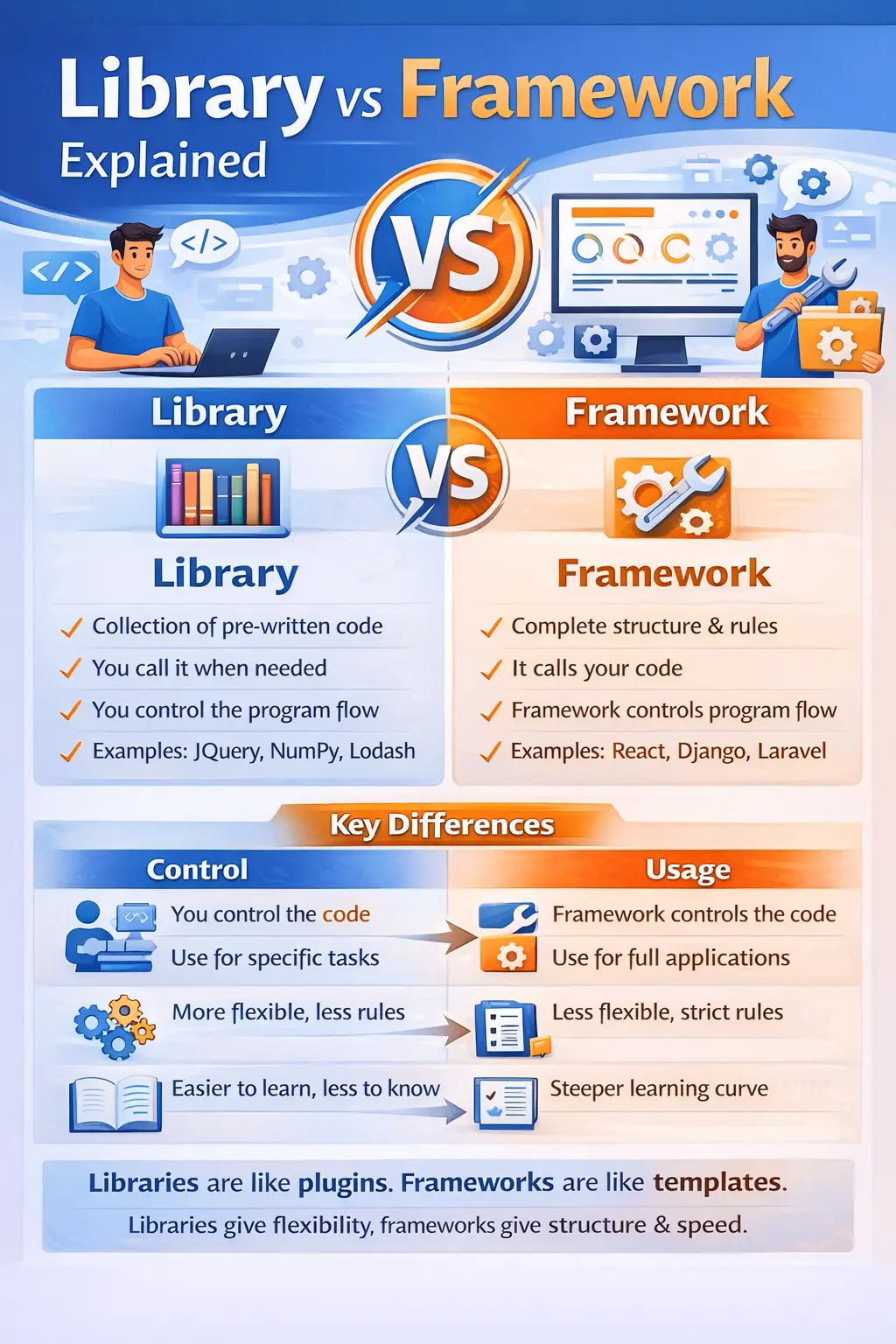
In software development, the terms library and framework are often used interchangeably, especially by beginners. However, they represent two very different approaches to building software. Understanding the difference between a library and a framework is crucial for writing clean code, choosing the right technology, and becoming a better developer.
This guide explains library vs framework from basic to advanced level with real-world understanding, practical examples, use cases, advantages, disadvantages, and best practices.
1. What Is a Library
A library is a collection of pre-written code that developers can use to perform specific tasks. Libraries are designed to solve a particular problem or set of problems.
A library:
-
Provides reusable functions or classes
-
Is called by your code
-
Does not control application flow
-
Focuses on specific functionality
You decide when and how to use a library.
Examples of libraries:
-
jQuery (JavaScript)
-
Lodash (JavaScript)
-
NumPy (Python)
-
Pandas (Python)
-
Requests (Python)
-
PHPMailer (PHP)
Libraries make development easier without taking control away from the developer.
2. What Is a Framework
A framework is a complete structure or foundation for building applications. It defines the architecture, rules, and flow of the application.
A framework:
-
Calls your code
-
Controls application flow
-
Enforces structure and patterns
-
Provides many built-in features
-
Handles common development tasks
Examples of frameworks:
-
Laravel (PHP)
-
CodeIgniter (PHP)
-
Django (Python)
-
Spring (Java)
-
Angular (JavaScript)
-
.NET (C#)
Frameworks guide developers on how an application should be built.
3. Key Concept: Control Flow Difference
The most important difference between a library and a framework is who controls the flow.
Library Control
-
You are in control
-
Your code calls the library
-
Library helps only when needed
Framework Control
-
Framework is in control
-
Framework calls your code
-
You work inside the framework rules
This concept is known as Inversion of Control.
4. Why Libraries Exist
Libraries exist to:
-
Avoid writing repetitive code
-
Solve common problems
-
Improve productivity
-
Simplify complex operations
-
Keep code clean and readable
Libraries are ideal for:
-
Utility functions
-
Data processing
-
API communication
-
File handling
-
Mathematical operations
Libraries are lightweight and flexible.
5. Why Frameworks Exist
Frameworks exist to:
-
Speed up application development
-
Provide a standard structure
-
Improve scalability
-
Improve security
-
Enable team collaboration
-
Reduce architecture decisions
Frameworks handle:
-
Routing
-
Authentication
-
Database interaction
-
Validation
-
Security
-
Error handling
Frameworks are best for large or long-term projects.
6. Real-World Analogy
Think of software development like cooking.
A library is like a spice:
-
You use it when needed
-
You decide how much to use
-
You control the recipe
A framework is like a cooking kit:
-
It gives you a recipe
-
It defines steps
-
You follow its structure
Both are useful, but for different situations.
7. Examples to Understand Better
JavaScript
-
Library: jQuery
-
Framework: Angular
With jQuery, you control everything.
With Angular, the framework controls app flow.
Python
-
Library: NumPy
-
Framework: Django
NumPy helps with calculations.
Django helps build full web applications.
PHP
-
Library: PHPMailer
-
Framework: Laravel
PHPMailer handles emails.
Laravel handles the entire application lifecycle.
8. Flexibility Comparison
Libraries:
-
Highly flexible
-
Minimal rules
-
Easy to integrate
-
Small learning curve
Frameworks:
-
Less flexible
-
Strict rules
-
Opinionated architecture
-
Steeper learning curve
Flexibility comes with responsibility.
9. Learning Curve Comparison
For beginners:
-
Libraries are easier to start with
-
Frameworks require concept understanding
Best learning path:
-
Learn programming basics
-
Use libraries
-
Move to frameworks
Skipping fundamentals causes confusion.
10. Performance Considerations
Libraries:
-
Lightweight
-
Minimal overhead
-
Faster execution
Frameworks:
-
Additional layers
-
More features
-
Slight overhead
Performance difference is usually negligible compared to productivity gain.
11. Security Perspective
Libraries:
-
Security depends on usage
-
Developer must handle protection
Frameworks:
-
Built-in security features
-
Protection against common vulnerabilities
-
Regular updates
Frameworks are safer for web applications.
12. When to Use a Library
Use a library when:
-
You need specific functionality
-
You want full control
-
Project is small
-
Custom architecture is required
-
Performance is critical
Libraries are ideal for focused tasks.
13. When to Use a Framework
Use a framework when:
-
Building full applications
-
Working in a team
-
Scalability is required
-
Time-to-market matters
-
Security is important
Frameworks are ideal for production systems.
14. Library vs Framework for Beginners
Beginners should:
-
Start with libraries
-
Understand how code works
-
Learn control flow
-
Then move to frameworks
Frameworks without basics create dependency, not understanding.
15. Career Perspective
From a career point of view:
-
Understanding libraries shows coding skills
-
Understanding frameworks shows architecture skills
-
Best developers master both
Frameworks change, fundamentals stay.
16. Common Myths
Myth: Framework is better than library
Truth: Both serve different purposes
Myth: Libraries are outdated
Truth: Libraries are essential
Myth: Frameworks remove coding
Truth: Frameworks require strong coding skills
17. Best Practice Strategy
Best developers:
-
Use libraries for flexibility
-
Use frameworks for structure
-
Understand what happens behind the scenes
-
Choose tools based on project needs
Tool selection is a skill.
18. Future of Libraries and Frameworks
Future trends:
-
Modular frameworks
-
Micro-libraries
-
Better performance
-
AI-assisted coding
-
Server-side frameworks growing
Both will continue to coexist.
19. Final Conclusion
Libraries and frameworks are not competitors. They are tools designed for different levels of abstraction.
A library helps you perform tasks.
A framework helps you build systems.
Understanding library vs framework empowers you to:
-
Write better code
-
Choose the right technology
-
Build scalable applications
-
Grow as a developer
Master the fundamentals first, then use frameworks wisely.
Your email address will not be published. Comments are moderated.
0 Comments on This Post
Leave a Reply
Comments (0)
Spread the Word!
Join Our Developer Community!
Get weekly coding tips, tool updates, and exclusive tutorials straight to your inbox.
Request a Tool
×