Programming Language vs Framework
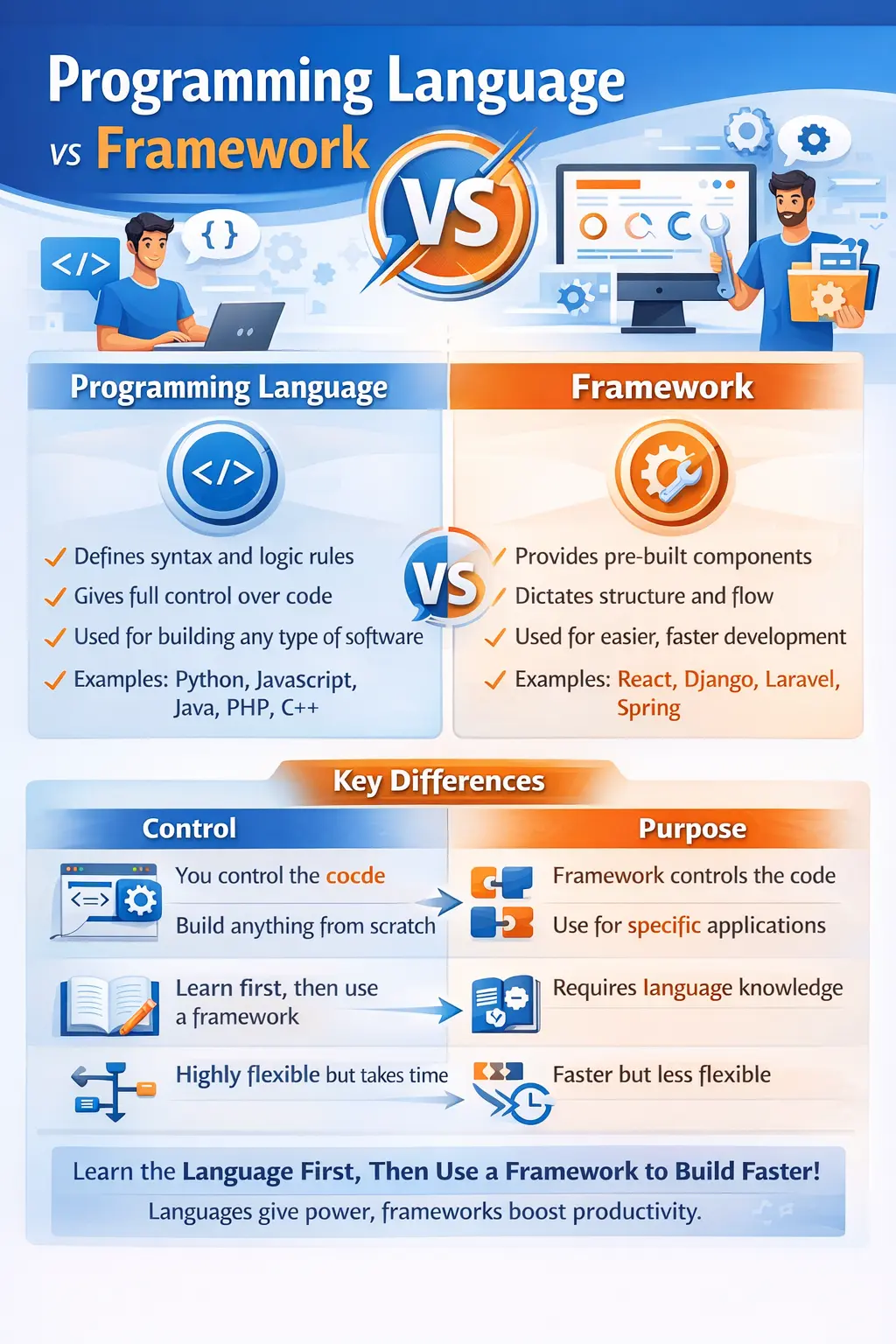
In modern software development, two terms appear almost everywhere: programming language and framework. Beginners often hear developers say things like “I work with PHP,” “I use Laravel,” “I develop with Python and Django,” or “I build applications with JavaScript and React.” Because these technologies are frequently mentioned together, it is easy to assume that a programming language and a framework are the same thing.
They are not.
A programming language is the language developers use to write instructions and logic that computers can execute. A framework is a structured development environment built around a programming language that provides reusable components, conventions, tools, and patterns for creating applications more efficiently.
Understanding this distinction is more than a matter of terminology. It helps developers choose technologies intelligently, understand documentation, troubleshoot applications, plan projects, learn new tools faster, and build a stronger long-term career.
For example, PHP is a programming language, while Laravel and CodeIgniter are frameworks built for PHP development. JavaScript is a programming language, while Angular is a framework for building web applications. Python is a programming language, while Django and FastAPI provide frameworks for developing applications and APIs.
In this comprehensive guide, we will explore the difference between programming languages and frameworks, how they work together, their advantages and limitations, their impact on performance and security, learning strategies for beginners, career considerations, and how to choose the right technology for a real-world project.
1. What Is a Programming Language?
A programming language is a formal language that allows developers to create instructions that computers can process and execute.
Computers ultimately operate using machine-level instructions, but writing software directly in machine code would be extremely difficult for humans. Programming languages provide a more understandable way to express logic, calculations, data processing, conditions, loops, functions, and other operations.
For example, a simple JavaScript statement can look like this:
const name = "Alex";
console.log("Hello " + name);
A developer can understand what this code is intended to do without dealing directly with binary machine instructions.
Programming languages define rules for writing valid programs. These rules generally include syntax, data types, operators, keywords, variables, functions, control structures, and other language features.
Popular programming languages include:
-
PHP
-
JavaScript
-
Python
-
Java
-
C
-
C++
-
C#
-
Go
-
Rust
-
Swift
-
Kotlin
-
Ruby
-
TypeScript
Each language has different characteristics and is commonly associated with particular types of development.
For example:
-
PHP is widely used for server-side web development.
-
JavaScript is essential for interactive web applications and is also used on servers through environments such as Node.js.
-
Python is popular for automation, data analysis, artificial intelligence, scripting, and web development.
-
C and C++ are widely used for systems, embedded applications, games, and performance-sensitive software.
-
Java is extensively used in enterprise software and Android development historically and remains important in many large systems.
-
Go is popular for cloud services, backend systems, and infrastructure software.
-
Rust focuses heavily on memory safety and performance.
The programming language is therefore the fundamental technology through which developers express computational instructions.
2. What Does a Programming Language Provide?
A programming language provides the fundamental building blocks required to create software.
These may include:
Syntax
Syntax defines how code should be written.
For example, a language may require parentheses, braces, semicolons, indentation, or specific keywords in particular places.
Variables
Variables allow programs to store and manipulate information.
For example:
$name = "Alex";
$age = 25;
Data Types
Programming languages provide ways to represent different kinds of data, such as:
-
Strings
-
Integers
-
Floating-point numbers
-
Booleans
-
Arrays
-
Objects
-
Structures
Operators
Operators allow developers to perform operations such as:
-
Addition
-
Subtraction
-
Comparison
-
Assignment
-
Logical operations
Conditions
Conditions allow software to make decisions.
if (age >= 18) {
    console.log("Adult");
}
Loops
Loops allow developers to execute code repeatedly.
for item in items:
    print(item)
Functions
Functions allow developers to organize reusable logic.
function calculateTotal(price, quantity) {
    return price * quantity;
}
Classes and Objects
Object-oriented languages often provide classes and objects for organizing complex applications.
These features are part of the programming language itself rather than being the same thing as a framework.
3. What Is a Framework?
A framework is a pre-built software structure that helps developers create applications using a particular programming language or ecosystem.
Instead of starting every project from an empty folder, developers can use a framework that already provides common structures and functionality.
A framework may provide:
-
Routing
-
Authentication
-
Database integration
-
Validation
-
Middleware
-
Error handling
-
Request processing
-
Session management
-
Templating
-
API structures
-
Configuration systems
-
Testing utilities
-
Security mechanisms
-
Project organization
The goal is not to replace the programming language.
The goal is to make development faster, more consistent, maintainable, and organized.
For example, Laravel is built around PHP. Django is built around Python. Spring is associated with Java. ASP.NET Core is part of the .NET ecosystem and commonly uses C#.
A developer still writes code using the underlying language while following the framework's architecture and conventions.
4. Frameworks Are Built on Programming Languages
This is one of the easiest ways to understand the relationship.
Think about building a house.
The programming language is similar to the fundamental construction materials and the ability to work with them.
The framework is similar to a construction system that provides an organized structure, standard designs, tools, and processes.
The framework does not eliminate the underlying language.
Instead, it uses that language.
For example:
| Programming Language | Framework / Development Framework |
|---|---|
| PHP | Laravel, CodeIgniter, Symfony |
| Python | Django, Flask, FastAPI |
| Java | Spring |
| C# | ASP.NET Core |
| Ruby | Ruby on Rails |
| JavaScript | Angular |
| JavaScript ecosystem | Express.js |
| C++ | Qt |
One important nuance is that the terminology around modern JavaScript can be confusing. Some tools are technically libraries rather than frameworks. React, for example, is officially described as a library for building user interfaces, although it is frequently grouped into the broader “framework” conversation. This distinction becomes important when learning software architecture.
5. The Core Difference Between a Programming Language and a Framework
The simplest distinction is:
A programming language lets you write software. A framework gives you an organized way to build software using that language.
A programming language focuses on the fundamental rules and capabilities of writing programs.
A framework focuses on application structure, reusable functionality, conventions, and development workflows.
For example, with PHP, you can create a web application using raw PHP:
<?php

$name = $_POST['name'] ?? '';

echo "Hello " . htmlspecialchars($name);
You are responsible for designing much of the application architecture yourself.
With a framework such as Laravel or CodeIgniter, you may have predefined locations and patterns for:
-
Controllers
-
Models
-
Views
-
Routes
-
Configuration
-
Middleware
-
Database operations
-
Validation
-
Application services
The framework provides structure while PHP remains the underlying programming language.
6. Programming Language vs Framework: Control
Another major difference is the amount of control developers have over application structure.
When writing software directly with a programming language, the developer generally has significant freedom to decide:
-
How files are organized
-
How functions are connected
-
How requests are handled
-
How data is processed
-
How application architecture is designed
A framework introduces conventions.
Instead of asking, “How should I build everything from scratch?”, developers work within an established architecture.
This can be extremely useful for large applications because every developer on the team can follow similar patterns.
For example, a framework may expect:
Controllers/
Models/
Views/
Routes/
Config/
Database/
This standardization makes projects easier to understand and maintain.
7. Understanding Inversion of Control
One of the most important technical concepts separating frameworks from ordinary libraries is Inversion of Control, often abbreviated as IoC.
In a simple program, your code usually controls the flow.
For example:
function main() {
    loadData();
    processData();
    displayResults();
}

main();
You decide what happens and when.
With a framework, the framework often controls the application lifecycle.
For example:
Incoming Request
       ↓
Framework
       ↓
Router
       ↓
Middleware
       ↓
Controller
       ↓
Business Logic
       ↓
Response
The framework determines when your controller, middleware, or callback is executed.
This is why developers sometimes say:
“You don't call the framework; the framework calls your code.”
That is a simplified explanation of Inversion of Control.
This architecture makes it easier to manage complex applications because the framework handles much of the application lifecycle.
8. Why Programming Languages Exist
Programming languages exist because humans need an efficient way to express instructions for computers.
They make it possible to build:
-
Operating systems
-
Web applications
-
Mobile applications
-
Desktop software
-
Games
-
APIs
-
Automation tools
-
Embedded systems
-
Databases
-
Artificial intelligence systems
-
Data processing applications
-
Cloud infrastructure
A programming language gives developers the ability to create custom logic.
Suppose you need a custom algorithm for calculating shipping costs.
You can write that logic directly in a programming language:
def calculate_shipping(weight, distance):
    return weight * 0.5 + distance * 0.1
The language provides the syntax and computational capabilities needed to express the algorithm.
9. Why Frameworks Exist
Developers quickly discovered that many applications repeat the same tasks.
A web application might repeatedly need:
-
URL routing
-
Database connections
-
Authentication
-
Session management
-
Input validation
-
Error handling
-
Request processing
-
Response formatting
-
Security protections
Writing these systems from scratch for every application wastes time and increases the chance of mistakes.
Frameworks solve this problem by providing reusable structures.
Instead of implementing a routing system from zero, a developer can define something like:
$routes->get('/users', 'Users::index');
The framework handles the process of matching the request and calling the appropriate controller.
This allows developers to spend more time solving business problems and less time rebuilding common infrastructure.
10. Frameworks Reduce Boilerplate Code
Boilerplate code refers to repetitive code that is required to make an application work but does not necessarily represent unique business logic.
For example, imagine building ten applications.
If each application requires you to independently implement:
-
Routing
-
Authentication
-
Database abstraction
-
Validation
-
Error handling
-
Session handling
you will repeatedly solve the same problems.
A framework provides many of these capabilities beforehand.
This can dramatically reduce development time.
However, less code does not automatically mean less complexity. Frameworks introduce their own concepts, conventions, configuration, dependencies, and lifecycle rules.
Therefore, developers still need to understand what the framework is doing.
11. Programming Language and Framework Examples
Let's look at several popular ecosystems.
PHP
PHP is a programming language.
Common PHP frameworks include:
-
Laravel
-
CodeIgniter
-
Symfony
-
Laminas
PHP can also be used without a framework.
For example:
<?php

$message = "Hello World";

echo $message;
The developer controls the application directly.
A framework adds an architectural layer around the language.
JavaScript
JavaScript is a programming language.
It can be used for:
-
Browser applications
-
Server-side applications
-
Desktop applications
-
Mobile applications
-
Interactive interfaces
The JavaScript ecosystem contains many frameworks and libraries.
Examples include:
-
Angular
-
Vue
-
React
-
Express.js
-
Next.js
These tools solve different problems, so they should not all be treated as identical types of technology.
Python
Python is a programming language.
Popular web frameworks include:
-
Django
-
Flask
-
FastAPI
Python itself can perform calculations, file processing, automation, data manipulation, and many other tasks without a web framework.
A framework becomes useful when you need an established application architecture.
Java
Java is a programming language.
The Spring ecosystem provides powerful tools and frameworks for building enterprise applications, APIs, and backend systems.
Java provides the language itself, while frameworks provide additional application infrastructure.
C#
C# is a programming language.
The .NET ecosystem provides libraries, runtime functionality, and frameworks such as ASP.NET Core for building web applications and APIs.
Again, the language and framework play different roles.
12. Programming Language vs Framework: Learning Curve
Beginners sometimes believe that frameworks are easier because they provide ready-made features.
In reality, frameworks are often easier after you understand the underlying language.
Suppose you are learning Laravel without understanding PHP fundamentals.
You may see code like:
return view('users.profile', [
    'user' => $user
]);
If you do not understand PHP variables, arrays, functions, objects, classes, and control flow, framework code can become confusing.
The same applies to other ecosystems.
Learning Django without understanding Python can create unnecessary difficulty.
Learning Angular without understanding JavaScript or TypeScript fundamentals can make debugging much harder.
Therefore, a strong learning path is usually:
Programming Fundamentals
        ↓
Programming Language
        ↓
Core Libraries
        ↓
Framework
        ↓
Real Projects
        ↓
Advanced Architecture
13. Should Beginners Learn a Language or Framework First?
For most beginners, learning the programming language first is the better approach.
Start by understanding:
-
Variables
-
Data types
-
Operators
-
Conditions
-
Loops
-
Functions
-
Arrays
-
Objects
-
Classes
-
Error handling
-
File handling
-
Basic debugging
-
Problem-solving
Once these concepts become comfortable, move to a framework.
For example:
Web Development with PHP
HTML
↓
CSS
↓
JavaScript basics
↓
PHP
↓
MySQL
↓
PHP framework
↓
REST APIs
↓
Authentication
↓
Deployment
The exact order can vary, but the important principle is to understand the fundamentals before relying heavily on abstraction.
14. Frameworks and Productivity
One of the biggest advantages of frameworks is developer productivity.
Imagine creating an API.
Without a framework, you may need to design:
-
Routing
-
Request parsing
-
Response handling
-
Authentication
-
Validation
-
Error handling
-
Database interaction
With a framework, much of the infrastructure already exists.
You can focus on your application's unique functionality.
For example, an e-commerce application needs custom business rules for:
-
Products
-
Orders
-
Discounts
-
Payments
-
Inventory
-
Customers
The framework can handle much of the infrastructure, allowing developers to spend more time on these business requirements.
15. Frameworks and Maintainability
A good framework can improve maintainability by encouraging consistent application structure.
Imagine two developers working on a large project.
If every developer creates files and functions wherever they want, understanding the codebase becomes difficult.
A framework can establish conventions.
For example:
Controller
    ↓
Service
    ↓
Model
    ↓
Database
When developers understand the framework's conventions, they can navigate unfamiliar projects more quickly.
This becomes particularly important for:
-
Large applications
-
Enterprise systems
-
SaaS platforms
-
E-commerce websites
-
APIs
-
Team projects
16. Frameworks and Scalability
Frameworks do not automatically make an application scalable.
This is an important misconception.
Scalability depends on many factors:
-
Application architecture
-
Database design
-
Query efficiency
-
Caching
-
Server configuration
-
Network architecture
-
Background jobs
-
Load balancing
-
Infrastructure
-
Code quality
A poorly designed application can remain slow even when built with a popular framework.
A well-designed application can scale effectively when the framework is used correctly.
Frameworks provide tools that can help with scalability, but developers still need to understand architecture.
17. Performance Differences
Another common question is whether programming languages are faster than frameworks.
This comparison is slightly misleading.
A framework is built using a programming language and adds additional layers of functionality.
For example:
Application
    ↓
Framework
    ↓
Language Runtime
    ↓
Operating System
    ↓
Hardware
Framework overhead can exist because additional processing occurs.
However, the practical performance difference depends on the application.
For most business applications, the productivity and maintainability benefits of a framework are much more important than attempting to eliminate every abstraction.
Performance problems are often caused by:
-
Poor database queries
-
Excessive network requests
-
Inefficient algorithms
-
Missing indexes
-
Poor caching
-
Large assets
-
Incorrect server configuration
Therefore, choosing a framework should not be based solely on theoretical overhead.
18. Security Differences
Security is another major reason developers use established frameworks.
A programming language provides language-level features, but application security is largely dependent on how developers implement their systems.
Frameworks can provide protections and safer patterns for common problems such as:
-
Cross-site request forgery
-
Input validation
-
Authentication
-
Session management
-
Password handling
-
Output escaping
-
Secure headers
-
Database query abstraction
However, a framework is not automatically secure simply because it is popular.
Developers still need to:
-
Keep dependencies updated
-
Validate input
-
Protect credentials
-
Use secure authentication
-
Configure production environments correctly
-
Avoid exposing sensitive information
-
Review third-party packages
Security is a shared responsibility between the developer, framework, dependencies, server, and deployment environment.
19. Programming Language Use Cases
There are situations where working directly with a programming language is useful.
Examples include:
Learning Programming
Beginners should understand programming fundamentals without hiding everything behind a framework.
Algorithms
Custom algorithms can be developed directly using the language.
Automation
Small scripts may not need an entire framework.
System Programming
Low-level applications may require direct access to language and system features.
Lightweight Applications
A simple utility may be unnecessarily complicated if a large framework is introduced.
Performance-Sensitive Applications
Some applications require highly optimized and specialized implementations.
The correct decision depends on the project's requirements.
20. Framework Use Cases
Frameworks are especially valuable when an application has significant complexity.
Typical examples include:
Web Applications
Frameworks provide routing, controllers, middleware, templates, validation, and database integration.
REST APIs
Frameworks can simplify:
-
Routing
-
Authentication
-
Request handling
-
JSON responses
-
Validation
-
Error handling
Enterprise Applications
Large applications benefit from standardized architecture.
SaaS Products
Frameworks can accelerate development of authentication, dashboards, billing systems, and APIs.
E-commerce
Frameworks can help organize complex product, order, customer, payment, and inventory systems.
Team Development
Framework conventions make collaboration easier.
21. Programming Language vs Framework for Web Development
Web development is one of the clearest areas where the difference becomes visible.
Consider a typical PHP website.
PHP itself gives you the ability to process requests and generate responses.
But a modern web application may require:
HTTP Request
      ↓
Router
      ↓
Middleware
      ↓
Authentication
      ↓
Controller
      ↓
Business Logic
      ↓
Database
      ↓
Response
A framework can provide the infrastructure for this flow.
Without a framework, you can still build the same system, but you need to design and implement more of it yourself.
This is why frameworks are so common in professional web development.
22. Framework vs Library
Another concept beginners often confuse is the difference between a framework and a library.
A library is generally a reusable collection of functionality that your application can call when needed.
For example:
calculateSomething();
Your application decides when to call the library.
With a framework, the framework often controls a larger portion of the application's lifecycle.
For example:
Request
   ↓
Framework
   ↓
Your Controller
   ↓
Framework
   ↓
Response
This distinction is commonly summarized as:
You call a library; a framework calls your application code.
The exact boundary can vary, especially in modern ecosystems, but the concept is useful for understanding software architecture.
23. Common Myths About Programming Languages and Frameworks
Myth 1: A Framework Is a Programming Language
This is incorrect.
Laravel is not a programming language.
Laravel is a PHP framework.
Django is not a programming language.
Django is a Python framework.
Angular is not a programming language.
Angular is a framework associated with TypeScript.
Myth 2: You Don't Need to Learn the Language
This is one of the most dangerous assumptions for beginners.
A framework can hide complexity, but eventually you will need to understand the underlying language.
Without language fundamentals, debugging becomes difficult.
Myth 3: The Most Popular Framework Is Always the Best
Not necessarily.
Technology choices depend on:
-
Project requirements
-
Team expertise
-
Performance requirements
-
Ecosystem
-
Maintenance needs
-
Available libraries
-
Budget
-
Deployment environment
The best framework is the one that fits the project's requirements.
Myth 4: Frameworks Automatically Make Applications Secure
Frameworks can provide security mechanisms, but developers must configure and use them correctly.
Security is not automatic.
Myth 5: Framework Knowledge Is More Important Than Fundamentals
Framework knowledge is valuable, but fundamentals provide long-term flexibility.
Frameworks evolve.
Programming concepts remain useful across technologies.
24. How to Choose the Right Programming Language
Before choosing a programming language, consider the type of application you want to build.
Ask:
What are you building?
A website, mobile application, game, automation tool, API, data system, or embedded application may require different technologies.
What is your team's expertise?
Using a language your team already understands can reduce development time.
What ecosystem is available?
A strong ecosystem can provide:
-
Libraries
-
Documentation
-
Community support
-
Development tools
-
Testing frameworks
-
Third-party integrations
What are the performance requirements?
Some applications need extremely high performance, while others prioritize development speed and maintainability.
What is the long-term maintenance plan?
A technology should remain practical to maintain after the initial release.
25. How to Choose the Right Framework
Once you choose a programming language, you can evaluate frameworks within that ecosystem.
Consider:
Documentation
Good documentation reduces development time.
Community
A large and active community can make troubleshooting easier.
Ecosystem
Check whether the framework has reliable packages and integrations.
Security
Review the framework's security practices and update history.
Performance
Consider whether it can meet your application's expected workload.
Team Experience
A familiar framework can often be more valuable than a theoretically superior framework that nobody on the team knows.
Long-Term Maintenance
Choose a framework with sustainable development and a healthy ecosystem.
26. One Programming Language Can Have Multiple Frameworks
There is no rule that says one programming language must have one framework.
In fact, popular languages usually have many frameworks.
For PHP:
PHP
├── Laravel
├── CodeIgniter
├── Symfony
└── Laminas
For Python:
Python
├── Django
├── Flask
└── FastAPI
Each framework can have a different philosophy.
Some prioritize:
-
Simplicity
-
Speed
-
Convention
-
Flexibility
-
Enterprise architecture
-
API development
This gives developers choices based on project requirements.
27. Can You Build an Application Without a Framework?
Absolutely.
A framework is not mandatory.
Developers can build applications using only a programming language and standard libraries or other libraries.
For example, PHP can process forms, connect to databases, generate HTML, and handle requests without Laravel or CodeIgniter.
However, as applications become larger, building everything from scratch can become difficult.
You may eventually need to create your own:
-
Routing system
-
Authentication system
-
Validation layer
-
Configuration system
-
Error handling
-
Database abstraction
-
Middleware
-
Security mechanisms
At that point, using a mature framework may save significant time.
28. Can You Use Multiple Frameworks Together?
Yes, but it depends on the ecosystem and architecture.
A large application may use different tools for different layers.
For example:
Frontend
   ↓
JavaScript Framework
   ↓
REST API
   ↓
Backend Framework
   ↓
Database
A project could have a frontend built with one ecosystem and a backend built with another.
For example:
React / Angular / Vue
        ↓
      API
        ↓
Laravel / Django / ASP.NET Core
        ↓
     Database
This architecture is common in modern web applications.
However, adding technologies also adds complexity, so teams should avoid using multiple frameworks simply because they are popular.
29. Frameworks and APIs
Frameworks are particularly useful for API development.
A modern API may need:
-
Routing
-
Authentication
-
Authorization
-
Validation
-
JSON responses
-
Rate limiting
-
Logging
-
Error handling
-
Database operations
A framework can provide many of these features or make them easier to implement.
A typical API flow looks like:
Client
  ↓
HTTP Request
  ↓
Router
  ↓
Middleware
  ↓
Authentication
  ↓
Controller
  ↓
Service
  ↓
Database
  ↓
JSON Response
This structured architecture helps developers maintain complex backend applications.
30. Programming Languages, Frameworks, and Databases
Another common misunderstanding is treating databases as programming languages or frameworks.
They are different technologies.
For example:
Programming Language
PHP

Framework
Laravel

Database
MySQL

Frontend
HTML + CSS + JavaScript
Each component performs a different role.
The programming language implements application logic.
The framework organizes the application.
The database stores information.
The frontend technologies create the user interface.
Together they form a technology stack.
31. Example of a Modern Web Stack
A typical web application might use:
Frontend
HTML
CSS
JavaScript
        ↓
Frontend Framework / Library
React
        ↓
API
REST / JSON
        ↓
Backend Language
PHP
        ↓
Backend Framework
Laravel
        ↓
Database
MySQL
Each technology has a specific role.
Understanding these roles helps developers avoid confusion when learning full-stack development.
32. Career Perspective
From a career perspective, both programming language knowledge and framework knowledge are important.
However, their value is different.
Programming languages provide fundamental skills.
Frameworks provide practical development skills.
A developer who understands only one framework may struggle when the framework changes.
A developer who understands programming fundamentals can usually learn new frameworks much faster.
For example, someone who understands:
-
Object-oriented programming
-
HTTP
-
APIs
-
Databases
-
Authentication
-
Data structures
-
Asynchronous programming
can adapt more easily to different technologies.
This is why strong fundamentals remain valuable throughout a developer's career.
33. Should You Learn Multiple Programming Languages?
You do not need to learn many languages at once.
For beginners, it is usually better to become comfortable with one language first.
For example:
Learn JavaScript
       ↓
Build projects
       ↓
Understand APIs
       ↓
Learn databases
       ↓
Learn a framework
       ↓
Then explore another language
Once you understand programming concepts, learning another language becomes easier because many concepts transfer.
For example:
-
Variables exist in many languages.
-
Functions exist in many languages.
-
Conditions exist in many languages.
-
Loops exist in many languages.
-
Object-oriented concepts exist in many languages.
Syntax changes, but the underlying programming concepts often remain similar.
34. Should You Learn Multiple Frameworks?
Eventually, learning multiple frameworks can be beneficial.
However, learning ten frameworks superficially is usually less valuable than becoming highly productive with one.
A strong strategy is:
One Language
        ↓
One Main Framework
        ↓
Several Real Projects
        ↓
Advanced Architecture
        ↓
Second Framework
This approach develops both depth and adaptability.
35. The Importance of Problem-Solving
Technology changes quickly.
Frameworks change.
Libraries change.
Programming languages evolve.
Development tools change.
But problem-solving remains fundamental.
A developer should learn how to:
-
Break large problems into smaller tasks
-
Analyze requirements
-
Design algorithms
-
Debug errors
-
Read documentation
-
Understand system behavior
-
Test solutions
-
Optimize performance
A framework cannot replace these skills.
36. Framework Dependency and Its Risks
Frameworks provide many advantages, but they also create dependencies.
When your application is heavily dependent on a framework, upgrading can require significant work.
Potential challenges include:
-
Breaking changes
-
Deprecated APIs
-
Dependency conflicts
-
Migration costs
-
Learning new versions
-
Third-party package compatibility
Therefore, developers should understand the underlying technology rather than treating the framework as a black box.
37. Framework Updates and Maintenance
Frameworks require maintenance.
Developers should monitor:
-
Security updates
-
Major releases
-
Dependency updates
-
Deprecated features
-
Compatibility changes
A production application should not blindly install every update immediately.
A better approach is to:
-
Review the update.
-
Read the release notes.
-
Test the application.
-
Check dependencies.
-
Deploy carefully.
Good maintenance is part of professional software development.
38. Frameworks and Team Collaboration
Framework conventions can be extremely useful for teams.
Imagine a team of ten developers.
If everyone follows a different architecture, the project becomes difficult to maintain.
A framework can establish common conventions.
Developers know where to find:
-
Controllers
-
Models
-
Routes
-
Services
-
Configuration
-
Tests
-
Views
This reduces the mental effort required to understand the codebase.
Frameworks therefore provide not only technical functionality but also organizational benefits.
39. Programming Language vs Framework: Simple Analogy
A simple analogy can make the difference easier to remember.
Imagine writing a book.
The programming language is like the language you use to write the book.
It provides:
-
Words
-
Grammar
-
Sentence structure
-
Rules
The framework is like a structured publishing template.
It may provide:
-
Chapter organization
-
Formatting conventions
-
Layout
-
Standard sections
-
Publishing workflows
You still write the actual content.
Similarly:
Programming Language
       ↓
Provides the language and computational fundamentals

Framework
       ↓
Provides structure and reusable application functionality
40. Another Simple Analogy: Building a House
Imagine constructing a house.
The programming language is the set of fundamental tools and materials you can use to construct the building.
A framework is closer to a standardized construction system.
It gives you:
-
Structure
-
Patterns
-
Tools
-
Established processes
-
Reusable components
You can build without the framework, but using a good framework can make the process faster and more consistent.
41. What Developers Should Actually Learn
If your goal is to become a professional developer, do not focus exclusively on framework syntax.
Build knowledge across several layers.
Layer 1: Programming
Learn:
-
Variables
-
Functions
-
Conditions
-
Loops
-
Data structures
-
Classes
-
Error handling
Layer 2: Computer Fundamentals
Understand:
-
Files
-
Processes
-
Memory
-
Networking
-
HTTP
-
DNS
Layer 3: Databases
Learn:
-
SQL
-
Tables
-
Relationships
-
Indexes
-
Transactions
-
Query optimization
Layer 4: Development Framework
Learn one framework deeply.
Layer 5: Architecture
Understand:
-
MVC
-
APIs
-
Authentication
-
Caching
-
Queues
-
Services
-
Dependency injection
Layer 6: Deployment
Learn:
-
Linux basics
-
Web servers
-
Domains
-
SSL
-
Environment variables
-
Logs
-
Backups
This broader understanding makes developers much more capable than someone who only memorizes framework syntax.
42. Programming Language vs Framework: Quick Comparison
| Feature | Programming Language | Framework |
|---|---|---|
| Primary purpose | Write program logic | Structure application development |
| Provides syntax | Yes | Uses the language |
| Provides architecture | Usually no | Yes |
| Provides routing | No, unless through libraries/tools | Often |
| Provides authentication | Not inherently | Often |
| Provides database tools | Through libraries/extensions | Often |
| Controls application lifecycle | Developer-controlled | Framework-controlled |
| Reusable components | Basic language ecosystem | Extensive application components |
| Learning requirement | Fundamental | Language knowledge recommended |
| Main benefit | Flexibility and control | Productivity and structure |
43. When Should You Avoid a Framework?
A framework may not be necessary when:
-
The project is extremely small.
-
You are creating a simple script.
-
You are learning programming fundamentals.
-
The framework adds unnecessary complexity.
-
You need highly specialized low-level control.
-
The application has very unusual requirements.
For example, a tiny command-line utility may not need a large web framework.
The right tool depends on the problem.
44. When Should You Definitely Consider a Framework?
A framework becomes increasingly valuable when your application requires:
-
Multiple developers
-
Authentication
-
Database integration
-
Routing
-
APIs
-
Validation
-
Complex business logic
-
Testing
-
Security features
-
Long-term maintenance
-
Scalability
In these situations, a mature framework can significantly reduce development effort.
45. The Relationship Between Language, Framework, Library, and Tool
Modern development involves multiple layers.
A simplified structure looks like:
Programming Language
        ↓
Runtime / Standard Library
        ↓
Libraries
        ↓
Framework
        ↓
Application
        ↓
Infrastructure
For example:
PHP
 ↓
PHP Runtime
 ↓
Composer Packages
 ↓
Laravel
 ↓
Your Application
 ↓
Web Server + Database
Understanding these layers helps developers diagnose problems.
If an application fails, you can ask:
-
Is the language code incorrect?
-
Is the dependency broken?
-
Is the framework configuration wrong?
-
Is the database unavailable?
-
Is the web server misconfigured?
This systematic thinking is extremely useful for debugging.
46. Future of Programming Languages and Frameworks
Software development continues to evolve rapidly.
Programming languages are increasingly focusing on:
-
Performance
-
Memory safety
-
Concurrency
-
Developer productivity
-
Type safety
-
Cross-platform development
Frameworks are increasingly focusing on:
-
Better developer experience
-
Faster builds
-
Server-side rendering
-
Edge computing
-
API development
-
Component-based architecture
-
Cloud integration
-
Automated testing
Artificial intelligence is also becoming an important part of development workflows.
AI coding tools can help developers:
-
Generate boilerplate
-
Explain code
-
Find potential bugs
-
Create tests
-
Refactor code
-
Generate documentation
However, AI does not eliminate the importance of programming fundamentals.
Developers still need to understand what generated code does and whether it is correct, secure, maintainable, and appropriate for the application.
47. Will Frameworks Replace Programming Languages?
No.
Frameworks depend on programming languages or their surrounding runtimes and ecosystems.
Frameworks can change dramatically, but the underlying programming concepts remain important.
A developer might move from one framework to another:
Laravel → Symfony
or:
Django → FastAPI
or:
Angular → another frontend ecosystem
The developer's knowledge of programming, HTTP, databases, architecture, debugging, and algorithms remains useful.
That is why fundamentals provide long-term career value.
48. A Practical Learning Roadmap
If you are starting software development, a practical roadmap is:
Step 1: Learn Programming Fundamentals
Understand:
-
Variables
-
Conditions
-
Loops
-
Functions
-
Arrays
-
Objects
-
Classes
Step 2: Choose One Language
Examples:
-
JavaScript
-
Python
-
PHP
-
Java
-
C#
Step 3: Build Small Projects
Create:
-
Calculator
-
To-do application
-
Form processor
-
CRUD application
-
Simple API
Step 4: Learn Databases
Understand:
-
SQL
-
CRUD
-
Relationships
-
Indexes
-
Transactions
Step 5: Learn a Framework
Choose a framework based on your goals.
Step 6: Build Real Applications
Build projects with:
-
Authentication
-
APIs
-
Database relationships
-
Validation
-
Error handling
-
Security
-
Testing
Step 7: Learn Deployment
Understand:
-
Servers
-
Domains
-
DNS
-
SSL
-
Environment configuration
-
Logs
-
Backups
Step 8: Learn Architecture
Eventually explore:
-
MVC
-
REST
-
Service layers
-
Dependency injection
-
Caching
-
Queues
-
Microservices
This progression creates a much stronger foundation than jumping from framework to framework.
49. Programming Language vs Framework: What Should You Choose?
The answer depends on what you are trying to accomplish.
If you are learning programming, prioritize the language.
If you are building a production web application, a framework can provide significant benefits.
If you are building a small script, a framework may be unnecessary.
If you are building a large application, a mature framework can improve structure and maintainability.
If you are looking for a developer job, learn both the underlying language and at least one widely used framework in your target ecosystem.
The key is not choosing one instead of the other.
It is understanding how they work together.
50. Final Conclusion
Programming languages and frameworks are fundamentally different technologies, but they work together to make modern software development possible.
A programming language provides the fundamental syntax, logic, data structures, operators, functions, and other mechanisms developers use to create software.
A framework provides an organized structure, reusable components, conventions, and development tools that make building complex applications faster and more maintainable.
The relationship can be summarized as:
Programming Language
        ↓
Provides fundamental programming capabilities
        ↓
Framework
        ↓
Provides application structure and reusable functionality
        ↓
Application
        ↓
Solves a real-world problem
For beginners, the best strategy is not to rush directly into a framework. First understand programming fundamentals and become comfortable with one programming language. Then learn a framework that matches your development goals.
For experienced developers, frameworks can dramatically improve productivity, but understanding the underlying language remains essential for debugging, optimization, security, architecture, and long-term adaptability.
Remember these three points:
-
A programming language is used to write software.
-
A framework provides structure and reusable functionality for building software.
-
A framework depends on an underlying language or ecosystem; it does not replace the language.
Once you understand this distinction, technologies such as PHP and Laravel, Python and Django, Java and Spring, or C# and ASP.NET Core become much easier to understand.
The most valuable developers are not simply those who memorize framework APIs. They are developers who understand programming fundamentals, software architecture, databases, security, problem-solving, and how frameworks fit into the larger technology stack.
Frameworks will continue to change, new languages will continue to emerge, and development tools will continue to evolve. Strong fundamentals, however, remain useful across generations of technology.
That is why learning the difference between a programming language and a framework is not just a beginner concept. It is an important foundation for becoming a capable, adaptable, and professional software developer.
Your email address will not be published. Comments are moderated.
0 Comments on This Post
Leave a Reply
Comments (0)
Spread the Word!
Join Our Developer Community!
Get weekly coding tips, tool updates, and exclusive tutorials straight to your inbox.
Request a Tool
×