Common GDPR Mistakes Small Businesses Make
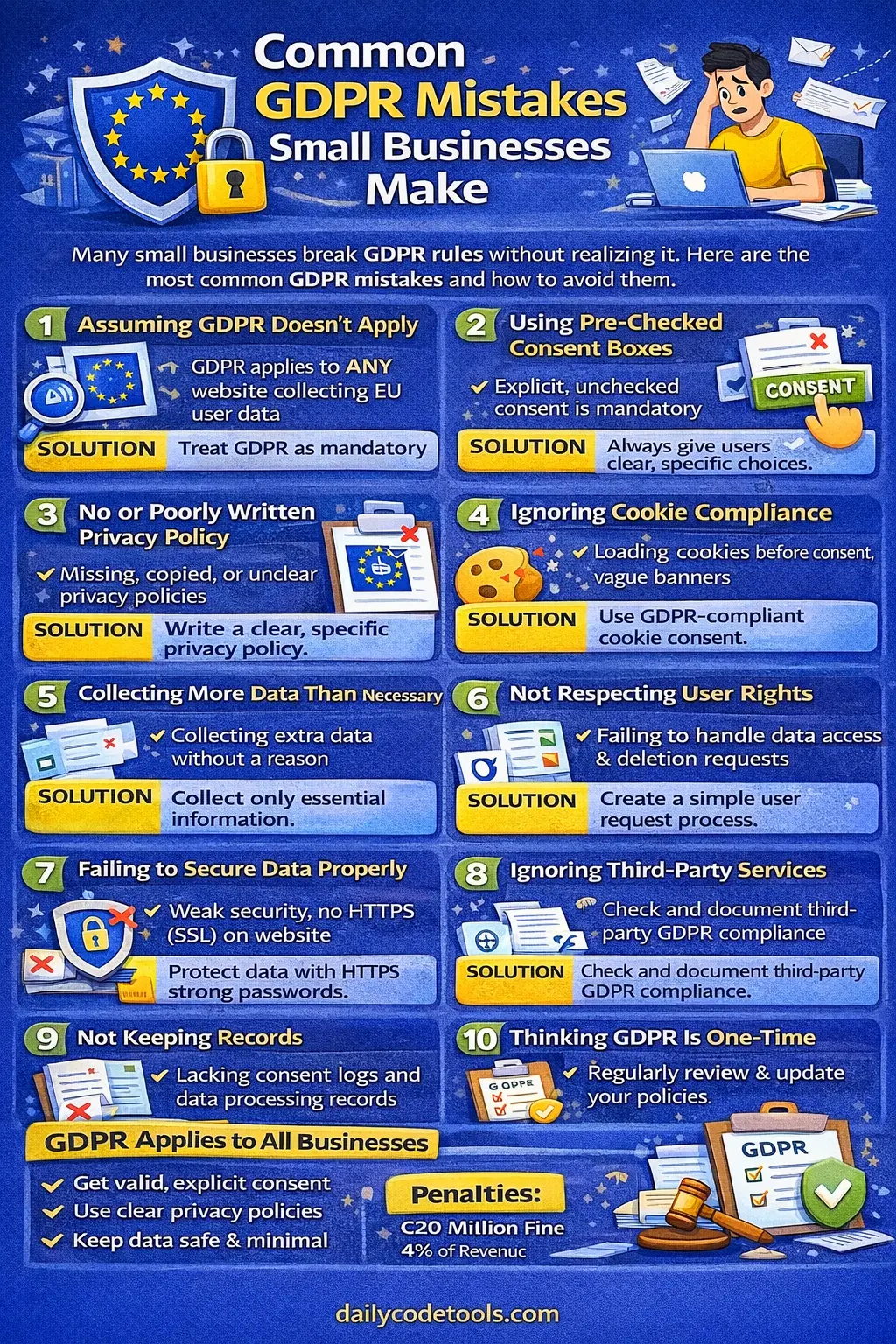
GDPR Compliance Guide for Small Businesses: Common Mistakes, Best Practices, and Data Privacy Tips
In today's digital economy, data privacy is no longer an issue reserved for large technology companies or multinational corporations. Small businesses, freelancers, startups, bloggers, online stores, agencies, SaaS companies, consultants, developers, and service providers may all collect and process personal information as part of their everyday operations. A simple contact form can collect a name and email address. An online store may collect customer names, addresses, phone numbers, and payment-related information. Analytics platforms may process identifiers and information about how visitors interact with a website. Email marketing systems may store subscriber information. Customer support tools may contain conversations and account details.
Whenever an organization handles personal information, privacy becomes an important responsibility.
The General Data Protection Regulation (GDPR) is one of the world's most influential privacy frameworks. It was introduced by the European Union to strengthen individual rights, establish responsibilities for organizations that process personal data, and create a more consistent approach to data protection. Although GDPR is an EU regulation, its potential reach extends beyond EU-based organizations. A business located outside the European Union may still be subject to GDPR when its activities involve people in the European Union or European Economic Area in circumstances covered by the regulation.
For small businesses, GDPR can initially appear complicated. There are legal concepts such as lawful bases, consent, data minimization, purpose limitation, data subject rights, processors, controllers, international transfers, retention, security, and accountability. However, the fundamental idea is relatively straightforward:
Businesses should handle personal data responsibly, transparently, securely, and only for legitimate purposes.
Many privacy problems are not caused by sophisticated legal issues. They happen because a website collects unnecessary information, installs tracking technologies without appropriate consent, stores information indefinitely, uses poorly configured third-party services, fails to secure accounts, or does not have a process for responding to customer privacy requests.
This guide explains the most common GDPR mistakes made by small businesses and provides practical ways to build better privacy practices. It is written for a global audience and is useful for businesses that operate websites, applications, online stores, SaaS platforms, digital services, or other internet-based products.
Important: This article provides general educational information and is not legal advice. GDPR requirements can depend on the specific circumstances of an organization, its processing activities, location, customers, contracts, and applicable laws. Businesses with significant privacy obligations should obtain appropriate professional legal advice.
What Is GDPR?
The General Data Protection Regulation, commonly known as GDPR, is a European Union data protection regulation designed to protect individuals with regard to the processing of their personal data and to regulate how organizations handle that information.
GDPR places greater emphasis on transparency, accountability, security, and individual control.
Instead of treating personal information as something a company can collect and keep indefinitely, GDPR encourages organizations to ask important questions:
- What information are we collecting?
- Why do we need it?
- What legal basis allows us to process it?
- How are we protecting it?
- Who can access it?
- Are we sharing it with another organization?
- How long do we need to keep it?
- What rights does the individual have?
- Can the organization demonstrate responsible processing?
These questions are useful even for organizations that are not directly subject to GDPR because they encourage better privacy and security practices.
Why GDPR Matters to Small Businesses
A common misconception is that privacy regulations only matter to organizations with thousands of employees.
That is not how GDPR works.
The relevance of GDPR depends largely on the nature of data processing and the circumstances in which an organization operates, rather than simply its employee count or annual revenue.
A small company could process personal information through:
- A website contact form
- An online registration system
- A newsletter
- An eCommerce checkout
- Customer support
- Website analytics
- Advertising platforms
- Cloud applications
- CRM software
- Appointment booking systems
- Membership accounts
- Mobile applications
- Payment systems
A business with only a few employees could therefore have significant privacy responsibilities.
Beyond regulatory requirements, privacy can also directly affect business reputation.
Customers increasingly want to know:
- Who has access to their information?
- Why is the business collecting it?
- Is their information being sold?
- Is it being shared with advertisers?
- How securely is it stored?
- Can they delete their account?
- Can they stop marketing messages?
A business that answers these questions clearly can establish stronger customer confidence.
Does GDPR Apply to Businesses Outside the EU?
One of the most important points for international businesses is that being physically located outside the European Union does not automatically mean GDPR is irrelevant.
Organizations outside the EU may fall within GDPR's territorial scope in certain circumstances, including situations involving the offering of goods or services to individuals in the EU or the monitoring of their behavior where applicable under the regulation.
For example, consider a software company based in another country that intentionally markets a subscription service to customers in European countries.
That organization should not automatically assume that being incorporated outside the EU removes its privacy responsibilities.
The same principle is relevant to online stores, SaaS platforms, marketplaces, educational services, applications, and other internet-based businesses.
However, simply having a website that happens to be accessible from anywhere in the world does not by itself answer the territorial-scope question. Businesses need to evaluate their actual activities and circumstances.
For this reason, international businesses should understand where their customers are located, what services they offer, what personal information they process, and why they process it.
Understanding Personal Data
GDPR uses a broad concept of personal data.
Personal data generally refers to information relating to an identified or identifiable individual.
Examples can include:
- Name
- Email address
- Phone number
- Postal address
- Account ID
- Online identifier
- IP address in appropriate circumstances
- Cookie identifiers
- Device-related identifiers
- Location information
- Customer records
- Employment information
- Online account information
Some categories of information receive additional protection under GDPR.
The important lesson for small businesses is that personal data is not limited to obvious information such as a person's name.
A website may collect information indirectly through analytics, advertising, cookies, account systems, logs, or other technologies.
Understanding the complete data flow is therefore an important first step toward responsible privacy management.
Mistake 1: Assuming GDPR Does Not Apply to Small Businesses
One of the biggest mistakes is assuming:
"We're a small company, so GDPR doesn't apply to us."
Business size alone does not determine whether GDPR applies.
A small online store may process hundreds or thousands of customer records. A freelancer may maintain a mailing list. A startup may process user accounts. A developer may operate a SaaS product used internationally.
The amount and nature of processing matter.
How to Avoid This Mistake
Start by creating a basic personal-data inventory.
Document:
- What information you collect
- Where you collect it
- Why you collect it
- Where it is stored
- Who can access it
- Which third parties receive it
- How long you keep it
This simple exercise can reveal privacy issues that were previously invisible.
Mistake 2: Using Invalid Consent Methods
Consent is an important concept under GDPR, but it is frequently misunderstood.
A business should not assume that every type of processing requires consent. GDPR recognizes multiple legal bases for processing personal data, and consent is only one of them.
Where consent is the chosen legal basis, however, it needs to meet the applicable requirements.
Consent should generally be:
- Freely given
- Specific
- Informed
- Unambiguous
- Based on a clear affirmative action
- Capable of being withdrawn
Common poor practices include:
- Pre-selected marketing checkboxes
- Hidden consent language
- Combining unrelated purposes
- Making consent unnecessarily difficult to refuse
- Making withdrawal harder than giving consent
For example, a newsletter signup should clearly communicate that the person is subscribing to marketing communications.
Better Approach
Use simple language.
Instead of a vague statement such as:
"By submitting this form, you agree to everything."
use separate and understandable choices where appropriate.
Users should know what they are agreeing to.
Mistake 3: Having an Incomplete Privacy Policy
A Privacy Policy should accurately reflect what your organization actually does.
Copying another company's Privacy Policy and replacing the company name is not a reliable compliance strategy.
A useful privacy notice should explain relevant information such as:
- What personal data is collected
- Purposes of processing
- Relevant legal bases
- Data retention
- Third-party recipients
- International transfers where relevant
- Individual rights
- Contact information
- Relevant information about automated decision-making where applicable
The exact requirements depend on the circumstances.
How to Improve Your Privacy Policy
Review your actual technology stack.
If your website uses:
- Analytics
- Advertising
- Contact forms
- Newsletter services
- Payment providers
- Cloud storage
- Customer support tools
- Social media integrations
make sure your privacy documentation accurately reflects relevant processing.
A privacy notice should describe reality rather than simply contain legal-sounding language.
Mistake 4: Implementing Cookie Consent Incorrectly
Cookies are another common source of privacy mistakes.
Websites often use cookies for:
- Authentication
- Preferences
- Analytics
- Advertising
- Personalization
- Security
- Performance measurement
Not every cookie necessarily requires the same treatment.
Essential technologies may be treated differently from optional tracking technologies, depending on applicable law and circumstances.
A common mistake is allowing analytics or advertising technologies to execute before a user has provided the necessary consent.
Another problem is creating a cookie banner where the "Accept" button is obvious but the rejection option is difficult to find.
Better Cookie Practices
A consent mechanism should:
- Clearly explain optional purposes
- Provide meaningful choices
- Avoid misleading design
- Record consent where required
- Respect the user's choice
- Allow preferences to be changed later
Cookie management should also be reviewed whenever new scripts or marketing tools are added.
Mistake 5: Collecting Too Much Personal Data
GDPR includes the principle of data minimization.
The basic idea is simple:
Collect only the information you actually need for the stated purpose.
For example, if someone is subscribing to a basic newsletter, requiring their:
- Full postal address
- Date of birth
- Gender
- Phone number
may not be necessary for that purpose.
Collecting unnecessary information increases risk.
Every additional field creates another piece of information that must potentially be:
- Secured
- Stored
- Managed
- Deleted
- Disclosed
- Protected from unauthorized access
Better Approach
Before adding a form field, ask:
Why do we need this information?
If there is no clear answer, consider removing it.
Data minimization can improve both privacy and user experience.
Shorter forms may also reduce friction during registration and checkout.
Mistake 6: Ignoring Data Subject Rights
GDPR provides individuals with important rights concerning their personal information.
Depending on the circumstances, these include rights relating to:
- Access
- Rectification
- Erasure
- Restriction of processing
- Data portability
- Objection
- Withdrawal of consent
These rights mean businesses need processes for responding to privacy requests.
A small company does not necessarily need a complicated enterprise system.
It does, however, need to know:
- Who receives privacy requests?
- How is identity verified?
- Where is customer information stored?
- How is relevant information located?
- How is the request documented?
- Who determines whether an exemption or limitation applies?
Create a Simple Privacy Request Process
For example:
- Receive request.
- Verify the requester where necessary.
- Identify relevant records.
- Determine applicable rights and limitations.
- Complete the request within the applicable timeframe.
- Document the action.
Having a documented process is much better than trying to invent one after receiving a request.
Mistake 7: Weak Website Security
Privacy and security are closely connected.
Even if a business has an excellent Privacy Policy, poor technical security can expose personal information.
Common security weaknesses include:
- Weak passwords
- Reused administrator credentials
- Outdated software
- Unpatched plugins
- Poor access control
- Insecure APIs
- Missing HTTPS
- Excessive database permissions
- Poor backup practices
- Unmonitored administrator accounts
Security Improvements for Small Businesses
Consider implementing:
- HTTPS
- Strong unique passwords
- Multi-factor authentication
- Regular software updates
- Secure password hashing
- Role-based permissions
- Database access restrictions
- Security monitoring
- Regular backups
- Malware detection
- Server hardening
- Secure API authentication
Security controls should be appropriate to the risks associated with the processing.
Mistake 8: Assuming Third-Party Services Automatically Make You Compliant
Modern websites rarely operate completely independently.
A website might use:
- Google Analytics
- Email providers
- Cloud hosting
- Payment gateways
- Customer support software
- Advertising networks
- CRM platforms
- Marketing automation
- Chat systems
- CDN services
When personal data is shared with another organization, the relationship needs to be understood.
Depending on the circumstances, another company may act as a processor or have a different role.
What Businesses Should Review
For important vendors, check:
- What data do they receive?
- Why do they receive it?
- Where is it processed?
- What security controls exist?
- Is a Data Processing Agreement needed?
- What subprocessors are involved?
- Are international transfers relevant?
- How is data deleted?
Third-party risk management should be part of your privacy program.
Mistake 9: Poor Record Keeping
GDPR includes an important principle of accountability.
A business should not only follow appropriate privacy practices; it should also be able to demonstrate responsible processing where required.
Useful records may include:
- Data inventories
- Processing activities
- Consent records
- Vendor documentation
- Data-processing agreements
- Privacy-policy versions
- Security procedures
- Incident records
- Data retention schedules
- Privacy request records
Documentation does not need to be unnecessarily complicated.
A well-organized internal document can be extremely useful.
Mistake 10: Treating GDPR as a One-Time Project
Another common mistake is updating a Privacy Policy once and assuming the job is finished.
Websites constantly change.
A business may add:
- A new analytics platform
- Advertising
- A customer portal
- A mobile application
- New forms
- A chatbot
- A payment provider
- Marketing automation
- Social login
Each new technology can change the organization's data-processing environment.
Make Privacy Reviews Routine
Consider reviewing privacy practices:
- During major website changes
- When launching new products
- When adding third-party services
- When changing analytics tools
- When changing hosting providers
- Periodically as part of internal governance
Privacy should be treated as an ongoing operational process.
Mistake 11: Underestimating Regulatory Consequences
GDPR violations can potentially result in regulatory action and significant financial penalties, depending on the nature and seriousness of the infringement.
However, financial penalties are not the only concern.
A privacy failure can also result in:
- Customer complaints
- Regulatory investigations
- Loss of customer confidence
- Negative publicity
- Business disruption
- Legal expenses
- Increased security costs
For a small business, reputational damage can be particularly difficult to recover from.
The goal should therefore not simply be avoiding fines.
The broader objective is to establish responsible data management.
Mistake 12: Failing to Train Employees
Privacy compliance is not purely a technical problem.
Employees interact with personal data every day.
They may:
- Access customer records
- Respond to support tickets
- Send emails
- Export reports
- Manage accounts
- Handle payment information
- Work with spreadsheets
- Use cloud applications
Human error can create serious privacy and security problems.
Employee Training Should Cover
Basic training can include:
- Data privacy principles
- Password security
- Phishing awareness
- Safe email practices
- Data-sharing rules
- Customer privacy requests
- Incident reporting
- Secure device usage
Training should be practical rather than purely theoretical.
Mistake 13: Ignoring Changes in Privacy Regulations
Privacy law is not static.
Organizations may publish:
- New regulatory guidance
- Enforcement decisions
- Updated interpretations
- Technical recommendations
- Cookie guidance
- Cross-border transfer requirements
Businesses operating internationally should monitor relevant developments.
This is especially important for companies whose products or services operate across multiple countries.
Understanding the Core GDPR Principles
A strong privacy program should be based on the fundamental principles behind GDPR.
Lawfulness, Fairness, and Transparency
Personal data should be processed lawfully and fairly, and people should receive appropriate information about how their data is used.
Transparency is particularly important.
Customers should not have to guess what happens to their information.
Purpose Limitation
Personal data should be collected for specified, explicit, and legitimate purposes.
Businesses should avoid collecting information simply because they might find it useful someday.
Clearly defining the purpose helps prevent unnecessary processing.
Data Minimization
Only information that is adequate, relevant, and necessary for the purpose should generally be collected.
This reduces privacy risk and simplifies data management.
Accuracy
Organizations should take reasonable steps to keep personal information accurate and up to date where necessary.
Incorrect customer information can create operational problems as well as privacy issues.
Storage Limitation
Personal information should not automatically be kept forever.
Organizations should establish appropriate retention periods.
When information is no longer necessary, it should be securely deleted or otherwise handled according to applicable requirements.
Integrity and Confidentiality
Personal data should be protected using appropriate technical and organizational measures.
This includes protecting against:
- Unauthorized access
- Accidental loss
- Destruction
- Damage
- Unauthorized disclosure
Security controls should reflect the nature and risks of processing.
Accountability
Businesses should be able to demonstrate responsible data protection practices.
This is why documentation, policies, procedures, vendor reviews, and internal controls matter.
Understanding GDPR Legal Bases
One important GDPR concept is the lawful basis for processing.
Consent is not automatically required for every activity.
Depending on the situation, processing may rely on different legal bases recognized by GDPR, such as:
- Consent
- Contract
- Legal obligation
- Vital interests
- Public task
- Legitimate interests
The appropriate legal basis depends on the actual processing activity.
For example, a business should not automatically use "consent" for everything simply because it appears easy.
Organizations should identify the appropriate legal basis for each relevant processing purpose and communicate appropriately with individuals.
Building a GDPR Compliance Strategy
A practical compliance strategy can start with a simple data-mapping exercise.
Step 1: Identify Personal Data
List all information your organization handles.
Examples:
- Customer accounts
- Contact forms
- Email subscriptions
- Orders
- Support tickets
- Analytics
- Cookies
- Employee records
Step 2: Identify Where Data Comes From
Determine whether information comes from:
- Website visitors
- Customers
- Employees
- Partners
- Third-party services
- Applications
Step 3: Identify Where Data Goes
Map relevant systems.
For example:
Website → Database → CRM → Email Provider
This makes third-party processing easier to understand.
Step 4: Define Retention
Determine how long information should remain in each system.
Step 5: Secure Access
Only authorized users should have access to information they actually need.
Reviewing Website Forms
Forms are one of the easiest places to improve privacy.
Review every form and ask:
- What fields are required?
- Why are they required?
- Is the privacy notice visible?
- Is marketing consent separate where necessary?
- Are users informed about processing?
- Is information sent securely?
- How long is the information retained?
Do not automatically add unnecessary fields.
Managing Third-Party Scripts
Modern websites can contain dozens of external scripts.
Examples include:
- Analytics
- Advertising
- Chat
- Social widgets
- Heatmaps
- A/B testing
- Marketing tools
Each script should be reviewed.
Ask:
Does this script collect or transmit personal information?
If yes, understand:
- What is collected
- Who receives it
- When it executes
- Whether consent is required
- What disclosures are necessary
Regular script audits can reveal unexpected data-sharing behavior.
Privacy by Design
Privacy should be considered during development rather than added after launch.
Developers can incorporate privacy into software architecture through:
- Minimal data collection
- Secure defaults
- Strong authentication
- Access controls
- Encryption
- Safe session handling
- Secure APIs
- Data deletion mechanisms
- Privacy-friendly settings
For example, if a user does not need to provide a phone number to create an account, making the phone number optional may reduce unnecessary data collection.
Data Retention Policies
A data retention policy helps businesses avoid storing information indefinitely.
A basic retention plan should identify:
- Data category
- Purpose
- Storage location
- Retention period
- Deletion method
- Responsible department
For example, old inactive records could be reviewed periodically rather than kept forever.
Retention requirements can vary significantly depending on the type of data and applicable legal obligations, so businesses should not choose arbitrary deletion periods without considering relevant requirements.
Preparing for a Data Breach
Security incidents can happen even when reasonable protections are in place.
A business should therefore have a basic incident response process.
The process may include:
- Detect the incident.
- Contain the affected system.
- Preserve relevant evidence.
- Determine what happened.
- Identify affected information.
- Assess risks.
- Take corrective action.
- Determine whether notification obligations apply.
- Document the incident.
- Improve controls to prevent recurrence.
Preparation is much easier than attempting to design an incident response process during an emergency.
GDPR Compliance Checklist for Small Businesses
Use the following checklist as a practical starting point:
- Identify personal data collected
- Document processing purposes
- Determine appropriate legal bases
- Review website forms
- Review cookies
- Audit third-party services
- Publish accurate privacy information
- Implement appropriate security
- Review administrator access
- Enable MFA where appropriate
- Create data retention rules
- Create privacy request procedures
- Document processing activities
- Review vendor agreements
- Prepare an incident response plan
- Train employees
- Periodically review privacy practices
- Delete unnecessary information
- Monitor relevant regulatory developments
This checklist is not a substitute for a legal compliance assessment, but it can help identify areas requiring attention.
GDPR Best Practices for Websites
Website owners can improve privacy through several practical measures.
Use HTTPS
HTTPS protects information during transmission and should be standard for modern websites.
Minimize Forms
Do not ask visitors for information that is not necessary.
Explain Data Usage
Tell visitors why information is being collected.
Review Tracking
Understand every analytics and advertising script running on the website.
Protect Administrative Accounts
Use strong passwords and multi-factor authentication.
Keep Software Updated
Outdated plugins and frameworks can create security vulnerabilities.
Limit Access
Employees should only access information necessary for their roles.
GDPR and eCommerce Businesses
Online stores often process significant amounts of personal information.
Typical data includes:
- Customer names
- Delivery addresses
- Email addresses
- Phone numbers
- Order information
- Account details
- Payment-related information
eCommerce companies should pay particular attention to:
- Checkout forms
- Payment processors
- Shipping partners
- Marketing emails
- Customer accounts
- Abandoned-cart tools
- Advertising platforms
- Analytics
Every integration should be reviewed to understand what information is shared.
GDPR for SaaS Businesses
SaaS companies often process customer information at multiple levels.
A SaaS platform may contain:
- User accounts
- Customer databases
- Application logs
- Support conversations
- Billing information
- Usage analytics
- API information
SaaS companies should clearly understand whether they act as a controller, processor, or another role for different processing activities.
Customers may also ask SaaS providers questions about:
- Data storage
- Security
- Subprocessors
- Data deletion
- Data export
- International transfers
Strong documentation can make these conversations much easier.
GDPR and Email Marketing
Email marketing requires careful privacy management.
Businesses should understand:
- Why an email address is collected
- What communications will be sent
- What legal basis applies
- How unsubscribe requests are handled
- How consent is recorded where consent is used
- How inactive subscribers are handled
An unsubscribe mechanism should be easy to use.
Do not make users search through complicated account settings just to stop receiving marketing communications.
GDPR and Analytics
Analytics can provide valuable business insights, but businesses should understand what information their analytics technology processes.
Review:
- Cookies
- Identifiers
- IP-related information
- Device information
- Tracking technologies
- Data-sharing settings
- Retention settings
Privacy-friendly analytics configuration can reduce unnecessary data collection.
GDPR and Advertising
Advertising technology can involve significant data processing.
Businesses using advertising platforms should understand:
- What tracking technology is installed
- What information is collected
- Whether third parties receive identifiers
- When tracking begins
- How user choices are respected
Advertising should never be treated as a reason to ignore privacy obligations.
Common GDPR Myths
Myth: GDPR Only Applies to European Companies
Reality: Organizations outside the EU may fall within GDPR's scope depending on their activities.
Myth: Small Businesses Are Exempt
Reality: Company size alone does not determine whether GDPR applies.
Myth: A Privacy Policy Solves Everything
Reality: Privacy documentation is only one component of a broader compliance program.
Myth: HTTPS Means a Website Is GDPR Compliant
Reality: HTTPS is an important security measure but does not address every GDPR requirement.
Myth: Every Data Processing Activity Requires Consent
Reality: GDPR recognizes multiple legal bases for processing.
Myth: Compliance Is Permanent
Reality: Business processes and technologies change, so privacy practices should be reviewed regularly.
GDPR and Global Privacy Laws
GDPR is one part of a broader global movement toward stronger privacy regulation.
Different jurisdictions have introduced their own privacy frameworks and requirements.
Businesses operating internationally may therefore need to consider more than GDPR.
Depending on where customers are located, relevant laws may address:
- Consumer privacy
- Cookies
- Marketing communications
- Data transfers
- Security
- Data deletion
- Access rights
- Children's privacy
- Sensitive information
A global business should avoid assuming that complying with one privacy law automatically satisfies every other jurisdiction.
Instead, organizations should identify the markets they serve and understand the privacy requirements relevant to those markets.
The Future of Data Privacy
The privacy landscape continues to evolve.
Important developments include:
- Artificial intelligence governance
- Automated decision-making
- Stronger transparency requirements
- Increased scrutiny of tracking technologies
- Cross-border data transfer rules
- Privacy-focused browsers
- Greater consumer awareness
- Automated privacy management
- Stronger cybersecurity expectations
Artificial intelligence is particularly important because AI systems can process large quantities of information and create new questions about transparency, profiling, automated decisions, data sources, and security.
Businesses should therefore build flexible privacy programs rather than relying on a single static policy.
Frequently Asked Questions About GDPR
Does GDPR apply to small businesses?
GDPR may apply to small businesses depending on their processing activities and territorial scope. Business size alone does not automatically exclude an organization from GDPR.
Is a Privacy Policy enough for GDPR compliance?
No. A Privacy Policy is only one part of a broader privacy framework.
Do websites need cookie consent?
The answer depends on the type of cookie or tracking technology and applicable law. Non-essential tracking technologies commonly require careful consent management where consent is legally required.
Can users request deletion of their data?
Yes. GDPR provides a right to erasure in certain circumstances, subject to applicable exceptions and limitations.
Is HTTPS important for GDPR?
Yes. HTTPS is an important security measure for protecting information during transmission, but it is not by itself equivalent to GDPR compliance.
What should a business do after a data breach?
The organization should contain and investigate the incident, assess risks, document what happened, and determine whether notification obligations apply.
Does every company need a Data Protection Officer?
Not necessarily. Whether an organization is required to appoint a Data Protection Officer depends on the circumstances and the GDPR requirements applicable to that organization.
How long should personal data be stored?
There is no universal retention period for all personal data. Retention should be based on the purpose, applicable legal requirements, business needs, and relevant privacy principles.
Should businesses delete old customer information?
Information that is no longer necessary should generally not be retained indefinitely. However, organizations should consider applicable legal or contractual retention requirements before deleting records.
Can a business use third-party analytics?
Businesses can use analytics services, but they should understand the data processing involved, configure services appropriately, provide required information to users, and obtain consent where legally necessary.
Final Thoughts: Building a Privacy-First Business
GDPR should not be viewed simply as a complicated collection of legal rules.
At its core, it represents a broader principle:
People should have meaningful control over their personal information, and organizations should handle that information responsibly.
For small businesses, the best way to approach privacy is not to wait until a problem occurs.
Start by understanding what information your organization collects.
Then determine why that information is needed, where it goes, who can access it, how it is protected, and how long it should remain stored.
Review your website forms. Audit cookies and third-party scripts. Check analytics and advertising technologies. Secure administrator accounts. Update software. Train employees. Document important processing activities. Create a process for privacy requests. Prepare for security incidents.
Most importantly, make privacy part of your normal business operations.
A privacy-friendly business does not necessarily need an enormous compliance department. What it needs is awareness, accountability, sensible processes, appropriate technical safeguards, and a commitment to treating customer information responsibly.
For global businesses, privacy is increasingly becoming a competitive advantage. Customers are more aware of how their information is collected and used, and organizations that communicate clearly can build stronger relationships.
The digital economy will continue to expand, and data will remain an important part of modern business. At the same time, expectations around privacy, transparency, and security will continue to increase.
Businesses that build privacy into their websites, applications, products, and internal processes today will be better prepared for tomorrow's regulatory and technological environment.
Good GDPR compliance is not just about avoiding penalties. It is about creating a more transparent, secure, responsible, and trustworthy digital business.
Your email address will not be published. Comments are moderated.
0 Comments on This Post
Leave a Reply
Comments (0)
Spread the Word!
Join Our Developer Community!
Get weekly coding tips, tool updates, and exclusive tutorials straight to your inbox.
Request a Tool
×