Do Developers Need to Care About GDPR?
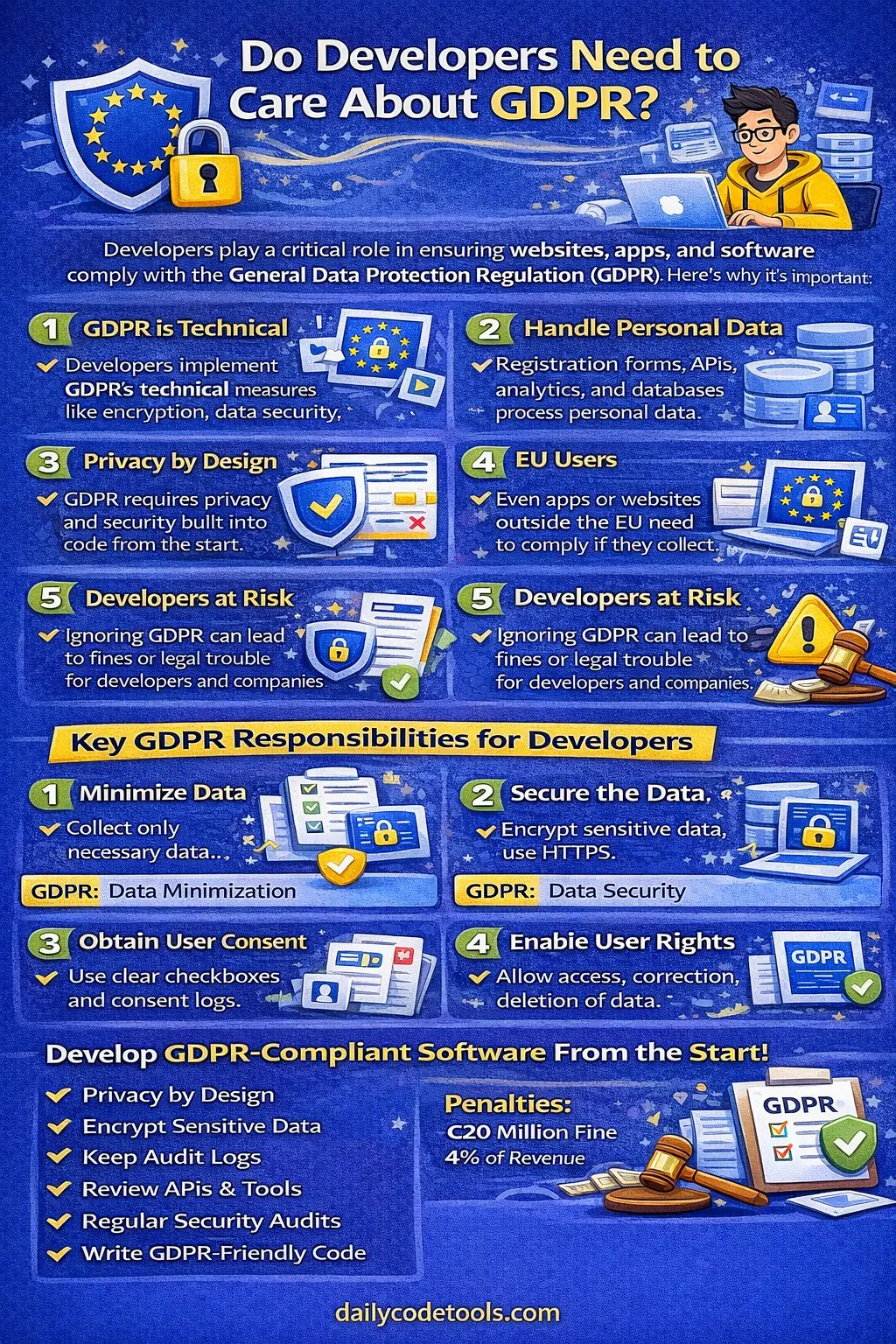
With data privacy becoming a global concern, the General Data Protection Regulation (GDPR) has become one of the most influential privacy frameworks affecting websites, software applications, SaaS products, mobile apps, APIs, and online services.
When people think about GDPR, they often think about lawyers, compliance officers, privacy policies, cookie banners, or large technology companies. But developers are equally important to the privacy process because developers build the systems that collect, process, store, transfer, analyze, and delete user data.
Every registration form, database table, API request, analytics script, authentication system, application log, cloud service, and third-party integration can have privacy implications.
This means GDPR is not simply a legal document that a company publishes on its website. Many GDPR requirements have to be translated into actual technical controls and software features.
A privacy policy may explain what information a company collects, but the application has to actually behave according to those promises.
For example, if a website tells users that their account can be deleted, developers need to build a reliable deletion workflow. If a company says that unnecessary personal information is not collected, developers need to make sure the application does not silently collect it. If users can withdraw consent, the system needs a mechanism for recording and honoring that withdrawal.
For developers, understanding GDPR therefore means understanding how privacy principles influence architecture, databases, APIs, authentication, logging, analytics, security, third-party services, and the entire data lifecycle.
This guide explains why developers need to care about GDPR, what GDPR means for software development, what technical responsibilities developers may have, common implementation mistakes, and how to build privacy-aware applications.
🌍 What Is GDPR?
The General Data Protection Regulation (GDPR) is a European Union data protection regulation designed to protect individuals' personal data and privacy.
It became applicable on May 25, 2018, replacing the previous EU Data Protection Directive framework.
One of the reasons GDPR became so influential is its broad approach to personal data and its potentially extraterritorial reach.
An organization does not necessarily avoid GDPR simply because its servers, developers, or company headquarters are outside the European Union.
Depending on the circumstances, GDPR can apply to organizations outside the EU when they offer goods or services to individuals in the EU or monitor their behavior.
Therefore, a development team located in India, the United States, Canada, the United Kingdom, or another country may still need to consider GDPR when building a product that falls within its scope.
However, it is important not to oversimplify this rule.
Having one visitor from Europe does not automatically mean every website is fully subject to every GDPR requirement. Applicability depends on factors such as the nature of the processing, the organization's activities, targeting, and whether the relevant GDPR territorial criteria are met.
That distinction is important for developers because privacy requirements should be based on the actual data processing activities of a product rather than assumptions.
🔎 What Does GDPR Protect?
GDPR focuses on the processing of personal data.
Personal data is broadly understood as information relating to an identified or identifiable natural person.
Examples can include:
-
Name
-
Email address
-
Phone number
-
Postal address
-
Account identifiers
-
IP addresses in relevant circumstances
-
Online identifiers
-
Location information
-
Device-related identifiers
-
Customer records
-
User activity information
-
Authentication information
-
Certain behavioral or profiling data
Some categories of information receive additional protection because they are considered special categories of personal data under GDPR.
Examples can include information relating to:
-
Health
-
Biometric data used for identification
-
Genetic data
-
Political opinions
-
Religious or philosophical beliefs
-
Racial or ethnic origin
-
Trade union membership
-
Sex life or sexual orientation
Developers do not need to become lawyers, but they should understand that not all data carries the same privacy risk.
A database field that looks harmless in isolation may become sensitive when combined with other information.
💻 Why Developers Need to Care About GDPR
GDPR Is Both a Legal and Technical Issue
One of the biggest misconceptions about GDPR is that compliance is purely a legal responsibility.
Legal teams may determine policies and interpret regulatory requirements, but developers often implement the technical systems that make those policies possible.
Consider a simple user account.
A company may state that:
Users can request access to their personal information.
That statement creates a technical requirement.
The system needs to know:
-
What personal data belongs to the user?
-
Where is it stored?
-
Which databases contain it?
-
Which services have copies?
-
Which logs contain related information?
-
Can the information be exported?
-
How is the user's identity verified?
-
How is the request tracked?
-
What information must be retained for legitimate reasons?
These are architecture and engineering questions.
The same principle applies to deletion requests, consent withdrawal, data security, access control, analytics, cookies, API integrations, and retention.
🧑💻 Developers Work With Personal Data Every Day
Modern applications process data continuously.
A developer might work on:
-
Registration systems
-
Login systems
-
Contact forms
-
Newsletter subscriptions
-
Payment integrations
-
Customer dashboards
-
Analytics
-
Error tracking
-
Advertising systems
-
CRM integrations
-
Cloud storage
-
APIs
-
Mobile applications
-
Customer support systems
Even a simple contact form can involve personal data.
For example:
Name
Email
Message
IP address
Timestamp
Browser information
Depending on how the system is configured, additional information may also be collected automatically.
The important question is not simply:
"Do we intentionally collect personal information?"
The better question is:
"What information does our entire technical system collect, generate, store, transmit, or expose?"
That broader perspective is much more useful for privacy engineering.
🏗️ Privacy by Design
One of the most important GDPR concepts for developers is Privacy by Design.
The basic idea is simple:
Privacy should be considered when a system is designed, not added after the application has already been built.
Imagine two development approaches.
Approach A: Privacy Later
A team builds an application first.
After launch, someone asks:
-
Do we need this data?
-
Where is it stored?
-
Can users delete it?
-
Why are we collecting this field?
-
Which third-party services receive it?
-
Are cookies enabled before consent?
The team then has to modify the architecture.
This can be expensive and risky.
Approach B: Privacy From the Beginning
The team considers privacy while designing:
-
Database schemas
-
APIs
-
Authentication
-
Data retention
-
Logging
-
Analytics
-
User permissions
-
Deletion workflows
-
Third-party integrations
This usually makes privacy easier to implement.
Privacy by Design does not mean that every application needs an enormous privacy system.
It means privacy should be treated as an engineering requirement.
📉 Data Minimization
One of the most useful GDPR principles for developers is data minimization.
The idea is straightforward:
Do not collect or retain more personal data than necessary for the purpose.
Suppose you are building a newsletter signup form.
Do you really need:
Name
Email
Phone
Date of Birth
Home Address
Gender
Company
Job Title
If the purpose is simply sending an email newsletter, probably not.
A minimal implementation may only need:
Email
Reducing unnecessary fields has several benefits.
It can:
-
Reduce privacy risk
-
Reduce database size
-
Simplify deletion
-
Reduce attack surface
-
Reduce storage costs
-
Improve user experience
-
Make data governance easier
Developers should regularly ask:
"Do we actually need to store this?"
That question can prevent many unnecessary privacy problems.
🗄️ Database Design and GDPR
Database architecture plays a major role in privacy.
Poorly designed databases can make compliance difficult.
For example, imagine personal information being duplicated across:
users
orders
support_tickets
analytics
logs
marketing
exports
If a user requests deletion, removing the account from only the users table may not be enough.
Copies may remain elsewhere.
This is why developers should understand the complete data lifecycle.
A useful architecture exercise is to document:
Collection
   ↓
Processing
   ↓
Storage
   ↓
Sharing
   ↓
Retention
   ↓
Deletion
For every important piece of personal data, ask where it travels.
🧩 Data Mapping
A practical privacy engineering technique is creating a data map.
For example:
| Data | Source | Storage | Used For | Shared With | Retention |
|---|---|---|---|---|---|
| Signup form | User DB | Account | Email provider | Defined period | |
| IP address | Web request | Logs | Security | Hosting/log service | Defined period |
| Payment information | Checkout | Payment provider | Payment | Payment processor | Provider rules |
| Analytics ID | Browser | Analytics system | Analytics | Analytics provider | Defined period |
The exact requirements depend on the organization and processing activities, but the exercise itself is extremely valuable.
Developers can use data mapping to discover:
-
Forgotten databases
-
Unnecessary fields
-
Duplicate storage
-
Unexpected third-party sharing
-
Long retention periods
-
Sensitive information in logs
🍪 Cookies, Analytics, and Tracking
Cookies and tracking technologies are another major area where developers need to understand privacy requirements.
A website may use:
-
Analytics cookies
-
Advertising cookies
-
Functional cookies
-
Session cookies
-
Preference cookies
-
Tracking pixels
-
Device identifiers
-
Similar technologies
The technical implementation matters.
For example, simply displaying a cookie banner does not automatically make a website compliant.
Developers may need to ensure that optional tracking technologies are not activated before the appropriate consent mechanism has been satisfied, depending on the applicable legal requirements and the type of technology being used.
A poorly implemented cookie banner might display:
Accept Cookies
Reject
while analytics scripts have already loaded.
That defeats the purpose of the consent mechanism.
A better technical design separates optional tracking from essential functionality and controls when third-party scripts are initialized.
🔐 User Consent
Consent is an important GDPR concept, but developers should avoid treating consent as the legal basis for everything.
GDPR provides several legal bases for processing personal data.
Depending on the processing activity, a lawful basis may include:
-
Consent
-
Contract
-
Legal obligation
-
Vital interests
-
Public task
-
Legitimate interests
The appropriate legal basis depends on the specific processing activity and context.
This is why developers should work with privacy or legal teams rather than deciding legal bases independently.
When consent is actually the chosen legal basis, the technical implementation becomes important.
The system may need to support:
-
Clear consent choices
-
Granular choices where appropriate
-
Recording consent
-
Recording relevant timestamps
-
Recording what the user agreed to
-
Withdrawal mechanisms
-
Applying the withdrawal to future processing where required
A checkbox such as:
<input type="checkbox">
is not automatically a compliant consent mechanism.
The surrounding wording, purpose, user choice, implementation, and processing context all matter.
🚫 Avoid Preselected Optional Consent
Developers should be careful with preselected optional consent controls.
For example:
<input type="checkbox" checked>
may be inappropriate where affirmative consent is required.
The goal is to make the user's choice meaningful rather than designing the interface to push users toward acceptance.
Privacy-friendly UX should be:
-
Clear
-
Understandable
-
Specific
-
Easy to use
-
Easy to change later
🔄 Right to Access
GDPR provides individuals with various rights concerning their personal data.
One important right is the right of access.
From a developer perspective, this can create a data export requirement.
A system may need to identify relevant personal data and provide it in an appropriate form.
A developer might therefore build a feature such as:
Account
   ↓
Privacy Settings
   ↓
Request My Data
   ↓
Identity Verification
   ↓
Data Collection
   ↓
Export Generation
   ↓
Secure Delivery
The difficult part is usually not generating JSON or CSV.
The difficult part is identifying all relevant data sources.
That is why good data architecture matters.
🗑️ Right to Erasure
The GDPR right to erasure is often described as the Right to Be Forgotten.
Developers should understand that deletion does not always mean pressing:
DELETE FROM users WHERE id = 123;
Real applications are more complicated.
User information might exist in:
-
Main databases
-
Secondary databases
-
Search indexes
-
Caches
-
Object storage
-
Analytics platforms
-
Customer support systems
-
Application logs
-
Backups
-
Third-party processors
A deletion workflow therefore needs careful planning.
However, developers should also understand that GDPR does not create an absolute right to delete every piece of information in every circumstance.
There can be legal obligations and other exceptions requiring certain information to be retained.
This is another reason deletion logic should be designed with legal and privacy requirements in mind.
🧹 Data Retention and Automatic Deletion
A strong privacy architecture should not keep personal information forever simply because storage is cheap.
Developers can implement retention policies such as:
Temporary data → Delete after purpose is complete

Inactive records → Review after defined period

Expired sessions → Delete automatically

Old logs → Rotate and remove

Unused accounts → Follow documented retention process
Automated retention can be safer than relying on someone to manually clean databases.
Possible technical approaches include:
-
Scheduled jobs
-
Queue workers
-
Database TTL mechanisms
-
Lifecycle policies
-
Log rotation
-
Object-storage lifecycle rules
Retention periods should come from organizational, legal, contractual, and business requirements rather than being invented purely by developers.
🔑 Authentication and Access Control
Protecting personal data is not only about encryption.
Access control is equally important.
A system should ensure that users and internal employees only have access to information they are authorized to access.
Developers should consider:
-
Authentication
-
Authorization
-
Role-based access control
-
Least privilege
-
Session security
-
Token expiration
-
Password protection
-
Multi-factor authentication where appropriate
-
Administrative access controls
For example, a customer support employee may need access to a customer's support history but may not need access to unrelated financial or authentication information.
The principle of least privilege helps reduce unnecessary access.
🔒 Password Security
Passwords are particularly important.
Passwords should never be stored as plaintext.
Instead, applications should use appropriate password hashing mechanisms.
For example, modern PHP applications can use:
password_hash($password, PASSWORD_DEFAULT);
and verify passwords with:
password_verify($password, $hash);
Developers should avoid designing their own password hashing algorithms.
They should also avoid:
MD5
SHA-1
Plaintext passwords
Reversible encryption for password storage
where those approaches are being used as password storage mechanisms.
Security practices should follow current platform and security guidance.
🔐 Encryption in Transit
Personal information should be protected while traveling between the user and the application.
For websites and APIs, this generally means using HTTPS.
Developers should avoid transmitting sensitive information over unencrypted HTTP.
HTTPS helps protect against attackers who may attempt to intercept network traffic.
For APIs, this is especially important because mobile applications, browsers, backend services, and third-party integrations may all exchange personal information.
🗝️ Encryption at Rest
Depending on the risk and type of information involved, encryption at rest can provide another layer of protection.
This may include:
-
Database encryption
-
Encrypted backups
-
Encrypted object storage
-
Encrypted file systems
-
Application-level encryption for particularly sensitive information
However, encryption should not be treated as a magic GDPR checkbox.
Security involves multiple layers:
Authentication
+
Authorization
+
Encryption
+
Monitoring
+
Secure coding
+
Patch management
+
Incident response
📝 Logging and GDPR
Logging is essential for debugging and security, but logs can accidentally become a privacy problem.
Consider:
logger($request);
If the request contains:
password
email
phone
address
access_token
the application may unintentionally store sensitive information in logs.
Developers should carefully decide what information is logged.
Avoid unnecessary logging of:
-
Passwords
-
Authentication tokens
-
Payment information
-
Sensitive personal information
-
Session secrets
Instead, logs should contain useful technical context without unnecessarily exposing personal data.
For example:
User login failed
User ID: 9382
Timestamp: ...
Reason: invalid credentials
may be more appropriate than storing the entire login request.
📊 Analytics and User Tracking
Analytics tools can provide valuable information about how users interact with an application.
However, developers should understand what information is being transmitted to analytics providers.
Before integrating an analytics platform, consider:
-
What data is collected?
-
What identifiers are used?
-
Where is the information processed?
-
Is personal information being sent?
-
Can IP-related data be minimized?
-
What configuration options are available?
-
Is consent required for the specific use?
-
What contractual arrangements are needed?
Simply adding:
<script src="analytics.js"></script>
can have privacy implications.
Third-party scripts should therefore be treated as part of the application's data-processing architecture.
🔗 APIs and GDPR
Modern applications are increasingly API-driven.
A frontend might communicate with:
Frontend
   ↓
API
   ↓
Application Server
   ↓
Database
   ↓
Third-party Services
Personal data can pass through every layer.
Developers should therefore review API design carefully.
Important considerations include:
-
Authentication
-
Authorization
-
Input validation
-
Output filtering
-
Rate limiting
-
Encryption
-
Logging
-
Data minimization
-
Error handling
An API should not return more personal information than the client actually needs.
For example, if a mobile app only needs:
{
  "name": "John"
}
there is usually little reason to return:
{
  "name": "John",
  "email": "...",
  "phone": "...",
  "address": "...",
  "internal_notes": "...",
  "admin_flags": "..."
}
API responses should be intentionally designed.
⚠️ Avoid Sensitive Information in API Errors
Error responses can also expose personal data.
Avoid responses such as:
{
  "error": "User john@example.com with password xyz failed..."
}
A safer error response might provide only the information necessary to understand the problem.
Developers should also make sure stack traces and internal database errors are not exposed to production users.
🌐 Third-Party Services
Most modern applications depend on external services.
Examples include:
-
Payment processors
-
Email providers
-
Cloud platforms
-
Analytics platforms
-
Customer support software
-
Authentication providers
-
Marketing systems
-
Hosting providers
-
Monitoring platforms
-
Error tracking tools
If personal data is sent to these services, developers need to understand the relationship and data flow.
Questions worth asking include:
-
What information is being sent?
-
Why is it being sent?
-
Is the provider processing data on the organization's behalf?
-
Is a Data Processing Agreement required?
-
Where is the information processed?
-
How long is it retained?
-
Can data be deleted?
-
What security controls are available?
Developers should not assume that a popular SaaS product is automatically suitable for every privacy-sensitive application.
🌍 International Data Transfers
International data transfers can become particularly important for organizations subject to GDPR.
For example, a European user's data might travel through:
EU User
   ↓
Website
   ↓
US Cloud Provider
   ↓
US Analytics Service
   ↓
Global Support Platform
This creates questions around where data is processed and what legal mechanisms apply to the transfer.
Developers may not be responsible for deciding the legal transfer mechanism, but they should know enough about their architecture to tell privacy and legal teams:
-
Which provider receives the data
-
What categories of data are transferred
-
Which region stores the data
-
Which APIs are involved
-
Whether backups are replicated internationally
Technical documentation is extremely valuable here.
🧪 Security Testing
GDPR and broader privacy requirements make secure development especially important.
Developers should regularly consider:
-
Dependency vulnerabilities
-
Authentication flaws
-
Authorization bugs
-
SQL injection
-
Cross-site scripting
-
CSRF
-
API vulnerabilities
-
Insecure direct object references
-
Misconfigured cloud storage
-
Exposed secrets
-
Weak access controls
Security testing should happen throughout the software lifecycle.
Useful practices include:
-
Code review
-
Dependency scanning
-
Static analysis
-
Dynamic testing
-
Penetration testing where appropriate
-
Secret scanning
-
Infrastructure security reviews
🔄 Secure Software Updates
Old dependencies can introduce security vulnerabilities.
Developers should maintain:
-
PHP versions
-
JavaScript libraries
-
Frameworks
-
Operating systems
-
Database systems
-
Container images
-
Third-party packages
A secure application is not a one-time achievement.
Security maintenance is an ongoing process.
🚨 Data Breach Preparation
Developers also need to understand what happens if personal data is compromised.
A breach could involve:
-
Stolen credentials
-
Exposed database
-
Misconfigured cloud bucket
-
Compromised API
-
Malware
-
Unauthorized employee access
-
Accidental data disclosure
Technical teams should have a clear incident response process.
That process can include:
Detect
  ↓
Contain
  ↓
Investigate
  ↓
Assess
  ↓
Remediate
  ↓
Document
  ↓
Notify appropriate parties when required
GDPR contains specific requirements concerning certain personal data breaches, including notification obligations in applicable circumstances and timeframes.
Developers therefore need to preserve enough technical evidence to help the organization investigate an incident.
📚 Documentation Matters
Good documentation can make privacy compliance significantly easier.
Developers should document important data flows such as:
Signup Form
     ↓
Application API
     ↓
User Database
     ↓
Email Provider
and:
User Request
     ↓
API
     ↓
Authentication
     ↓
Data Export Service
     ↓
Secure Download
Documentation helps teams understand:
-
What data exists
-
Where it goes
-
Who can access it
-
Which systems process it
-
How it is deleted
-
What third parties are involved
Without documentation, privacy reviews become much harder.
⚠️ Common GDPR Mistakes Developers Make
1. Collecting Everything "Just in Case"
Developers sometimes add database fields because the information might be useful later.
This creates unnecessary data.
Better approach:
Collect data because there is a defined purpose for it.
2. Logging Sensitive Information
Developers may log complete requests for debugging.
This can accidentally expose:
-
Passwords
-
Tokens
-
Emails
-
Addresses
-
Personal messages
Production logging should be intentionally designed.
3. Treating HTTPS as Complete Compliance
HTTPS is important, but HTTPS alone does not make an application GDPR compliant.
Privacy involves:
-
Lawful processing
-
Transparency
-
Data minimization
-
User rights
-
Security
-
Retention
-
Third-party processing
-
Governance
4. Assuming the Privacy Policy Fixes Everything
A privacy policy cannot compensate for technical behavior that contradicts it.
If the policy says:
We do not collect location information.
but the application sends precise location data to an analytics platform, the technical implementation needs attention.
5. Ignoring Third-Party Scripts
Developers sometimes install:
Analytics
Chat widget
Advertising pixel
Heatmap
Social widget
without reviewing what information those scripts collect.
Every external script should be evaluated.
6. Making Deletion Impossible
If personal data is spread across ten systems and nobody knows where it exists, handling user requests becomes difficult.
Data architecture should therefore consider deletion from the beginning.
7. Building Consent UI Without Understanding the Requirement
A cookie popup is not automatically compliant.
The technical behavior behind the popup matters.
🧠 GDPR and the Principle of Least Privilege
Least privilege means giving users, applications, and employees only the permissions they actually need.
For example:
Customer Support
→ Support tickets

Billing Team
→ Billing information

Developer
→ Development environment

Production Admin
→ Production systems
A developer should not automatically have unrestricted access to production personal data simply because they are part of the engineering team.
Development environments should ideally avoid using unnecessary real customer information.
Where appropriate, teams can use:
-
Synthetic data
-
Anonymized data
-
Pseudonymized data
-
Sanitized database copies
🧪 Development and Testing Data
One often-overlooked issue is using real production data during development.
For example:
Production Database
       ↓
Developer Laptop
This can unnecessarily expose personal information.
A safer approach may be:
Production Database
       ↓
Sanitization Process
       ↓
Test Dataset
       ↓
Development Environment
The exact method depends on the system, but developers should always ask whether real personal data is genuinely required for testing.
Often it is not.
🧩 Pseudonymization vs Anonymization
Developers may encounter the terms pseudonymization and anonymization.
They are not identical.
Pseudonymization
Identifiers are replaced or separated so that direct identification becomes more difficult.
However, additional information may still allow the person to be identified.
Therefore, pseudonymized information can still fall within GDPR's concept of personal data.
Anonymization
Information is processed so that individuals are no longer identifiable in a meaningful way.
True anonymization is technically and legally more demanding than simply replacing a name with an ID.
For example:
John Smith
changing to:
User-9382
does not automatically make the data anonymous.
If another database maps:
User-9382 → John Smith
the information remains linkable.
📱 GDPR and Mobile Applications
Mobile developers face many of the same privacy challenges as web developers.
Mobile applications may access:
-
Location
-
Contacts
-
Camera
-
Microphone
-
Photos
-
Device identifiers
-
Advertising identifiers
-
Health information
-
Usage data
Developers should avoid requesting permissions that the application does not actually need.
A flashlight application asking for contacts and precise location would raise obvious privacy questions.
Permission requests should be:
-
Necessary
-
Understandable
-
Timely
-
Related to the feature being used
🖥️ GDPR and SaaS Applications
SaaS platforms can involve complex data relationships.
A SaaS application may contain:
Organization
   ↓
Teams
   ↓
Users
   ↓
Projects
   ↓
Files
   ↓
Comments
   ↓
Audit Logs
Deleting one user may therefore require careful handling of multiple relationships.
Developers should define:
-
Ownership
-
Tenant boundaries
-
Access rules
-
Retention
-
Deletion
-
Export
-
Audit history
Multi-tenant systems require particularly careful authorization because one customer's data must never become visible to another customer.
🏢 Multi-Tenant Data Isolation
For SaaS products, tenant isolation is a major security and privacy concern.
For example:
Company A
 ├── User 1
 ├── User 2
 └── Projects

Company B
 ├── User 3
 ├── User 4
 └── Projects
An API bug that allows Company A to request Company B's records is both a serious security issue and potentially a serious privacy issue.
Developers should therefore enforce authorization at the server side.
Never rely only on frontend restrictions.
For example, hiding a button with JavaScript does not prevent an attacker from calling the underlying API directly.
🔍 Privacy Testing Checklist
Before launching a new application, developers can perform a privacy-focused technical review.
Data Collection
-
What personal data is collected?
-
Is each field necessary?
-
Are hidden fields collecting unexpected information?
-
Are IP addresses being stored?
Storage
-
Where is personal data stored?
-
Are backups included?
-
Are caches storing personal information?
-
Are logs storing sensitive values?
Access
-
Who can access the information?
-
Are permissions enforced server-side?
-
Is least privilege implemented?
APIs
-
Does the API return only necessary data?
-
Are endpoints authenticated?
-
Are authorization checks enforced?
Third Parties
-
Which external services receive personal data?
-
What information do they receive?
-
Are the integrations documented?
Retention
-
How long is information retained?
-
Is automatic deletion possible?
User Rights
-
Can users access relevant data?
-
Can they correct it?
-
Can they request deletion where applicable?
-
Can they withdraw consent where consent is the legal basis?
Security
-
Is HTTPS enabled?
-
Are passwords properly hashed?
-
Are secrets protected?
-
Are dependencies updated?
📋 Practical GDPR Checklist for Developers
A developer-friendly checklist can look like this:
-
Identify personal data collected by the application.
-
Document where that data is stored.
-
Document where the data is transmitted.
-
Review every third-party integration.
-
Minimize unnecessary data collection.
-
Implement appropriate access controls.
-
Protect passwords with secure hashing.
-
Use HTTPS.
-
Review logs for sensitive information.
-
Define retention and deletion processes.
-
Support applicable user rights.
-
Review cookies and tracking technologies.
-
Avoid unnecessary production data in development.
-
Secure APIs and backend endpoints.
-
Keep dependencies updated.
-
Prepare for security incidents.
-
Document important data flows.
-
Work with privacy/legal teams when requirements are unclear.
🚀 How Developers Can Build Privacy-Friendly Applications
Privacy does not need to be treated as something that happens after development.
A better software lifecycle is:
Requirements
     ↓
Privacy Review
     ↓
Architecture
     ↓
Implementation
     ↓
Security Testing
     ↓
Privacy Testing
     ↓
Deployment
     ↓
Monitoring
     ↓
Continuous Improvement
At every stage, developers can ask:
What data are we handling, why are we handling it, who can access it, and how long do we need it?
These questions are simple, but they can dramatically improve software architecture.
📈 Why GDPR Compliance Can Improve Software
GDPR may initially look like additional work.
However, privacy-aware engineering can produce several technical benefits.
Better Data Architecture
When teams understand their data, databases and APIs often become cleaner.
Reduced Attack Surface
Collecting less information means there is less information available to attackers.
Better User Trust
Users are more likely to trust products that clearly respect their privacy.
Easier Maintenance
Documented data flows make future development easier.
Better Security
Privacy requirements often encourage stronger authentication, authorization, encryption, logging, and monitoring.
Reduced Technical Debt
Privacy problems discovered late can become expensive technical debt.
Building privacy into the architecture reduces that risk.
🌍 GDPR's Influence Beyond Europe
GDPR has influenced privacy discussions around the world.
Many jurisdictions have introduced or updated data protection frameworks with concepts involving:
-
Transparency
-
Data minimization
-
User rights
-
Security
-
Consent
-
Accountability
-
Data governance
Examples include privacy laws and frameworks in regions such as California, India, Brazil, Canada, and other jurisdictions.
However, developers should not assume that every privacy law is identical to GDPR.
Each jurisdiction has its own scope, definitions, rights, exemptions, obligations, and enforcement structure.
The broader lesson is that privacy-aware development is becoming increasingly important globally.
🔮 The Future of Privacy Engineering
As applications become more data-driven, privacy engineering is likely to become a more important part of software development.
Technologies such as:
-
Artificial intelligence
-
Machine learning
-
Personalization
-
Behavioral analytics
-
Large-scale data processing
-
Internet of Things devices
-
Location services
-
Biometric systems
can create new privacy challenges.
Developers will increasingly need to think about not only:
"Can we collect this data?"
but also:
"Should we collect this data?"
That distinction is fundamental to responsible software engineering.
🤖 GDPR and Artificial Intelligence
AI systems introduce additional privacy questions.
An AI-powered application may process:
-
User prompts
-
Uploaded documents
-
Customer records
-
Conversations
-
Personal identifiers
-
Behavioral information
-
Internal company data
Developers should understand where this information goes and how it is processed.
For example, before sending customer information to an external AI service, a development team should understand:
-
What information is being transmitted
-
Whether personal data is included
-
What contractual arrangements apply
-
How the provider handles submitted information
-
Whether data is retained
-
Whether the processing is appropriate for the use case
Developers should avoid sending personal information to external systems simply because an API makes it technically easy.
🧑💼 Developers Are Part of the Privacy Team
GDPR compliance works best when privacy is treated as a shared organizational responsibility.
A typical project may involve:
Legal
   +
Privacy
   +
Security
   +
Product
   +
Developers
   +
DevOps
   +
Design
Each team contributes something different.
Developers provide the technical implementation.
Security teams focus on protection.
Legal and privacy teams interpret regulatory requirements.
Product teams define functionality.
Design teams influence how consent and privacy choices are presented.
No single team can solve every GDPR issue alone.
❓ Frequently Asked Questions About GDPR for Developers
Do developers need to understand GDPR?
Yes. Developers who build systems that process personal data should understand the GDPR concepts relevant to their work. They do not need to become lawyers, but they should understand privacy principles and how technical decisions affect personal data.
Is GDPR only for European companies?
No. GDPR can apply to organizations outside the EU depending on their activities and whether they fall within its territorial scope.
Does GDPR apply to websites?
It can. The applicability depends on the site's activities, users, processing operations, and other circumstances.
Does every website visitor from Europe automatically make a website subject to GDPR?
No. GDPR applicability should not be reduced to the presence of a single European visitor. The actual territorial scope and processing activities matter.
Is HTTPS enough for GDPR compliance?
No. HTTPS is an important security measure, but GDPR covers much more than encrypted communication.
Do developers need to implement data deletion?
Developers may need to build technical capabilities that support applicable deletion requests and organizational retention policies.
Should developers store every piece of user information?
No. Data minimization means unnecessary personal data should generally not be collected or retained.
Is consent always required under GDPR?
No. Consent is one possible legal basis for processing, but GDPR recognizes several legal bases. The correct basis depends on the specific processing activity.
Are IP addresses personal data?
An IP address can constitute personal data under GDPR depending on the circumstances and whether it relates to an identifiable individual.
Should passwords be encrypted?
Passwords should generally be stored using secure, one-way password hashing rather than plaintext or reversible encryption.
Can developers use real customer data in development?
They should avoid unnecessary use of real personal data in development and testing. Where possible, teams should use synthetic, anonymized, or appropriately sanitized data.
Do APIs need GDPR considerations?
Yes. APIs can transmit personal data between browsers, mobile applications, backend systems, and third-party services. Authentication, authorization, minimization, logging, and security all matter.
Do third-party analytics tools create privacy concerns?
They can. Developers should understand what information analytics tools collect, where it goes, and what legal and consent requirements apply.
Does deleting a user account delete all information automatically?
Not necessarily. Data may exist in multiple systems, and certain information may need to be retained for legitimate legal or operational reasons. Deletion workflows should therefore be designed carefully.
Does GDPR apply to developers personally?
GDPR primarily establishes obligations for organizations and other entities involved in personal-data processing. Individual developer responsibility depends on their role, organization, applicable laws, and circumstances. Developers should focus on implementing the technical requirements assigned to them and escalating uncertainty to appropriate privacy, security, or legal teams.
🛠️ A Simple Privacy-First Development Workflow
Developers who want a practical approach can use this workflow for new features.
Step 1: Identify the Data
Before coding, list the personal information the feature will handle.
Step 2: Define the Purpose
Ask why each piece of information is required.
Step 3: Minimize
Remove fields that are unnecessary.
Step 4: Map the Flow
Document:
Input → API → Database → Third Party → Retention → Deletion
Step 5: Secure It
Implement authentication, authorization, encryption, validation, and secure storage.
Step 6: Review Logs
Make sure debugging information does not expose sensitive information.
Step 7: Review Third Parties
Check external APIs, analytics, cloud services, payment systems, and other providers.
Step 8: Test User Rights
Where applicable, test:
-
Data access
-
Correction
-
Deletion
-
Consent withdrawal
Step 9: Document
Record the important technical decisions.
Step 10: Monitor
Privacy and security need ongoing maintenance after launch.
🏁 Final Thoughts
Yes, developers absolutely need to care about GDPR.
GDPR is not simply a legal document that belongs to lawyers or compliance departments. Modern software development is deeply connected to privacy because applications are responsible for collecting, processing, storing, transmitting, analyzing, and deleting personal data.
Developers influence privacy through everyday technical decisions.
The database schema determines what information is stored.
The API determines what information is exposed.
The frontend determines what users are asked to provide.
The analytics implementation determines what behavioral information may be collected.
The logging system determines what information may remain in technical records.
The authentication system determines who can access personal data.
The deletion architecture determines whether privacy requests can actually be fulfilled.
That is why privacy needs to be considered throughout the software development lifecycle.
The goal should not be to collect as much information as possible and then attempt to secure it later.
A better approach is:
Collect only what is necessary.
Protect what you collect.
Know where the data goes.
Limit who can access it.
Delete information when it is no longer needed, subject to applicable requirements.
Give users appropriate control over their information.
Document important data flows and processing activities.
Developers do not need to become privacy lawyers, but they do need enough GDPR awareness to recognize privacy risks and build systems that can support the organization's legal and privacy obligations.
In 2026 and beyond, privacy-aware development is becoming an increasingly important engineering skill. Developers who understand data minimization, secure architecture, consent mechanisms, access controls, retention, deletion, API security, third-party integrations, and Privacy by Design are better prepared to build trustworthy digital products.
GDPR should therefore not be viewed only as a compliance burden.
For developers, it can also be a framework for building safer, cleaner, more transparent, and more trustworthy software.
Your email address will not be published. Comments are moderated.
0 Comments on This Post
Leave a Reply
Comments (0)
Spread the Word!
Join Our Developer Community!
Get weekly coding tips, tool updates, and exclusive tutorials straight to your inbox.
Request a Tool
×