What is GDPR and Why It Matters for Small Businesses
Introduction
In today's digital world, data has become one of the most valuable resources for businesses.
Every time a customer fills out a contact form, creates an account, subscribes to a newsletter, places an order, downloads a resource, requests a quotation, or interacts with a website, some form of information may be collected.
For a small business, this data can be extremely useful.
Customer information can help businesses:
-
Communicate with customers
-
Process orders
-
Provide services
-
Send marketing emails
-
Improve products
-
Understand website usage
-
Provide customer support
-
Manage accounts
-
Prevent fraud
-
Personalize experiences
However, collecting personal information also creates responsibility.
Businesses need to understand what information they collect, why they collect it, where it is stored, who can access it, how long they keep it, and what happens if something goes wrong.
This is where GDPR, or the General Data Protection Regulation, becomes important.
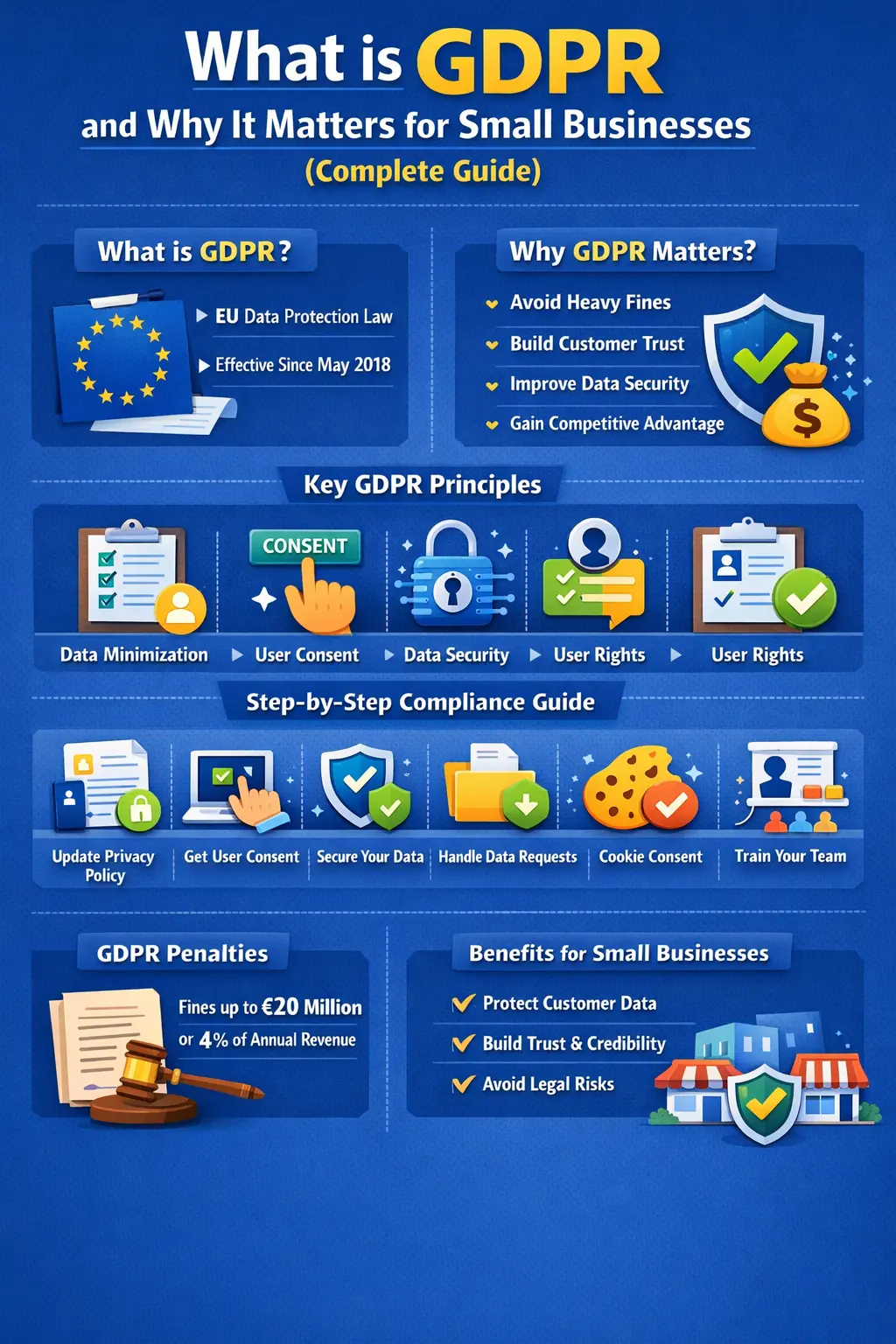
GDPR is a European Union data protection regulation designed to protect individuals and give them greater control over their personal data. It has applied since 25 May 2018 and can apply to organizations outside the EU when they offer goods or services to people in the EU or monitor their behaviour there. The rules apply to organizations of different sizes; being a small business does not automatically remove an organization from GDPR's scope.
One of the biggest misconceptions about GDPR is:
"GDPR is only for large companies."
That is not correct.
A small online store, freelancer, SaaS business, marketing agency, consultant, blogger, or service provider may have GDPR responsibilities depending on what it does and whether the regulation applies to its processing activities.
At the same time, GDPR should not be treated as a requirement to create mountains of paperwork. The regulation follows a risk-based approach, and some obligations depend on factors such as the nature, scale, context, and risk of the processing.
In this complete guide, we will explain GDPR in simple language and show how small businesses can approach data protection in a practical way.
You will learn:
-
What GDPR means
-
What personal data is
-
When GDPR applies to a small business
-
The difference between personal data and sensitive data
-
GDPR's seven principles
-
Legal bases for processing
-
Individual rights
-
Consent requirements
-
Cookie and tracking considerations
-
Privacy policies
-
Data security
-
Data breaches
-
Third-party processors
-
Data retention
-
International data transfers
-
GDPR compliance steps
-
Common mistakes
-
GDPR myths
-
Practical compliance checklist
-
Frequently asked questions
Important: This article is an educational guide, not legal advice. GDPR requirements can depend on your business, customers, processing activities, contracts, jurisdictions, and risk profile. If your business handles sensitive or high-risk data, consider obtaining advice from a qualified privacy professional or lawyer.
1. What Is GDPR?
GDPR stands for General Data Protection Regulation.
It is an EU regulation that establishes rules for processing personal data and gives individuals rights over information relating to them.
The regulation focuses on several fundamental ideas:
-
Businesses should process personal data lawfully.
-
People should understand how their information is being used.
-
Organizations should collect only the information they actually need.
-
Personal information should be protected.
-
Data should not be retained indefinitely without a valid reason.
-
Individuals should be able to exercise their data protection rights.
-
Organizations should be able to demonstrate compliance.
The European Commission identifies seven core principles of GDPR:
-
Lawfulness, fairness and transparency
-
Purpose limitation
-
Data minimisation
-
Accuracy
-
Storage limitation
-
Integrity and confidentiality
-
Accountability
These principles are useful even for a very small business because they provide a practical framework for responsible data handling.
2. Why Was GDPR Introduced?
Before GDPR, European data protection rules were based largely on the earlier Data Protection Directive.
As technology changed, businesses began collecting significantly more information through:
-
Websites
-
Smartphones
-
Online advertising
-
Social media
-
Cloud applications
-
E-commerce
-
Analytics
-
Digital payment systems
-
Mobile applications
People also became increasingly concerned about how companies collected, analyzed, shared, and stored their information.
GDPR created a more consistent data protection framework across the EU and strengthened individuals' rights.
The regulation also established rules that can apply beyond the EU in certain circumstances.
This is important for modern online businesses because geographical location alone does not always determine whether GDPR is relevant.
3. What Is Personal Data Under GDPR?
Personal data is information relating to an identified or identifiable living individual.
It can identify someone directly or indirectly.
For example:
-
Full name
-
Email address
-
Telephone number
-
Home address
-
Online identifier
-
IP address in relevant circumstances
-
Location information
-
Account information
-
Identification numbers
-
Customer records
-
Device identifiers
The European Commission explains that different pieces of information can also become personal data when combined and capable of identifying an individual. Data that has been pseudonymised or encrypted may still be personal data if a person can potentially be re-identified. Truly anonymous information, where an individual is no longer identifiable, is treated differently.
This distinction is important for small businesses.
A business might think:
"We don't store people's government ID numbers, so we don't handle personal data."
But that does not mean GDPR is irrelevant.
A basic contact form containing:
Name
Email
Message
already involves personal information.
4. Examples of Personal Data
Small businesses may process personal data in many everyday situations.
Customer Information
-
Name
-
Email
-
Phone number
-
Billing address
-
Shipping address
Account Information
-
Username
-
Customer ID
-
Login information
-
Account preferences
Business Communication
-
Emails
-
Support tickets
-
Contact forms
-
Chat messages
Website and Technical Information
Depending on how information is collected and combined:
-
IP addresses
-
Online identifiers
-
Device information
-
Cookie identifiers
-
Usage information
Transaction Information
-
Order details
-
Purchase history
-
Invoice information
-
Payment-related records
Businesses should evaluate the information they process rather than assuming that only obvious identifiers count.
5. What Is Sensitive or Special Category Data?
GDPR provides additional protection for certain categories of personal data.
These include information relating to areas such as:
-
Racial or ethnic origin
-
Political opinions
-
Religious or philosophical beliefs
-
Trade union membership
-
Genetic data
-
Biometric data used for uniquely identifying a person
-
Health data
-
Sex life or sexual orientation
Processing these categories is subject to additional rules and generally requires a specific legal condition under GDPR.
This matters because a small business may accidentally collect sensitive information without realizing the additional compliance implications.
For example, a basic customer feedback form may unintentionally ask questions that reveal health information.
A business should therefore think carefully about whether it actually needs to collect such information.
6. Does GDPR Apply to Small Businesses?
Yes, potentially.
GDPR can apply to a small business if it falls within the regulation's territorial scope.
The European Commission explains that GDPR applies to organizations established in the EU when processing personal data in the context of their activities, regardless of where the processing itself takes place. It can also apply to organizations outside the EU when they offer goods or services to individuals in the EU or monitor their behaviour there.
This means a company does not automatically escape GDPR simply because it is based outside Europe.
For example, imagine a small online store based outside the EU that intentionally sells products to customers in EU countries and processes their customer information to complete those sales.
The business may need to consider GDPR.
However, simply having a website that happens to be accessible from Europe does not automatically mean every business activity falls within GDPR's territorial scope.
The actual circumstances matter.
7. Small Business Does Not Mean "No GDPR"
Another common misconception is:
"My business is too small for GDPR."
The size of a company is not the sole factor that determines whether GDPR applies.
However, not every GDPR obligation applies identically to every organization.
For example, some requirements depend on the nature and scale of processing, the risks involved, and whether processing is a core activity.
The European Commission specifically notes that certain obligations, such as appointing a Data Protection Officer in specific circumstances, may not apply to small organizations whose processing does not meet the relevant conditions.
The correct approach is therefore:
Don't assume GDPR applies to everything, and don't assume it applies to nothing. Assess your actual processing activities.
8. Why GDPR Matters for Small Businesses
GDPR is not simply about avoiding fines.
Good data protection practices can improve the way a business operates.
1. Customer Trust
Customers are more likely to feel comfortable when businesses clearly explain:
-
What information is collected
-
Why it is collected
-
How it is used
-
How long it is retained
-
Who receives it
Transparency can make a business appear more professional.
2. Better Data Management
Many small businesses collect data without having a clear understanding of where it goes.
A GDPR-focused review can help identify:
-
Old customer lists
-
Unused accounts
-
Duplicate records
-
Unnecessary information
-
Third-party services
-
Unprotected files
This can make internal processes cleaner.
3. Better Security
GDPR requires organizations to implement appropriate technical and organizational measures based on risk. Examples can include encryption, pseudonymisation, access controls, recovery capabilities, and regular testing of security measures.
Improving security can reduce the chance and impact of data incidents.
4. Reduced Operational Risk
A business that understands its data flows is better positioned to respond when:
-
A customer asks for their data
-
Someone requests deletion
-
An employee leaves
-
A third-party service changes
-
A security incident occurs
5. Stronger Business Processes
Privacy compliance encourages businesses to document important processes.
For example:
Data Collection
      ↓
Purpose
      ↓
Legal Basis
      ↓
Storage
      ↓
Access
      ↓
Retention
      ↓
Deletion
This creates a more organized approach to customer data.
9. The Seven GDPR Principles
Understanding the seven principles is one of the easiest ways to understand GDPR.
Principle 1: Lawfulness, Fairness and Transparency
A business needs an appropriate legal basis for processing personal data and should process it fairly and transparently.
People should be given understandable information about how their information is used.
The European Commission notes that transparency information can include the organization's identity, processing purposes, categories of data, legal basis, retention period, recipients, transfers, and relevant individual rights.
Example
Bad approach:
"We may use your information for various business purposes."
Better approach:
"We collect your email address to send the newsletter you requested."
The second explanation is more specific and understandable.
10. Principle 2: Purpose Limitation
Personal data should be collected for specific, explicit and legitimate purposes.
A business should not collect information simply because it "might be useful someday."
Example
Suppose a customer buys a product.
You may need:
-
Name
-
Shipping address
-
Contact details
-
Order information
But that does not automatically mean you should collect unrelated information.
Purpose matters.
If you later want to use information for a different purpose, you may need to assess whether that further processing is compatible with the original purpose and whether another legal basis or additional action is required.
11. Principle 3: Data Minimisation
Data minimisation means collecting only the personal data that is adequate, relevant and necessary for the intended purpose.
For example, if a customer is downloading a free PDF, you might need an email address if email delivery is the purpose.
Do you also need:
-
Home address?
-
Date of birth?
-
Passport number?
-
Personal phone number?
Probably not, unless there is a genuine reason.
The less unnecessary personal data a business collects, the less information it has to protect.
12. Principle 4: Accuracy
Businesses should take reasonable steps to ensure personal data is accurate and up to date where necessary.
For example, if a customer changes their:
-
Email address
-
Phone number
-
Shipping address
your records may need updating.
Incorrect information can cause:
-
Failed deliveries
-
Communication problems
-
Incorrect invoices
-
Customer frustration
Allowing people to correct inaccurate information is therefore an important part of responsible data management.
13. Principle 5: Storage Limitation
Personal data should not be kept indefinitely without a reason.
Businesses should consider:
-
Why do we need this information?
-
How long do we need it?
-
Is there a legal requirement to retain it?
-
Can old records be deleted or anonymised?
For example, keeping every customer contact forever simply because storage is cheap may not be appropriate.
A practical retention policy can define different periods for different types of information.
14. Principle 6: Integrity and Confidentiality
Businesses must protect personal data against:
-
Unauthorized access
-
Unlawful processing
-
Accidental loss
-
Destruction
-
Damage
Security measures should be appropriate to the risks.
Possible measures include:
-
HTTPS
-
Encryption
-
Strong passwords
-
Multi-factor authentication
-
Access controls
-
Secure backups
-
Software updates
-
Employee training
-
Logging and monitoring
The European Commission emphasizes that security measures should be appropriate to the likelihood and severity of risks created by the processing.
15. Principle 7: Accountability
Accountability means a business should not simply say:
"We follow GDPR."
It should be able to demonstrate how it complies.
This may involve keeping records such as:
-
Data inventories
-
Privacy policies
-
Processing records where required
-
Consent records
-
Retention procedures
-
Security policies
-
Vendor agreements
-
Data breach records
-
Data request procedures
The exact documentation required depends on the organization and its processing activities.
16. GDPR Legal Bases: Consent Is Not the Only Option
One of the most important GDPR concepts for small businesses is the lawful basis for processing.
Many beginners assume:
"I need consent for every piece of personal data."
That is not correct.
GDPR provides multiple legal bases for processing, including:
-
Consent
-
Contract
-
Legal obligation
-
Vital interests
-
Public task
-
Legitimate interests, subject to the relevant requirements
For example, processing an address to deliver a product may be connected to fulfilling a contract rather than relying on marketing consent.
Similarly, certain accounting records may need to be retained because of a legal obligation.
The correct legal basis depends on the actual processing activity.
Businesses should document the basis they rely on and communicate the relevant information to individuals.
17. What Makes Consent Valid?
When consent is the legal basis, it needs to meet GDPR requirements.
Consent should be:
-
Freely given
-
Specific
-
Informed
-
Unambiguous
Businesses should avoid confusing or manipulative consent mechanisms.
Poor example
☑ Yes, send me marketing emails
if the checkbox is already selected.
Better approach
☐ Yes, I want to receive promotional emails.
The user actively chooses whether to subscribe.
Consent should also not be treated as permanent.
Where processing is based on consent, people can withdraw that consent, and organizations need to provide an appropriate way to do so.
18. GDPR and Email Marketing
Email marketing is a common area where small businesses need to think carefully about privacy and marketing rules.
Suppose a business collects:
Name
Email address
through a newsletter form.
The business should consider:
-
Why is the email being collected?
-
What type of messages will be sent?
-
What legal basis applies?
-
What information is provided to the subscriber?
-
How can the person unsubscribe?
-
Which email provider receives the data?
-
How is subscriber data retained?
A clear unsubscribe mechanism is an important part of responsible email marketing.
Also remember that GDPR is not the only law that can affect electronic marketing. Depending on the audience and location, other privacy or electronic communications laws may also apply.
19. GDPR and Cookies
Cookies are another common source of confusion.
Not all cookies serve the same purpose.
Some cookies are necessary for a website to function.
Others may be used for:
-
Analytics
-
Advertising
-
Personalization
-
Tracking
-
Social media integration
A business should understand what cookies and similar technologies its website actually uses.
Do not install a cookie banner simply because competitors have one.
First identify:
-
Which cookies exist
-
Who sets them
-
What they do
-
How long they last
-
Whether they are necessary
-
Whether consent is required under the applicable rules
The exact requirements for cookies can also involve rules beyond GDPR, including national implementations of the EU ePrivacy framework.
20. Why a Cookie Banner Alone Is Not GDPR Compliance
A common mistake is thinking:
"I installed a cookie banner, so my website is GDPR compliant."
A banner alone does not solve every privacy issue.
A business still needs to understand:
-
Its data processing activities
-
Legal bases
-
Privacy notices
-
Third-party vendors
-
Data retention
-
User rights
-
Security
-
International transfers
A cookie consent tool is only one part of a broader privacy program.
21. GDPR Privacy Policy
A privacy policy should explain how the business handles personal information.
Depending on the circumstances, it may need to explain:
-
Who the organization is
-
What personal data is processed
-
Why it is processed
-
Legal basis
-
Retention periods
-
Recipients or categories of recipients
-
International transfers
-
Individual rights
-
How users can contact the organization
-
How complaints can be made
-
Information about automated decision-making where applicable
The European Commission emphasizes that privacy information should be concise, transparent, intelligible, accessible, and written in clear language.
22. Why Copy-Pasting a Privacy Policy Can Be Risky
Many small businesses search for a privacy policy online, copy one from another website, replace the company name, and publish it.
This can create problems.
A privacy policy should reflect the business's actual practices.
For example, if your policy says:
"We do not share information with third parties."
but your website uses:
-
Email marketing software
-
Analytics tools
-
Payment providers
-
Cloud hosting
-
Customer support software
the statement may not accurately describe what happens to customer information.
Your privacy documentation should match your real data flows.
23. GDPR Individual Rights
GDPR gives individuals several rights concerning their personal data.
These include:
-
Right to be informed
-
Right of access
-
Right to rectification
-
Right to erasure
-
Right to restriction
-
Right to data portability
-
Right to object
-
Certain rights concerning automated decision-making and profiling
Let's understand the major rights in simple terms.
24. Right to Access
A person can request access to personal data held about them, subject to the rules and applicable exceptions.
For a small business, this means having a process to identify:
-
Which systems contain the person's data
-
What information is stored
-
Which vendors process it
-
What information can be provided
The organization should be prepared to handle these requests within the applicable time limit.
25. Right to Rectification
If personal data is inaccurate or incomplete, individuals may request correction.
For example:
Old email:
customer@example-old.com

New email:
customer@example-new.com
The business may need to update relevant records.
26. Right to Erasure
This is commonly known as the "right to be forgotten."
In certain circumstances, an individual can request that their personal data be deleted.
However, the right is not absolute.
For example, legal obligations or the establishment, exercise, or defence of legal claims can affect whether information can be erased.
Therefore, a business should not automatically delete every record simply because someone asks.
Instead, it should evaluate the request and applicable exceptions.
27. Right to Restrict Processing
Under certain circumstances, an individual can ask an organization to restrict how their data is processed.
This is different from deletion.
The information may remain stored but its processing can be limited.
28. Right to Data Portability
Under certain conditions, individuals have the right to receive personal data they provided in a structured, commonly used, machine-readable format and to transmit it to another controller.
This can be particularly relevant to digital services.
29. Right to Object
Individuals can object to certain processing activities.
This is particularly important for direct marketing.
A business should therefore have a process for handling objections and unsubscribing people from applicable marketing communications.
30. How Quickly Must a Business Respond?
For many GDPR rights requests, the organization generally needs to respond without undue delay and within one month.
In certain circumstances, the period can be extended by up to two additional months if the request is complex or numerous, but the individual must be informed within the initial period.
This means the original statement that businesses simply have "30 days" is an oversimplification.
A better approach is to create an internal process that starts tracking requests immediately.
31. Create a Data Request Process
A small business can create a simple internal workflow:
Request Received
      ↓
Verify Identity
      ↓
Identify Data
      ↓
Check Applicable Exceptions
      ↓
Prepare Response
      ↓
Send Response
      ↓
Record Completion
Employees should know where to forward privacy requests.
A dedicated email address such as:
privacy@example.com
can make the process easier to manage.
32. Data Security for Small Businesses
Small businesses are often targeted because they may have limited security resources.
Good security does not necessarily require an expensive enterprise system.
Start with basics.
Use HTTPS
Ensure your website uses HTTPS.
Strong Passwords
Do not use simple shared passwords.
Multi-Factor Authentication
Enable MFA on important accounts wherever possible.
Especially protect:
-
Email
-
Hosting
-
Domain registrar
-
CMS
-
Cloud storage
-
Payment systems
Limit Access
Employees should only have access to the information and systems they actually need.
Keep Software Updated
Update:
-
CMS
-
Plugins
-
Themes
-
Servers
-
Operating systems
-
Applications
Secure Backups
Maintain backups and make sure they are appropriately protected.
33. Employee Access to Personal Data
A business should ask:
"Who actually needs access to this information?"
For example, a marketing employee may not need access to complete payment records.
A developer may not need access to an entire customer database.
An accountant may need access to financial records but not every support conversation.
Using role-based access can reduce unnecessary exposure.
34. Data Processors and Third-Party Tools
Small businesses often use third-party services to process personal information.
Examples include:
-
Email marketing platforms
-
CRM software
-
Cloud storage
-
Hosting providers
-
Payment providers
-
Customer support platforms
-
Analytics services
-
Accounting software
Under GDPR, a business may act as a controller, while another organization processes personal data on its behalf as a processor.
Businesses need to understand these relationships and their contractual obligations.
The fact that a service provider is popular does not automatically mean your specific configuration is compliant.
35. Keep a Vendor List
Create a simple table:
| Vendor | Purpose | Data Shared | Location | Contract Reviewed |
|---|---|---|---|---|
| Email Provider | Newsletter | Email, name | Check provider | Yes/No |
| Hosting | Website | Website data | Check provider | Yes/No |
| Payment Provider | Payments | Transaction data | Check provider | Yes/No |
| Analytics | Website analysis | Usage data | Check provider | Yes/No |
This simple exercise can reveal how many external organizations have access to customer information.
36. International Data Transfers
Modern cloud services can involve data moving between countries.
A small business may use:
-
US-based cloud services
-
Global email providers
-
International CRM systems
-
Global analytics platforms
If personal data is transferred outside the European Economic Area, specific GDPR requirements can become relevant.
Businesses should therefore understand:
-
Where data is processed
-
Which legal transfer mechanism applies
-
What contractual safeguards exist
-
Whether the vendor provides relevant documentation
This is an area where professional advice may be appropriate for businesses with significant international processing.
37. GDPR and Data Breaches
A data breach is not limited to hackers stealing information.
A breach can involve:
-
Unauthorized access
-
Accidental disclosure
-
Lost devices
-
Mis-sent emails
-
Exposed databases
-
Malware
-
Ransomware
-
Accidental deletion
-
Lost availability of personal data
The European Commission explains that when a personal data breach is likely to pose a risk to individuals' rights and freedoms, the relevant supervisory authority generally needs to be notified without undue delay and, where applicable, within 72 hours after the organization becomes aware of the breach. High-risk breaches may also require communication to affected individuals.
This makes incident preparation extremely important.
38. Create a Data Breach Response Plan
A simple plan can look like:
Incident Detected
      ↓
Contain the Problem
      ↓
Identify What Happened
      ↓
Determine What Data Was Affected
      ↓
Assess Risk
      ↓
Document the Incident
      ↓
Notify Authority if Required
      ↓
Notify Individuals if Required
      ↓
Fix Security Weakness
      ↓
Review Lessons Learned
Do not wait until a breach occurs to decide who should handle it.
39. Data Retention Policy
A small business should consider creating a retention schedule.
Example:
| Data Type | Purpose | Retention Approach |
|---|---|---|
| Newsletter Subscribers | Marketing | Until unsubscribe or according to defined policy |
| Customer Orders | Business/legal purposes | According to applicable requirements |
| Support Tickets | Customer service | Defined retention period |
| Old Leads | Sales | Periodic review |
| Employee Records | Employment | According to legal requirements |
The exact periods should be based on business needs and applicable legal obligations.
There is no universal rule saying every type of personal data must be deleted after one specific number of days.
40. Data Minimization in Contact Forms
A common small-business mistake is creating unnecessarily large forms.
For example:
Name
Email
Phone
Address
Date of Birth
Gender
Company
Job Title
Website
Social Media
Favorite Color
If the customer only needs to request a quote, much of this may be unnecessary.
A simpler form might be:
Name
Email
Project Details
This is easier for users and reduces the amount of personal data the business needs to manage.
41. GDPR and E-Commerce
Online stores typically process significant amounts of customer information.
Examples include:
-
Customer names
-
Delivery addresses
-
Billing information
-
Order history
-
Account information
-
Support messages
-
Marketing preferences
An e-commerce business should map where this information goes.
For example:
Customer
   ↓
Online Store
   ↓
Payment Provider
   ↓
Order System
   ↓
Shipping Provider
   ↓
Customer Support
Each step may involve different privacy considerations.
42. GDPR for Freelancers
Freelancers often assume GDPR does not apply because they are individuals rather than large companies.
But a freelancer who processes personal data as part of professional activity may have data protection responsibilities when GDPR applies.
Examples include:
-
Web developers
-
Designers
-
Consultants
-
Digital marketers
-
Photographers
-
SEO professionals
-
Coaches
A freelancer may process client contact information, customer lists, analytics data, or website form submissions.
The appropriate obligations depend on the freelancer's activities and role.
43. GDPR for Bloggers and Content Websites
A small blog may collect:
-
Email addresses
-
Comments
-
Contact messages
-
Analytics information
-
Cookie information
If the website uses advertising, analytics, newsletters, or third-party embeds, its data flows may become more complex.
Blog owners should therefore audit:
-
Contact forms
-
Newsletter tools
-
Analytics
-
Advertising
-
Cookies
-
Comments
-
Social media plugins
44. GDPR for SaaS Businesses
SaaS businesses can have more complicated privacy responsibilities because they may process information belonging to their own customers and their customers' users.
A SaaS company may need to consider:
-
Account data
-
User activity
-
Customer content
-
Logs
-
Authentication data
-
Billing information
-
Support tickets
-
API data
It may also act as a controller for some processing and a processor for other processing, depending on the activity.
This distinction is important when creating contracts and privacy documentation.
45. GDPR Compliance Checklist for Small Businesses
Here is a practical checklist.
Data Discovery
-
Identify personal data collected
-
Identify where data is stored
-
Identify who can access it
-
Identify third-party processors
-
Identify international transfers
Legal Basis
-
Identify the legal basis for each major processing activity
-
Document consent where consent is used
-
Review marketing practices
Transparency
-
Publish an appropriate privacy notice
-
Use clear language
-
Explain relevant processing activities
-
Explain individual rights
Security
-
Use HTTPS
-
Enable MFA
-
Use strong passwords
-
Limit access
-
Update software
-
Secure backups
-
Review security regularly
Data Retention
-
Define retention periods where appropriate
-
Delete unnecessary data
-
Review old customer records
-
Remove unused accounts
User Rights
-
Create a request-handling process
-
Track deadlines
-
Verify identity where appropriate
-
Handle access requests
-
Handle correction requests
-
Handle deletion requests
-
Handle objections
Breach Management
-
Create an incident response process
-
Identify responsible staff
-
Document incidents
-
Understand notification requirements
46. Common GDPR Mistakes Small Businesses Make
Mistake 1: Assuming GDPR Only Applies to European Companies
Territorial scope can extend to organizations outside the EU in certain circumstances.
Mistake 2: Collecting Too Much Information
More data means more responsibility.
Mistake 3: Using Pre-Checked Marketing Consent
Consent should meet GDPR requirements when consent is the legal basis.
Mistake 4: Copying Another Company's Privacy Policy
Your documentation should describe your actual processing.
Mistake 5: Ignoring Third-Party Services
Your business may share data with multiple vendors without realizing how extensive its data ecosystem is.
Mistake 6: Keeping Data Forever
Storage limitation matters.
Mistake 7: Ignoring Security
A privacy policy cannot protect data by itself.
Mistake 8: Having No Data Request Process
If a customer asks what information you hold, employees should know what to do.
Mistake 9: Assuming a Cookie Banner Solves Everything
Cookie management is only one component of broader privacy compliance.
Mistake 10: Waiting Until a Data Breach Happens
Incident response should be planned in advance.
47. Is GDPR Compliance Expensive?
GDPR compliance does not necessarily require a large budget.
Many basic improvements can be implemented using existing business tools and processes.
For example:
-
Enable MFA
-
Use strong passwords
-
Review website forms
-
Update privacy information
-
Remove unnecessary data
-
Create a retention schedule
-
Train employees
-
Review third-party services
-
Establish a data request process
However, costs can increase if a business needs:
-
Specialized legal advice
-
Privacy consultants
-
Enterprise security systems
-
Data mapping software
-
Formal audits
-
Complex compliance programs
The appropriate level of investment depends on the organization's size, processing activities, and risk.
48. GDPR Fines and Penalties
GDPR provides supervisory authorities with several enforcement options.
Depending on the circumstances, these can include:
-
Warnings
-
Reprimands
-
Orders to comply
-
Restrictions on processing
-
Fines
The highest administrative fine levels can reach €20 million or 4% of total worldwide annual turnover, whichever is higher, for certain infringements.
This does not mean every small business violation results in a maximum fine.
Enforcement depends on the circumstances.
The important lesson for a small business is that privacy should be treated as a genuine business responsibility rather than an optional website checkbox.
49. GDPR and Customer Trust
Privacy can also become part of a company's customer experience.
Imagine two businesses.
Business A
Collects a large amount of information without explaining why.
Business B
Clearly explains:
-
What it collects
-
Why it collects it
-
How it protects it
-
How customers can control it
The second approach can create a more transparent relationship with customers.
Privacy should therefore be viewed not only as a compliance issue but also as part of responsible customer communication.
50. GDPR and Website Development
Developers can play an important role in privacy compliance.
When building websites, developers should consider:
-
Form fields
-
Cookies
-
Analytics
-
Third-party scripts
-
User accounts
-
Logs
-
Error tracking
-
Database storage
-
Access controls
-
Security headers
-
Data deletion functionality
Privacy should ideally be considered during development rather than added at the end.
This aligns with the broader concept of data protection by design and by default, which the European Commission highlights as part of GDPR's requirements.
51. Privacy by Design Explained
Privacy by design means considering privacy while designing a system.
For example, instead of storing a user's full information everywhere, the system could store only what is needed for each function.
Instead of giving every employee access to the entire database, permissions can be limited.
Instead of retaining every log forever, the business can establish appropriate retention practices.
The principle is simple:
Build privacy into the system instead of trying to fix privacy problems later.
52. Privacy by Default
Privacy by default means systems should use privacy-protective settings by default where appropriate.
For example:
-
Collect less information
-
Limit access
-
Avoid unnecessary tracking
-
Use appropriate retention periods
-
Protect stored information
This can reduce privacy risks without requiring every user to manually configure complicated settings.
53. GDPR vs CCPA
GDPR is an EU data protection regulation.
California's CCPA is a different privacy law with its own requirements.
Although both address privacy, they are not identical.
Differences can include:
-
Scope
-
Definitions
-
Consumer rights
-
Consent requirements
-
Business obligations
-
Enforcement mechanisms
A business operating internationally should not assume:
"If we're compliant with one privacy law, we're automatically compliant with all others."
Different jurisdictions may impose different obligations.
54. GDPR vs UK GDPR
The UK has its own post-Brexit data protection framework, commonly referred to as UK GDPR, alongside the UK's Data Protection Act 2018.
The EU GDPR and UK GDPR share many concepts, but businesses should consider the specific rules that apply to their activities.
Companies operating across both the EU and UK may need to account for both regulatory environments.
55. GDPR and India's DPDP Framework
Businesses in India that handle personal information may also need to consider India's own data protection framework.
The Indian framework and GDPR are separate legal regimes.
A business should not assume that complying with one automatically means complying with the other.
If an Indian business serves customers in Europe and falls within GDPR's territorial scope, it may need to consider GDPR as well as applicable Indian requirements.
For businesses operating internationally, legal advice can be valuable because multiple laws may overlap.
56. A Practical GDPR Action Plan for a Small Business
If you are starting from zero, do not try to solve everything in one day.
Use a phased approach.
Week 1: Discover
Create a list of:
-
Forms
-
Databases
-
Email tools
-
Analytics
-
Cookies
-
CRM
-
Payment systems
-
Hosting
-
Customer support tools
Week 2: Understand
For every data source, ask:
-
What data do we collect?
-
Why do we collect it?
-
What legal basis applies?
-
Where is it stored?
-
Who receives it?
-
How long is it kept?
-
How is it protected?
Week 3: Improve
Implement:
-
Better passwords
-
MFA
-
Access controls
-
Software updates
-
Secure backups
-
Data minimization
-
Retention rules
Week 4: Document
Create or update:
-
Privacy notice
-
Data processing documentation where required
-
Retention procedures
-
Data request procedure
-
Breach response plan
-
Vendor records
57. A Simple GDPR Data Audit
You can perform a basic audit using a spreadsheet.
Create columns such as:
Data Type
Source
Purpose
Legal Basis
Storage Location
Third Party
Retention
Security
Deletion Process
Then enter each processing activity.
For example:
| Data | Source | Purpose | Storage | Third Party |
|---|---|---|---|---|
| Newsletter form | Marketing | Email platform | Email provider | |
| Name | Contact form | Customer communication | CRM | CRM provider |
| Address | Checkout | Delivery | Store database | Shipping provider |
This simple exercise can reveal where your business needs further investigation.
58. How Developers Can Help Small Businesses With GDPR
Developers do not normally decide the legal basis for a business on their own, but they can help implement privacy-friendly technical systems.
For example, developers can create:
-
Consent management
-
Data export tools
-
Account deletion features
-
Access controls
-
Audit logs
-
Secure authentication
-
Encryption
-
Data retention automation
A developer might implement a deletion workflow such as:
User Requests Deletion
        ↓
Verify Request
        ↓
Identify User Data
        ↓
Check Legal Retention Requirements
        ↓
Delete Eligible Data
        ↓
Record Completion
This can make privacy operations more manageable.
59. How Small Businesses Can Avoid Overcomplicating GDPR
GDPR can sound intimidating because the regulation contains legal terminology.
But small businesses can start with simple questions:
What data do we collect?
Make a list.
Why do we collect it?
Document the purpose.
Are we allowed to process it?
Identify the relevant legal basis.
Do we really need all of it?
Remove unnecessary information.
Who has access?
Limit access.
How long do we keep it?
Define retention practices.
What happens if someone asks for their data?
Create a process.
What happens if we suffer a breach?
Create an incident response plan.
These questions provide a practical starting point.
60. Final GDPR Checklist
Before considering your privacy program mature, review the following.
Data
-
We know what personal data we collect.
-
We know where it comes from.
-
We know where it is stored.
-
We know who can access it.
-
We know which third parties receive it.
Legal Basis
-
We have considered the legal basis for processing.
-
We understand when consent is being used.
-
We document relevant processing decisions.
Transparency
-
Our privacy notice reflects our actual practices.
-
Information is written clearly.
-
Customers can understand how their data is used.
Security
-
HTTPS is enabled.
-
Important accounts use MFA.
-
Passwords are protected.
-
Access is limited.
-
Software is updated.
-
Backups are protected.
Retention
-
We do not keep unnecessary data indefinitely.
-
Retention periods are reviewed.
-
Old data is deleted or otherwise handled appropriately.
Individual Rights
-
We have a process for privacy requests.
-
We can handle access requests.
-
We can correct inaccurate information.
-
We can evaluate deletion requests.
-
We can handle objections.
-
We track applicable deadlines.
Breaches
-
We have an incident response process.
-
Employees know whom to contact.
-
We can identify affected systems.
-
We know when regulatory notification may be required.
Frequently Asked Questions About GDPR
What does GDPR stand for?
GDPR stands for General Data Protection Regulation.
It is an EU regulation concerning the protection and processing of personal data.
Does GDPR apply to small businesses?
Yes, GDPR can apply to small businesses when they fall within its territorial scope. The regulation can apply to organizations outside the EU in certain circumstances, including when they offer goods or services to people in the EU or monitor their behaviour there.
Does GDPR apply to a business outside Europe?
Potentially, yes.
Location alone does not determine whether GDPR applies. The organization's activities and processing of personal data need to be assessed.
Do I need consent for all personal data?
No.
Consent is one possible legal basis for processing. Other legal bases include contract, legal obligation, legitimate interests, and others, depending on the circumstances.
Is an email address personal data?
Generally, an email address associated with an identifiable individual can be personal data.
Is an IP address personal data?
An IP address can constitute personal data when it relates to an identifiable individual in the circumstances covered by GDPR.
Do I need a cookie banner?
It depends on the cookies and similar technologies used and the applicable legal requirements.
Not every cookie is treated identically.
You should first understand what your website actually uses.
Does having a privacy policy make my business GDPR compliant?
No.
A privacy policy is only one part of a broader data protection program.
You also need to consider:
-
Legal bases
-
Security
-
Retention
-
Individual rights
-
Vendors
-
Data breaches
-
Actual processing practices
How long do I have to answer a GDPR data request?
Many rights requests must generally be answered without undue delay and within one month. Certain complex or numerous requests can allow an extension of up to two additional months, subject to the applicable requirements and notification rules.
What happens if a customer asks to delete their data?
You should evaluate the request under GDPR and determine whether the right to erasure applies and whether any exception or legal retention obligation prevents deletion.
The right to erasure is not absolute.
What should I do after a data breach?
First contain and investigate the incident, identify affected data and assess the risk. Where GDPR notification requirements apply, the supervisory authority may need to be notified without undue delay and, where applicable, within 72 hours of becoming aware of the breach. High-risk incidents may also require communication to affected individuals.
Is GDPR only about websites?
No.
GDPR concerns the processing of personal data, regardless of whether the processing happens through:
-
Websites
-
Mobile applications
-
Paper records
-
Email
-
CRM systems
-
Cloud services
-
Internal business systems
Do freelancers need to think about GDPR?
Potentially, yes.
A freelancer who processes personal data as part of professional or commercial activity may have GDPR responsibilities if the regulation applies to their activities.
Is GDPR the same as a privacy policy?
No.
GDPR is a legal framework.
A privacy policy is one way an organization communicates information about its data processing practices.
Does GDPR require businesses to delete everything?
No.
GDPR includes a storage limitation principle, but other legal obligations may require certain records to be retained.
The correct approach is to define appropriate retention practices for different categories of data.
Conclusion
GDPR is much more than a privacy notice or cookie banner.
It is a framework for responsible handling of personal information.
For small businesses, the most important lesson is simple:
Know what personal data you collect, understand why you collect it, protect it properly, and respect the rights of the people whose data you process.
A small business does not necessarily need a massive compliance department to begin improving its privacy practices.
Start with the basics:
-
Identify the personal data you collect.
-
Map where the data goes.
-
Understand the purpose of each processing activity.
-
Identify the appropriate legal basis.
-
Collect only necessary information.
-
Keep privacy information clear and accurate.
-
Secure personal data.
-
Review third-party services.
-
Establish retention practices.
-
Create a process for individual rights requests.
-
Prepare for data breaches.
-
Review your privacy practices regularly.
GDPR can initially seem complicated because it combines legal, organizational, and technical requirements.
But the underlying philosophy is straightforward:
People should have meaningful control over their personal data, and businesses should handle that data responsibly.
For small businesses, implementing good privacy practices can also improve data management, security, transparency, and customer communication.
The goal should not simply be to place a "GDPR compliant" message on a website.
The goal should be to build a business where privacy is considered throughout the entire data lifecycle:
Collect
   ↓
Explain
   ↓
Use
   ↓
Protect
   ↓
Review
   ↓
Retain When Necessary
   ↓
Delete When Appropriate
That approach can help small businesses build more responsible and sustainable digital operations while giving customers greater confidence in how their information is handled.
Note: GDPR requirements can vary according to the organization's activities, role, processing risks, location, and the people whose data is processed. This article is intended for general educational purposes and should not be treated as legal advice.
Your email address will not be published. Comments are moderated.
0 Comments on This Post
Leave a Reply
Comments (0)
Spread the Word!
Join Our Developer Community!
Get weekly coding tips, tool updates, and exclusive tutorials straight to your inbox.
Request a Tool
×