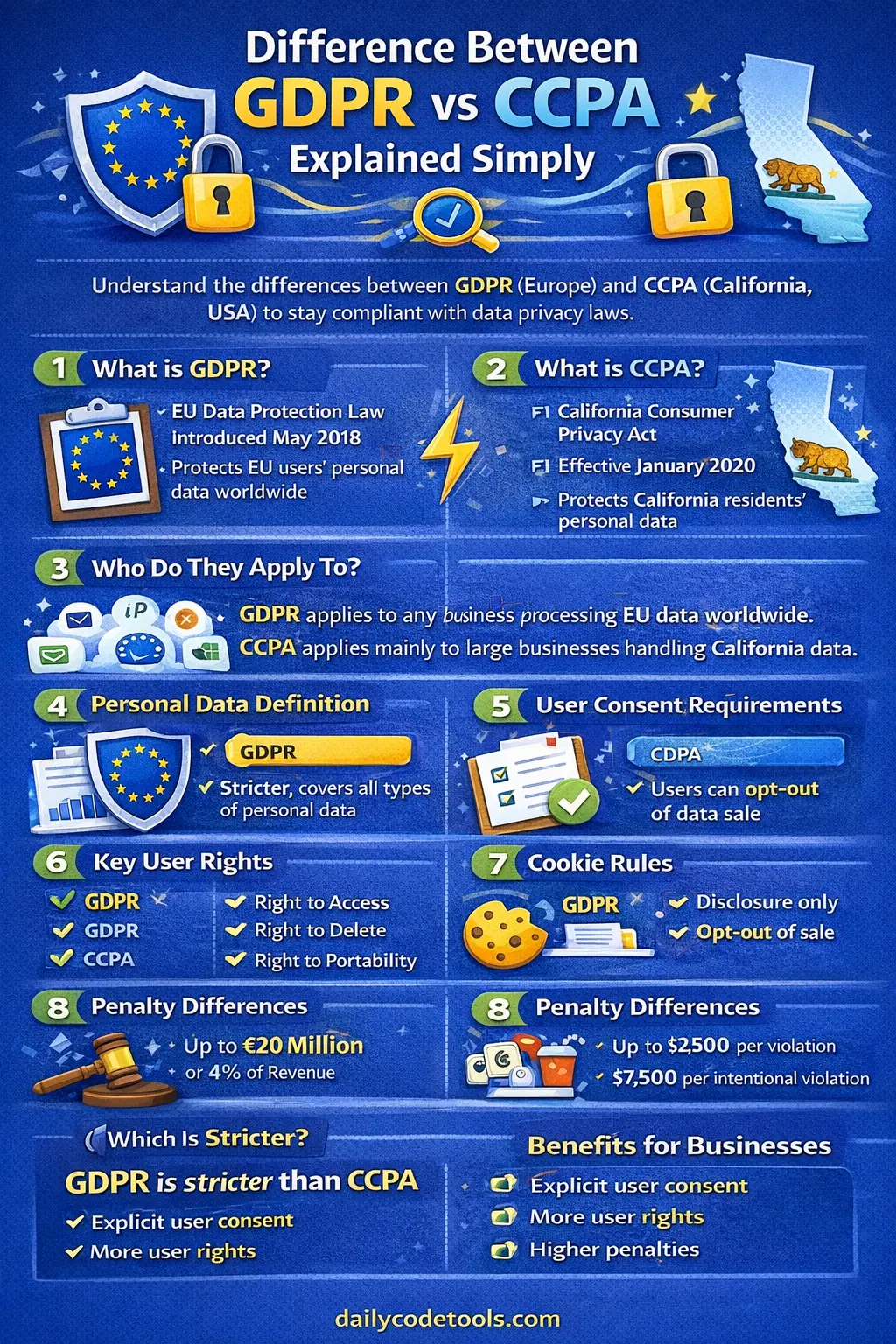
Difference Between GDPR and CCPA Explained Simply
Introduction
Online privacy has become one of the most important issues in the digital world.
Every time someone visits a website, creates an account, buys a product, downloads an application, subscribes to a newsletter, fills out a contact form, or interacts with an advertisement, some form of information may be collected or processed.
Businesses use this information for many legitimate purposes, including:
-
Providing products and services
-
Processing orders
-
Communicating with customers
-
Improving websites
-
Personalizing experiences
-
Preventing fraud
-
Measuring marketing performance
-
Providing customer support
-
Understanding how digital products are used
But collecting personal information also creates responsibility.
People want to know:
-
What information is being collected?
-
Why is it being collected?
-
Who receives it?
-
How long is it stored?
-
Is it being sold or shared?
-
Can users request deletion?
-
Can they stop certain uses of their information?
Governments and regulators around the world have introduced privacy laws to address these concerns.
Two of the most widely discussed privacy frameworks are:
GDPR — General Data Protection Regulation
and
CCPA — California Consumer Privacy Act
At first glance, they may appear similar because both give individuals greater control over personal information. However, they are not the same law, and they use different approaches in several important areas.
GDPR is an EU data protection regulation that has applied since 25 May 2018. It can apply to organizations outside the EU when they offer goods or services to people in the EU or monitor their behaviour there.
CCPA is a California privacy law. The California Attorney General describes it as giving California consumers rights including the right to know, delete, opt out of sale or sharing, correct inaccurate information, limit certain uses of sensitive personal information, and receive non-discriminatory treatment for exercising their rights.
For website owners, bloggers, SaaS companies, e-commerce businesses, agencies, marketers, and developers, understanding the difference between these laws is increasingly important.
In this complete guide, we will explain GDPR and CCPA in simple language.
You will learn:
-
What GDPR is
-
What CCPA is
-
How their scopes differ
-
How they define personal information
-
The difference between consent and opt-out rights
-
User rights under each law
-
Cookie and tracking considerations
-
Privacy policy requirements
-
Data deletion rules
-
Sensitive personal information
-
Data selling and sharing
-
Penalties
-
Practical compliance steps
-
GDPR vs CCPA comparison
-
Common misconceptions
-
FAQs
Important: This article is for general educational purposes and is not legal advice. Whether GDPR, CCPA, or another privacy law applies depends on your business, activities, customers, data processing practices, and other facts.
1. What Is GDPR?
GDPR stands for General Data Protection Regulation.
It is the European Union's major data protection regulation.
The official regulation is known as Regulation (EU) 2016/679.
Although GDPR entered into force in 2016, it has applied since 25 May 2018.
The main objective of GDPR is to protect individuals when their personal data is processed and to give people meaningful rights and control over information relating to them.
GDPR is built around principles such as:
-
Lawfulness
-
Fairness
-
Transparency
-
Purpose limitation
-
Data minimization
-
Accuracy
-
Storage limitation
-
Security
-
Accountability
The regulation also provides individuals with rights concerning their personal information.
These include:
-
Right to be informed
-
Right of access
-
Right to rectification
-
Right to erasure
-
Right to restrict processing
-
Right to data portability
-
Right to object
The European Commission confirms these rights and explains that organizations generally need to respond to rights requests without undue delay and at the latest within one month, subject to the rules and possible extensions.
2. What Is CCPA?
CCPA stands for California Consumer Privacy Act.
It is a California privacy law designed to give California consumers greater control over their personal information.
The CCPA came into effect in 2020.
The law was later significantly amended by the California Privacy Rights Act (CPRA), approved by California voters in November 2020.
The California Attorney General explains that CPRA amended the CCPA rather than creating an entirely separate privacy law. The amended framework added protections including the right to correct inaccurate personal information and the right to limit certain uses and disclosures of sensitive personal information.
Today, you will often see the framework described as:
CCPA, as amended by CPRA
or simply:
CCPA
The law gives qualifying California consumers rights relating to their personal information.
These include:
-
Right to know
-
Right to delete
-
Right to correct
-
Right to opt out of sale or sharing
-
Right to limit certain uses and disclosures of sensitive personal information
-
Right to non-discrimination
3. GDPR vs CCPA at a Glance
Before going into details, here is a simplified comparison.
| Feature | GDPR | CCPA |
|---|---|---|
| Region | European Union / EEA framework | California, USA |
| Main focus | Personal data protection | Consumer privacy and control |
| Effective | 25 May 2018 | 2020 |
| Scope | Broad, including certain organizations outside EU | Applies to qualifying businesses doing business in California |
| Legal framework | EU regulation | California state law |
| Consent | Important for some processing activities | Not generally a universal pre-collection requirement |
| Opt-out | Important for certain processing/marketing contexts | Major right for sale/sharing |
| Deletion | Right to erasure under conditions | Right to delete with exceptions |
| Correction | Right to rectification | Right to correct |
| Data portability | Yes, under conditions | Consumer rights include access and other disclosures |
| Sensitive data | Special category rules | Sensitive personal information rules |
| Enforcement | EU/EEA supervisory authorities | California privacy enforcement framework |
| Maximum fine framework | Up to €20M or 4% worldwide annual turnover for certain infringements | Penalties depend on the applicable CCPA provisions and violation circumstances |
This table provides a high-level overview. It should not be used as a substitute for a legal analysis of a particular business.
4. The Biggest Difference: Where the Laws Apply
One of the most important differences between GDPR and CCPA is their territorial scope.
GDPR
GDPR can apply to:
-
Organizations established in the EU that process personal data in connection with their activities.
-
Certain organizations outside the EU that offer goods or services to people in the EU.
-
Certain organizations outside the EU that monitor behaviour of people in the EU.
The European Commission specifically states that an SME outside the EU may still need to comply when its activities fall within GDPR's scope.
However, simply having a website that can technically be accessed from Europe does not automatically mean every website owner is subject to GDPR.
The actual activity matters.
For example, intentionally offering products or services to EU customers is very different from simply having a publicly accessible website.
5. CCPA Territorial Scope
CCPA works differently.
It applies to qualifying businesses that do business in California and meet the relevant statutory criteria.
According to the California Attorney General's current consumer guidance, the CCPA applies to for-profit businesses doing business in California that meet at least one of the listed thresholds, including:
-
Gross annual revenue above the statutory threshold
-
Buying, selling, or sharing personal information of at least 100,000 California residents or households
-
Deriving at least 50% of annual revenue from selling California residents' personal information
The official California source currently lists the revenue threshold as over $25 million.
This means a very small local business may not automatically be subject to all CCPA requirements simply because one California resident visits its website.
The business must be evaluated against the applicable requirements and thresholds.
6. GDPR Has a Broader Organizational Reach
GDPR can apply to organizations of different sizes.
A company does not escape GDPR simply because it has:
-
Five employees
-
Ten employees
-
One website
-
A small customer base
The European Commission specifically explains that SMEs processing personal data within GDPR's scope have to comply, although certain obligations may depend on factors such as the nature and risk of the processing.
For example, some small organizations may not be required to appoint a Data Protection Officer merely because GDPR applies to them.
The important distinction is:
GDPR applicability does not mean every GDPR obligation applies identically to every business.
7. What Is Personal Data Under GDPR?
GDPR uses a broad concept of personal data.
The European Commission defines personal data as information relating to an identified or identifiable living person. Different pieces of information can also become personal data when combined and capable of identifying someone.
Examples can include:
-
Name
-
Email address
-
Telephone number
-
Home address
-
Identification number
-
IP address
-
Location information
-
Online identifiers
-
Account information
-
Certain cookie identifiers
Pseudonymized information may still be personal data if re-identification is possible.
Truly anonymized information, where the person is no longer identifiable, is treated differently.
8. What Is Personal Information Under CCPA?
CCPA also has a broad definition of personal information.
It can include categories such as:
-
Identifiers
-
Commercial information
-
Internet or network activity
-
Geolocation information
-
Professional information
-
Inferences
-
Certain sensitive personal information
For example, information about a person's browsing activity can potentially fall within the law's definition.
The California framework also distinguishes personal information from certain categories of information that are excluded or regulated separately. The California Attorney General notes, for example, that certain publicly available government-record information is not considered personal information under the CCPA.
9. GDPR vs CCPA: Definition of Personal Information
Both laws cover much more than names and email addresses.
Consider a website visitor.
The website might collect:
Name
Email
IP Address
Device Information
Browser Information
Location
Pages Visited
Purchase History
Advertising Interactions
Some or all of this information may fall within privacy-law definitions depending on the circumstances.
The important difference is not simply:
"Which law covers more data?"
Instead, businesses should understand the specific definitions and rules that apply to each processing activity.
10. The Biggest Conceptual Difference: GDPR and Legal Bases
One of GDPR's defining features is the requirement for an appropriate legal basis for processing personal data.
GDPR provides several legal bases, including:
-
Consent
-
Contract
-
Legal obligation
-
Vital interests
-
Public task
-
Legitimate interests, where applicable
This means a business does not necessarily need consent for every processing activity.
For example, processing information needed to fulfill an order may be connected to a contract.
Keeping certain records may be necessary because of a legal obligation.
Other activities may rely on legitimate interests where the relevant requirements are satisfied.
Therefore, saying:
"GDPR means you must get consent for everything"
is incorrect.
11. GDPR Consent Requirements
When consent is used as the legal basis, GDPR has strict requirements.
Consent should be:
-
Freely given
-
Specific
-
Informed
-
Unambiguous
The European Commission explains that consent requests should be clear, understandable, distinguishable from other information, and explain the intended processing. People must also be able to withdraw consent.
For example:
☐ I agree to receive marketing emails.
is conceptually different from:
☑ I agree to receive marketing emails.
where the checkbox has already been selected.
However, consent is only one part of GDPR.
12. CCPA Does Not Use the Same Consent Model
CCPA is structured differently.
Generally, the CCPA does not require businesses to obtain universal prior consent before collecting personal information from adults.
Instead, it gives consumers specific rights, including the ability to opt out of the sale or sharing of personal information.
The California Attorney General explains that consumers can direct businesses to stop selling or sharing their personal information, including through a user-enabled Global Privacy Control where applicable.
This creates a major conceptual difference:
GDPR asks whether the processing has an appropriate legal basis.
CCPA gives consumers specific rights and controls, including opt-out rights for sale/sharing.
Therefore, describing GDPR as simply "opt-in" and CCPA as simply "opt-out" is too simplistic.
13. What Does "Sale" Mean Under CCPA?
The word "sale" can be confusing.
People often assume that a business must literally receive money in exchange for data.
Privacy laws can define sale more broadly than a simple cash transaction.
CCPA also separately addresses "sharing," including certain disclosures for cross-context behavioural advertising.
The California Attorney General explains that the CCPA opt-out right covers both sale and sharing, with sharing referring to certain cross-context behavioural advertising activity.
This is particularly important for websites using:
-
Advertising platforms
-
Retargeting
-
Behavioural advertising
-
Analytics integrations
-
Social media pixels
-
Marketing technology
A business should therefore evaluate how information moves between its website and advertising ecosystem.
14. GDPR vs CCPA: User Rights
Both laws provide significant consumer or individual rights.
But the rights are structured differently.
GDPR Rights
GDPR includes:
-
Right to be informed
-
Right of access
-
Right to rectification
-
Right to erasure
-
Right to restriction
-
Right to data portability
-
Right to object
Certain rules also address automated decision-making and profiling.
15. CCPA Consumer Rights
Under the current CCPA framework, California consumers may have rights including:
-
Right to know
-
Right to delete
-
Right to correct
-
Right to opt out of sale or sharing
-
Right to limit certain uses and disclosures of sensitive personal information
-
Right to non-discrimination
This is important because older articles often describe CCPA using only three rights:
-
Know
-
Delete
-
Opt out
That description is now incomplete.
The law has evolved.
16. Right to Know: GDPR vs CCPA
Both frameworks provide transparency and access-related rights, but the details differ.
Under GDPR, individuals can request access to their personal data and information about processing.
Under CCPA, California consumers can request information about what personal information a business collects and how it is used and shared.
The California Attorney General explains that CCPA requests can cover categories and/or specific pieces of personal information, sources, purposes, and categories of third parties with whom information is disclosed.
17. Right to Delete
Both GDPR and CCPA provide deletion-related rights.
But neither should be described as:
"Users can always delete everything immediately."
There are exceptions.
Under GDPR, the right to erasure is subject to specific conditions and exceptions.
Under CCPA, consumers can request deletion, but businesses may retain certain information when statutory exceptions apply.
For example, businesses may need to keep certain records to:
-
Comply with legal obligations
-
Complete transactions
-
Detect security incidents
-
Exercise legal rights
-
Fulfill other legally permitted purposes
Therefore, deletion workflows should include an exception review.
18. Right to Correct
GDPR provides a right to rectification.
This means individuals can request correction of inaccurate or incomplete personal data.
CCPA, as amended by CPRA, also provides California consumers with a right to correct inaccurate personal information.
For businesses, this means customer databases should ideally support controlled updates.
19. Sensitive Data Under GDPR
GDPR provides additional protection for certain categories of personal data.
These include:
-
Health data
-
Genetic data
-
Biometric data used for unique identification
-
Religious beliefs
-
Political opinions
-
Trade union membership
-
Racial or ethnic origin
-
Information concerning sex life or sexual orientation
Processing such data is subject to additional requirements.
Businesses should therefore avoid collecting sensitive information unless there is a genuine business and legal reason.
20. Sensitive Personal Information Under CCPA
CCPA also recognizes a category called sensitive personal information.
Depending on the circumstances, it can include information such as:
-
Government identifiers
-
Financial account information
-
Precise geolocation
-
Certain login information
-
Genetic data
-
Certain health information
-
Racial or ethnic origin
-
Religious or philosophical beliefs
-
Union membership
-
Certain contents of communications
The CCPA gives consumers a right to limit certain uses and disclosures of sensitive personal information.
This is an important area where current CCPA comparisons differ from older descriptions of the law.
21. GDPR vs CCPA: Cookies
Cookies are one of the most confusing areas for website owners.
A cookie can be used for:
-
Essential website functionality
-
Login sessions
-
Analytics
-
Personalization
-
Advertising
-
Tracking
The privacy requirements depend on what the cookie does and which laws apply.
For GDPR-covered processing, businesses may need a lawful basis and, depending on the technology and applicable rules, consent before certain non-essential tracking technologies are used.
There are also separate ePrivacy rules that can affect cookies and similar technologies.
Therefore:
GDPR compliance cannot be reduced to simply adding a cookie banner.
22. Does CCPA Require Cookie Consent?
CCPA and GDPR do not use identical cookie-consent models.
CCPA focuses heavily on transparency and consumer rights, particularly around sale and sharing.
A California-focused website may therefore have different requirements from an EU-focused website.
However, if a website serves people in multiple jurisdictions, it may need to build a privacy and consent system capable of handling different legal requirements.
23. Global Privacy Control and CCPA
One modern CCPA issue website owners should understand is Global Privacy Control (GPC).
GPC is a browser or user signal that can communicate a consumer's privacy preference.
The California Attorney General explains that consumers can use a user-enabled global privacy control to exercise the right to opt out of sale or sharing.
This means businesses cannot always think only in terms of a visible:
"Do Not Sell or Share My Personal Information"
link.
They may also need to consider applicable automated signals.
24. Privacy Policy: GDPR vs CCPA
Both laws require transparency, but the information and format requirements are different.
A GDPR privacy notice may need to explain:
-
Identity of the controller
-
Purposes of processing
-
Categories of personal data
-
Legal basis
-
Retention period
-
Recipients
-
International transfers
-
Individual rights
-
Complaint rights
-
Automated decision-making where applicable
The European Commission emphasizes that GDPR information should be concise, transparent, intelligible, accessible, and written in clear language.
25. CCPA Privacy Policy
A business subject to CCPA must provide information about its privacy practices and consumer rights.
The California Attorney General explains that privacy policies must address relevant CCPA rights and explain how consumers can exercise them.
A CCPA-focused privacy policy may discuss:
-
Categories of personal information collected
-
Sources
-
Business or commercial purposes
-
Categories of third parties
-
Sale or sharing
-
Consumer rights
-
How consumers can submit requests
-
Opt-out mechanisms
-
Sensitive personal information practices
26. GDPR vs CCPA: Data Minimization
Data minimization is a central GDPR principle.
The idea is simple:
Don't collect more personal data than you need.
For example, a newsletter subscription may require:
Email Address
It may not require:
Home Address
Date of Birth
Government ID
Phone Number
unless there is a genuine purpose and appropriate basis.
CCPA does not use exactly the same seven-principle framework as GDPR, but data practices under CCPA still need to be evaluated against the law's requirements and disclosures.
27. GDPR and Storage Limitation
GDPR explicitly includes a storage limitation principle.
Personal data should not be kept longer than necessary for the purposes for which it is processed, subject to applicable legal requirements.
The European Commission lists storage limitation among GDPR's core principles.
This means businesses should periodically review old data.
Ask:
-
Do we still need it?
-
Is there a legal reason to retain it?
-
Can it be deleted?
-
Can it be anonymized?
28. CCPA and Data Retention
CCPA also contains requirements concerning disclosure of retention practices and prohibits retaining certain personal information longer than reasonably necessary for disclosed purposes under the applicable framework.
For businesses, the practical lesson is similar:
Don't build a database where every piece of customer information is stored forever without a clear reason.
Create retention practices based on:
-
Business needs
-
Legal requirements
-
Security
-
Privacy obligations
29. GDPR vs CCPA: Third-Party Services
Modern websites rarely operate alone.
A typical website may use:
-
Hosting
-
Cloud storage
-
Analytics
-
Email marketing
-
CRM
-
Payment processing
-
Advertising
-
Customer support
-
Security services
This creates a chain of data processing.
For example:
Visitor
   ↓
Website
   ↓
Analytics
   ↓
CRM
   ↓
Email Platform
   ↓
Advertising Platform
Each service should be evaluated.
30. GDPR: Controllers and Processors
GDPR distinguishes between roles such as:
Controller
The organization deciding why and how personal data is processed.
Processor
An organization processing personal data on behalf of a controller.
For example, an online store may decide why customer data is processed, while a cloud service provider may process information on the store's behalf.
These roles create different responsibilities.
31. CCPA: Service Providers and Contractors
CCPA uses its own terminology and contractual concepts, including service providers and contractors.
Businesses should understand how third-party relationships are classified under the applicable law.
This matters because privacy obligations can depend on:
-
What information is shared
-
Why it is shared
-
What the recipient can do with it
-
Contractual restrictions
-
Whether the information is sold or shared
Simply labeling every vendor a "service provider" does not automatically make the relationship compliant.
32. GDPR vs CCPA: Data Breaches
Data security is important under both privacy frameworks.
A business should have reasonable safeguards appropriate to its risks.
Basic security practices include:
-
HTTPS
-
Strong passwords
-
MFA
-
Access controls
-
Encryption where appropriate
-
Secure backups
-
Software updates
-
Employee training
-
Monitoring
-
Incident response
However, the legal obligations following a breach differ between jurisdictions.
Businesses serving multiple markets should understand the notification rules that apply to each relevant law.
33. GDPR Penalties
GDPR has a significant enforcement framework.
For certain infringements, administrative fines can reach:
€20 million
or
4% of total worldwide annual turnover
whichever is higher, depending on the relevant provision.
These are maximum statutory levels, not automatic penalties for every violation.
Regulators consider the circumstances of the infringement.
Other enforcement measures can include warnings, reprimands, and restrictions or bans on processing.
34. CCPA Penalties
CCPA has its own enforcement and penalty framework.
The amount and consequences can depend on:
-
Type of violation
-
Whether it was intentional
-
Applicable statutory provisions
-
Number and circumstances of violations
-
Enforcement authority involved
Therefore, saying simply:
"CCPA has lower fines than GDPR"
does not provide a complete legal comparison.
A better way to understand the difference is:
GDPR and CCPA have different enforcement structures and penalty provisions.
Businesses should examine the specific requirements applicable to their circumstances.
35. Is GDPR Stricter Than CCPA?
This is one of the most common questions.
There is no single answer that applies to every possible situation.
GDPR has:
-
A comprehensive legal-basis framework
-
Broad individual rights
-
Data minimization
-
Storage limitation
-
Accountability requirements
-
Specific rules around consent
-
Special-category data rules
-
International transfer rules
CCPA focuses strongly on:
-
Consumer transparency
-
Access/know rights
-
Deletion
-
Correction
-
Sale and sharing opt-outs
-
Sensitive personal information
-
Non-discrimination
So rather than saying:
"GDPR is simply a stronger version of CCPA."
it is more accurate to say:
They are different privacy frameworks with overlapping goals but different scopes, concepts, rights, and obligations.
36. Does GDPR Automatically Make You CCPA Compliant?
No.
This is a very important misconception.
A business may have strong GDPR practices and still need to review CCPA-specific requirements.
For example, CCPA includes specific concepts around:
-
Sale
-
Sharing
-
Global Privacy Control
-
Sensitive personal information
-
California consumer rights
-
Statutory notices
A GDPR program may not automatically address every one of these requirements.
Similarly, CCPA compliance does not automatically make an organization GDPR compliant.
37. Can a Business Need Both GDPR and CCPA?
Yes.
A company can potentially fall within both frameworks.
For example, imagine an international SaaS company that:
-
Has customers in the EU
-
Has customers in California
-
Uses behavioral advertising
-
Processes customer accounts
-
Uses analytics
-
Stores customer information in cloud systems
Depending on the facts, the company may need to consider:
-
GDPR
-
CCPA
-
Other US state privacy laws
-
Cookie/ePrivacy rules
-
Sector-specific laws
-
Contractual obligations
This is why international privacy compliance often requires a broader data governance strategy.
38. One Privacy Program Can Support Multiple Laws
Businesses serving multiple markets do not necessarily need completely separate systems for every jurisdiction.
Instead, they can build a strong privacy foundation.
For example:
Data Inventory
      ↓
Data Mapping
      ↓
Privacy Notice
      ↓
Consent Management
      ↓
User Rights System
      ↓
Security Controls
      ↓
Retention Policy
      ↓
Vendor Management
Then jurisdiction-specific rules can be layered on top.
39. GDPR vs CCPA for Small Businesses
Small businesses should avoid assuming that one law automatically applies.
Instead, ask:
Question 1
Where is the business located?
Question 2
Where are the customers?
Question 3
What personal information is collected?
Question 4
How is that information used?
Question 5
Is it sold or shared?
Question 6
Which third parties receive it?
Question 7
What advertising technologies are used?
Question 8
What is the company's size and business model?
Question 9
Does the business meet CCPA applicability thresholds?
Question 10
Does the business fall within GDPR's territorial scope?
These questions provide a much better starting point than simply asking:
"Do I have a privacy policy?"
40. GDPR vs CCPA for Bloggers
Bloggers may collect personal information through:
-
Newsletter forms
-
Contact forms
-
Comments
-
Analytics
-
Advertising
-
Social media embeds
-
Affiliate platforms
A blog owner should create a data inventory.
For example:
| Tool | Data | Purpose |
|---|---|---|
| Newsletter | Email communication | |
| Analytics | Usage data | Website measurement |
| Contact form | Name/email/message | Communication |
| Advertising | Tracking information | Advertising |
| Comments | Name/email/comment | Discussion |
Then evaluate the relevant legal requirements.
41. GDPR vs CCPA for E-Commerce Stores
E-commerce websites can process large amounts of personal information.
Typical information includes:
-
Name
-
Email
-
Shipping address
-
Billing information
-
Order history
-
Account information
-
Support conversations
-
Marketing preferences
An e-commerce business should map the customer journey.
Customer
   ↓
Store
   ↓
Payment Provider
   ↓
Order System
   ↓
Shipping Provider
   ↓
Customer Support
Each step may involve a different vendor or processing purpose.
42. GDPR vs CCPA for SaaS Companies
SaaS businesses often have complex privacy requirements.
They may process:
-
Account information
-
User activity
-
Customer content
-
IP addresses
-
Logs
-
Billing information
-
Support tickets
-
API data
A SaaS company may also have different roles depending on the processing activity.
For example, it may act as a controller for its own customer relationship information while acting as a processor/service provider for certain customer-controlled data.
This makes contracts and data mapping particularly important.
43. GDPR vs CCPA for Developers
Developers often implement the systems that privacy teams rely on.
A developer may need to build:
-
Cookie controls
-
Consent management
-
Data deletion
-
Data export
-
Account settings
-
Privacy dashboards
-
Access controls
-
Audit logs
-
Security systems
For example:
User Requests Data
        ↓
Identity Verification
        ↓
Find User Records
        ↓
Collect Eligible Data
        ↓
Review Exceptions
        ↓
Generate Export
        ↓
Send Securely
Technical implementation should reflect the actual legal requirements determined by the business.
44. Common GDPR and CCPA Mistakes
Mistake 1: Copying a Privacy Policy
A copied privacy policy may not describe your actual data practices.
Mistake 2: Assuming a Cookie Banner Solves Everything
A banner does not automatically solve legal-basis, retention, vendor, security, or rights issues.
Mistake 3: Collecting Too Much Information
Only collect information that has a legitimate purpose.
Mistake 4: Ignoring Third-Party Services
Analytics, advertising, hosting, and CRM platforms can all affect your privacy obligations.
Mistake 5: Assuming GDPR Equals Consent for Everything
GDPR provides multiple legal bases.
Mistake 6: Assuming CCPA Equals "Do Not Sell"
CCPA provides several additional rights beyond sale opt-out.
Mistake 7: Using Outdated CCPA Information
Older articles may not include CPRA-related rights such as correction and limits concerning sensitive personal information.
Mistake 8: Assuming California Visitors Automatically Trigger CCPA
CCPA applicability depends on the statutory requirements, not merely on having a random California visitor.
Mistake 9: Assuming EU Visitors Automatically Trigger GDPR
GDPR territorial scope requires a proper assessment of the organization's activities and circumstances.
Mistake 10: Ignoring Data Retention
Keeping everything forever can create unnecessary privacy and security risks.
45. A Practical Compliance Strategy
If you are building a website for a global audience, consider the following workflow.
Step 1: Identify Your Users
Determine where your customers or visitors are located.
Step 2: Map Your Data
Create a list of everything you collect.
Name
Email
Phone
IP Address
Location
Purchase History
Cookies
Account Data
Support Messages
Step 3: Identify Purposes
For each data type, ask:
Why do we collect this?
Step 4: Identify Vendors
List:
-
Hosting
-
Analytics
-
CRM
-
Email
-
Payment
-
Advertising
-
Customer support
Step 5: Review Legal Requirements
Determine which privacy laws apply.
Step 6: Build User Controls
Depending on the applicable laws, provide appropriate mechanisms for:
-
Access
-
Deletion
-
Correction
-
Opt-out
-
Consent withdrawal
-
Data portability
-
Other relevant rights
Step 7: Improve Security
Implement:
-
MFA
-
Strong authentication
-
Access control
-
HTTPS
-
Encryption where appropriate
-
Secure backups
-
Monitoring
Step 8: Review Regularly
Privacy compliance is not a one-time task.
Your website changes.
Your vendors change.
Your analytics tools change.
Your marketing strategy changes.
Your customers change.
Therefore, your privacy documentation and controls should be reviewed periodically.
46. GDPR vs CCPA Decision Checklist
Use these questions to understand your starting point.
GDPR
-
Is our organization established in the EU?
-
Do we offer goods/services to people in the EU?
-
Do we monitor behaviour of people in the EU?
-
What personal data do we process?
-
What legal basis applies?
-
Do we use consent?
-
Do we process sensitive data?
-
Do we transfer data internationally?
CCPA
-
Do we do business in California?
-
Are we a business covered by the CCPA?
-
Do we meet the applicable statutory thresholds?
-
What California consumer information do we process?
-
Do we sell or share personal information?
-
Do we process sensitive personal information?
-
Do we provide required notices?
-
Can consumers exercise applicable rights?
47. GDPR vs CCPA Comparison Table
| Category | GDPR | CCPA |
|---|---|---|
| Full Name | General Data Protection Regulation | California Consumer Privacy Act |
| Jurisdiction | EU/EEA framework | California |
| Main Focus | Protection and processing of personal data | California consumer privacy |
| Territorial Reach | Can apply outside EU in defined circumstances | Applies to qualifying businesses doing business in California |
| Effective Date | 25 May 2018 | 2020 |
| Legal Basis | Multiple legal bases required for processing | Different framework; no universal GDPR-style legal-basis requirement |
| Consent | Important for consent-based processing | Not generally required for all collection |
| Opt-Out | Applies in relevant contexts | Major right for sale/sharing |
| Access | Yes | Yes |
| Deletion | Yes, subject to conditions | Yes, subject to exceptions |
| Correction | Yes | Yes |
| Data Portability | Yes, under conditions | Consumer access rights include specific disclosure requirements |
| Sensitive Data | Special category data | Sensitive personal information |
| Marketing | Subject to GDPR legal basis and other applicable rules | Subject to CCPA and other applicable laws |
| Cookies | Must consider GDPR/ePrivacy requirements | Different approach; sale/sharing and privacy rules matter |
| Privacy Notice | Detailed transparency requirements | CCPA-specific notice requirements |
| Enforcement | EU/EEA supervisory authorities | California enforcement framework |
| Maximum Fine Framework | Up to €20M or 4% global annual turnover for certain infringements | Depends on applicable statutory provisions |
| Scope for Small Business | Can apply | Thresholds and statutory scope matter |
48. Which Law Should Your Website Follow?
There is no universal answer.
It depends on:
-
Business location
-
Customer location
-
Business model
-
Data collected
-
Processing activities
-
Advertising model
-
Company size
-
Applicable statutory thresholds
-
Third-party tools
-
International operations
A business serving only local customers may have a very different privacy profile from a global SaaS company.
49. What If Your Website Has a Global Audience?
If your website serves users internationally, consider creating a privacy architecture capable of handling multiple jurisdictions.
For example:
Global Website
      ↓
User Location / Applicable Rules
      ↓
Privacy Notice
      ↓
Consent / Preference Controls
      ↓
Data Processing
      ↓
Rights Management
This does not mean automatically applying every legal requirement from every country.
Instead, it means building systems that can adapt to applicable requirements.
50. Should You Follow GDPR-Level Privacy Standards?
Some businesses voluntarily adopt privacy practices that are stronger or broader than the minimum requirement for one market.
This can simplify internal processes.
For example, a company may create:
-
Strong data minimization
-
Detailed privacy notices
-
Comprehensive data rights tools
-
Robust security
-
Centralized consent management
However, businesses should not assume that one framework automatically satisfies every other law.
A global privacy program still needs jurisdiction-specific review.
51. Why Privacy-by-Design Matters
The easiest time to address privacy is during product development.
Suppose you are building a new application.
Instead of:
Collect Everything
        ↓
Store Forever
        ↓
Figure Out Privacy Later
consider:
Define Purpose
        ↓
Collect Necessary Data
        ↓
Protect Data
        ↓
Limit Access
        ↓
Define Retention
        ↓
Provide User Controls
This can reduce both technical and compliance complexity.
52. Simple Example: Newsletter Website
Imagine a small website with a newsletter.
It collects:
Email Address
Name
It uses:
-
Email marketing software
-
Analytics
-
Advertising
-
Cookies
A privacy review should ask:
GDPR
-
What is the legal basis?
-
Is newsletter consent required for this use?
-
What cookies are being used?
-
What information is provided to subscribers?
-
Which vendor processes subscriber information?
-
How can users withdraw consent?
CCPA
If the business is covered:
-
What categories of information are collected?
-
What is disclosed?
-
Is information sold or shared?
-
Is cross-context behavioral advertising involved?
-
What consumer rights apply?
-
How can consumers submit requests?
The same website can therefore require different analysis under each framework.
53. Simple Example: Online Store
Suppose an online store collects:
Name
Email
Shipping Address
Billing Information
Order History
The store uses:
-
Payment provider
-
Shipping provider
-
CRM
-
Analytics
-
Email marketing
Under GDPR, the store needs to evaluate the legal basis and principles applicable to each processing activity.
Under CCPA, if the business is covered, it must consider the California-specific rights, notices, sale/sharing rules, sensitive personal information requirements, and other obligations.
This demonstrates why privacy compliance is about data flows, not simply websites.
54. Frequently Asked Questions
Is GDPR the same as CCPA?
No.
Both are privacy laws, but they were created by different jurisdictions and have different scopes, definitions, rights, and compliance requirements.
Which came first: GDPR or CCPA?
GDPR began applying on 25 May 2018.
CCPA became effective in 2020.
Is GDPR only for European companies?
No.
GDPR can apply to organizations outside the EU in certain circumstances, including when they offer goods or services to people in the EU or monitor their behaviour there.
Is CCPA only for companies located in California?
Not necessarily.
The CCPA can apply to qualifying businesses that do business in California and meet the applicable statutory criteria.
Does every small business have to follow CCPA?
Not automatically.
The CCPA's applicability depends on the statutory scope and thresholds.
The California Attorney General currently lists specific thresholds including revenue and the volume or source of California consumers' personal information.
Does GDPR require consent for everything?
No.
GDPR provides multiple legal bases for processing.
Consent is only one of them.
Does CCPA require consent before collecting data?
CCPA does not use a universal GDPR-style prior-consent model for all collection.
It gives consumers specific rights, including the right to opt out of sale or sharing.
Does CCPA have a right to delete?
Yes.
California consumers can request deletion of personal information, subject to statutory exceptions.
Does CCPA have a right to correct?
Yes.
The current CCPA framework includes a right to correct inaccurate personal information.
Does GDPR have a right to delete?
Yes.
GDPR includes the right to erasure, but it is subject to conditions and exceptions.
What is the difference between GDPR deletion and CCPA deletion?
Both provide deletion rights, but their legal rules, exceptions, procedures, and terminology differ.
A business should implement separate jurisdiction-aware procedures rather than assuming one deletion process automatically satisfies both laws.
Does CCPA cover sensitive information?
Yes.
CCPA includes rules concerning sensitive personal information and gives consumers a right to limit certain uses and disclosures.
Does GDPR protect sensitive information?
Yes.
GDPR provides special rules for certain special categories of personal data.
Does GDPR require a cookie banner?
The answer depends on the cookies and technologies being used and the applicable legal requirements.
A generic cookie banner is not itself proof of GDPR compliance.
Does CCPA require a cookie banner?
CCPA does not simply mirror the GDPR cookie-consent model.
The business should assess what its cookies and tracking technologies do and whether they involve practices covered by CCPA or other applicable laws.
Can a website be subject to both GDPR and CCPA?
Yes.
A global business may potentially fall within both frameworks.
Does GDPR compliance automatically mean CCPA compliance?
No.
There is overlap, but CCPA contains specific California requirements.
Does CCPA compliance automatically mean GDPR compliance?
No.
GDPR has its own legal-basis, transparency, security, rights, international-transfer, and accountability requirements.
Is GDPR stricter than CCPA?
The two laws have different structures and should not be reduced to a simple "strict vs weak" comparison.
GDPR has a broad data-protection framework, while CCPA focuses strongly on California consumer rights, transparency, sale/sharing controls, and related privacy obligations.
What is CPRA?
CPRA stands for California Privacy Rights Act.
It amended the CCPA and added or strengthened several privacy protections.
The California Attorney General notes that CPRA amended the CCPA rather than creating a separate new law.
What is the difference between CCPA and CPRA?
CCPA is the underlying California privacy law.
CPRA amended it.
Therefore, current discussions often refer to:
CCPA as amended by CPRA.
What is Global Privacy Control?
Global Privacy Control, or GPC, is a browser/user-enabled signal that can communicate a privacy preference.
California's Attorney General explains that it can be used for applicable opt-out rights concerning sale or sharing.
55. Final GDPR vs CCPA Checklist
If you operate a website or online business, use this checklist as a starting point.
GDPR Review
-
Identify whether GDPR applies
-
Map personal data
-
Identify processing purposes
-
Identify legal bases
-
Review consent mechanisms
-
Review privacy notices
-
Review cookies and tracking
-
Review data retention
-
Review user-rights procedures
-
Review security
-
Review third-party processors
-
Review international transfers
CCPA Review
-
Determine whether the business is covered
-
Check applicable thresholds
-
Identify California consumer information
-
Review privacy notices
-
Review right-to-know procedures
-
Review deletion procedures
-
Review correction procedures
-
Review sale/sharing practices
-
Review opt-out mechanisms
-
Consider Global Privacy Control requirements
-
Review sensitive personal information
-
Review non-discrimination requirements
Conclusion
GDPR and CCPA are two of the most important privacy frameworks for modern digital businesses, but they are not interchangeable.
GDPR is an EU data protection regulation with a broad framework governing the processing of personal data. It includes principles such as data minimization, purpose limitation, storage limitation, transparency, security, and accountability, along with extensive individual rights.
CCPA is California's privacy law, as amended by CPRA, and provides qualifying California consumers with rights including access to information, deletion, correction, opting out of sale or sharing, limiting certain uses of sensitive personal information, and protection against discrimination for exercising privacy rights.
The biggest mistake businesses can make is treating privacy compliance as a single checkbox.
Privacy is not simply:
Add Privacy Policy
        ↓
Done
A better approach is:
Understand Your Data
        ↓
Understand Your Users
        ↓
Identify Applicable Laws
        ↓
Map Data Processing
        ↓
Create Appropriate Privacy Notices
        ↓
Implement User Controls
        ↓
Secure Personal Information
        ↓
Manage Vendors
        ↓
Control Retention
        ↓
Review Regularly
If your business operates internationally, it may need to consider GDPR, CCPA, and other privacy laws at the same time.
The good news is that many privacy practices overlap.
A strong privacy program can include:
-
Data minimization
-
Clear transparency
-
Strong security
-
Proper retention
-
User rights management
-
Vendor management
-
Privacy-friendly product design
-
Appropriate consent and preference controls
However, overlap does not mean equivalence.
GDPR compliance does not automatically equal CCPA compliance, and CCPA compliance does not automatically equal GDPR compliance.
The best approach is to understand where the laws overlap, identify where they differ, and then build privacy processes that reflect the actual laws applicable to your business.
For website owners, developers, bloggers, e-commerce businesses, SaaS companies, and marketers, understanding these differences is an important step toward building more transparent and privacy-conscious digital products.
Final reminder: Privacy laws change, regulatory guidance evolves, and applicability depends on the specific facts of a business. Use this article as an educational starting point and obtain qualified legal advice when you need a determination about your specific compliance obligations.
Your email address will not be published. Comments are moderated.
0 Comments on This Post
Leave a Reply
Comments (0)
Spread the Word!
Join Our Developer Community!
Get weekly coding tips, tool updates, and exclusive tutorials straight to your inbox.
Request a Tool
×