JSON to SQL Conversion Explained for Beginners (Complete Tutorial)
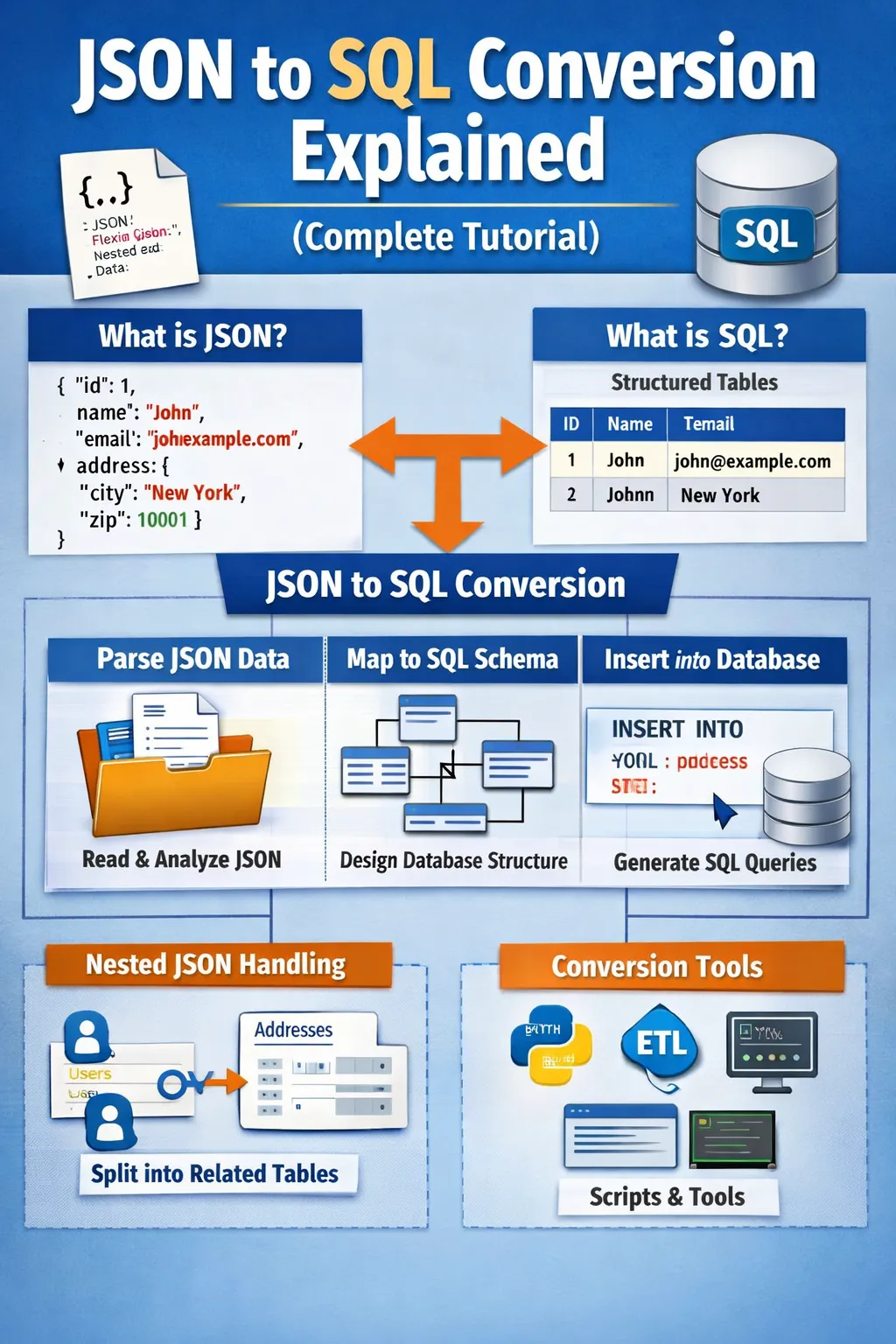
In today’s data-driven world, applications constantly exchange information between systems, databases, and web services. One of the most common formats used to transfer data across applications is JSON. At the same time, relational databases powered by SQL remain one of the most reliable and widely used methods for storing structured data.
Because of this, developers frequently encounter situations where they must convert JSON data into SQL format so that it can be stored and processed inside relational databases. This process is known as JSON to SQL conversion.
If you are new to databases or backend development, understanding how JSON data can be transformed into SQL tables and queries is an essential skill. This complete beginner tutorial will explain everything you need to know about JSON to SQL conversion, including how it works, why it is important, common methods used by developers, real-world examples, challenges you may encounter, and best practices to follow.
By the end of this guide, you will clearly understand how JSON data can be converted into structured SQL queries and database tables.
Understanding JSON
JSON stands for JavaScript Object Notation. It is a lightweight and flexible data format used for storing and exchanging information between systems. JSON is widely used in web applications, APIs, mobile apps, and modern software systems because it is easy to read, simple to write, and supported by almost every programming language.
JSON organizes data using key-value pairs. Each piece of information is stored as a key and its corresponding value. This structure makes JSON easy to understand and easy for machines to process.
A typical JSON object might contain information such as a user's name, email address, and age. Each of these fields is represented as a key with an associated value. JSON can also include nested objects and arrays, which allow developers to represent complex relationships within the data.
For example, a user object might contain an address object inside it, which includes fields such as city, country, and postal code. JSON can also store lists of items, such as multiple products in an order or multiple users in a system.
This flexibility is one of the biggest advantages of JSON. However, it also introduces challenges when trying to store the same data inside relational databases.
Understanding SQL and Relational Databases
SQL stands for Structured Query Language. It is the standard language used to interact with relational database systems. Unlike JSON, which allows flexible and nested data structures, SQL databases require a structured schema that defines exactly how the data should be organized.
Relational databases store data in tables. Each table contains rows and columns. A row represents a single record, while each column represents a specific field of information within that record.
For example, a table storing user data might contain columns such as user ID, name, email address, and registration date. Each user in the system would be stored as a separate row in the table.
SQL provides commands that allow developers to insert data, retrieve information, update records, and delete entries. It also supports powerful features such as joins, indexing, filtering, and aggregation.
Some of the most widely used SQL database systems include MySQL, PostgreSQL, Microsoft SQL Server, Oracle Database, and SQLite. These databases are used in applications ranging from small websites to large enterprise systems.
Why JSON to SQL Conversion Is Important
Modern applications often rely on APIs and external services to gather data. Most APIs deliver their responses in JSON format because it is lightweight and easy to parse. However, applications that store data in relational databases must convert this JSON information into SQL queries before inserting it into database tables.
This makes JSON to SQL conversion an essential step in many development workflows.
One common use case involves storing API responses in a database. For example, an application might retrieve product data from an external API. The API returns the product information as JSON. In order to store this information in a database for later use, the JSON data must be converted into SQL insert queries.
Another situation where JSON to SQL conversion is necessary is during data migration. Companies sometimes move their data from document-based storage systems or JSON files into relational databases. This migration process requires converting the JSON records into SQL table structures.
Data analysis is another major reason for converting JSON into SQL. Analysts often prefer working with relational databases because SQL queries make it easy to filter, sort, and analyze large datasets. If the data originates from JSON logs or API responses, it must first be transformed into structured database tables.
Key Differences Between JSON and SQL Data Structures
One of the main reasons JSON to SQL conversion is required is that these two formats are designed differently.
JSON uses a hierarchical structure. It allows nested objects, arrays, and flexible schemas. This means that different JSON records may contain different fields, and the structure can vary between documents.
SQL databases, on the other hand, require a predefined schema. Each table has a fixed set of columns, and every record must follow the same structure.
Because of this difference, developers must carefully design SQL tables that can represent the structure of JSON data. In some cases, nested JSON objects must be separated into multiple related tables in order to preserve the relationships between the data elements.
How JSON to SQL Conversion Works
The process of converting JSON to SQL generally follows several steps. The first step is loading or reading the JSON data. This may come from a file, an API response, or a data stream.
Once the JSON data has been loaded, the next step is parsing the data. Parsing means interpreting the JSON structure so that the program can access individual keys and values.
After parsing the JSON data, the developer must analyze the structure and determine how it should map to SQL tables. Each JSON object may correspond to a row in a database table, while the keys within the object may become columns.
If the JSON data contains nested objects or arrays, additional tables may need to be created to represent those relationships. These tables are connected using foreign keys so that the relational structure of the database reflects the hierarchy of the original JSON data.
Once the database schema has been designed, SQL queries are generated to insert the JSON data into the tables. Each JSON record is converted into an SQL insert statement that stores the values in the corresponding columns.
Simple JSON to SQL Conversion Example
Consider a simple JSON object that contains user information. The object includes fields such as ID, name, email, and age.
To store this information in a relational database, a table must first be created with columns that match these fields. Once the table exists, the JSON values can be inserted into the database using SQL queries.
Each JSON object becomes a single row in the table. If the JSON file contains multiple user objects, multiple SQL insert queries will be generated to store each record.
This is the simplest form of JSON to SQL conversion and is commonly used when working with flat JSON structures that do not contain nested objects.
Handling JSON Arrays
Many JSON documents contain arrays that represent lists of records. For example, an API might return a list of users, products, or orders.
When converting JSON arrays to SQL, each object inside the array typically becomes a separate row in the database table. The conversion process iterates through each element in the array and generates an SQL insert query for that element.
This approach allows developers to store multiple records efficiently within relational tables.
Handling Nested JSON Data
Nested JSON structures are more complex because relational databases do not support nested objects directly. Instead, nested data must be separated into different tables that are linked using relationships.
For example, a JSON object representing a user might contain an embedded address object. In a relational database, the user information would be stored in one table, while the address information would be stored in another table. The address table would include a foreign key referencing the user ID so that the relationship between the two records is preserved.
This process is known as normalization, and it is a common practice in relational database design.
Methods for Converting JSON to SQL
There are several different methods developers use to convert JSON data into SQL queries.
One of the simplest methods is manual conversion. For small datasets, developers can manually read the JSON data and write SQL insert queries that match the structure of the database. While this method works for small examples, it becomes impractical for large datasets.
A more common method is using programming languages such as Python, JavaScript, Java, or PHP. These languages provide libraries that can parse JSON data and generate SQL queries automatically. Developers write scripts that read JSON objects, extract the relevant fields, and construct SQL insert statements dynamically.
Database systems themselves also provide tools for working with JSON. Many modern relational databases include built-in functions that allow developers to parse JSON data directly within SQL queries. These functions can extract values from JSON documents and insert them into relational tables.
Another option is using dedicated data transformation tools. ETL tools, which stand for Extract, Transform, and Load, are commonly used in enterprise environments to move data between systems. These tools can automatically convert JSON data into relational database structures as part of a data pipeline.
Best Practices for JSON to SQL Conversion
When converting JSON data to SQL databases, following best practices can help ensure accuracy and efficiency.
One important practice is validating JSON data before processing it. Invalid JSON can cause parsing errors and interrupt the conversion process. Using a JSON validator ensures that the data is correctly formatted before attempting to convert it.
Another best practice is choosing appropriate SQL data types for each field. JSON values are often represented as strings, but SQL databases require specific data types such as integers, decimals, dates, or text fields.
Handling missing or optional fields is also important. JSON records may not always contain the same set of fields. Developers must design database schemas that allow null values or provide default values for missing data.
Normalization is another important principle. When JSON data contains nested objects or repeated elements, these should often be stored in separate tables to reduce redundancy and improve database performance.
Finally, developers should consider performance when working with large JSON datasets. Instead of inserting records one by one, batch inserts or bulk loading techniques can significantly improve efficiency.
Challenges in JSON to SQL Conversion
While JSON to SQL conversion is a common task, it can also present several challenges.
One of the biggest challenges is dealing with complex nested structures. Deeply nested JSON documents may require multiple tables and relationships to represent the data correctly in a relational database.
Another challenge is schema inconsistency. JSON allows flexible schemas, meaning different records may contain different fields. Relational databases, however, require a consistent schema. Developers must decide how to handle optional fields and unexpected data structures.
Large datasets can also create performance challenges. Converting and inserting millions of JSON records requires careful optimization to avoid slow database operations.
Data type mismatches are another common issue. JSON values may be stored as strings even when they represent numbers or dates. Proper data type conversion is necessary to ensure that the data is stored correctly.
Real-World Applications of JSON to SQL Conversion
JSON to SQL conversion is widely used in real-world applications.
Many e-commerce platforms collect product data from external APIs. This data is returned in JSON format and must be converted into SQL tables before it can be stored and displayed on the website.
Log processing systems also use JSON to record application events. These logs may later be converted into SQL databases for analysis and reporting.
Financial applications often receive transaction data from external services in JSON format. Converting this data into relational databases allows companies to generate reports, perform audits, and analyze trends.
Business intelligence platforms frequently convert JSON datasets into SQL databases to make them easier to query and analyze.
Future of JSON and SQL Integration
Modern databases are increasingly supporting hybrid data models that combine the flexibility of JSON with the structure of relational databases. Some databases now allow developers to store JSON documents directly within SQL tables while still providing relational query capabilities.
This integration allows developers to work with both structured and semi-structured data in a single database system. As data systems continue to evolve, the ability to combine JSON and SQL will become even more powerful.
Conclusion
JSON and SQL are two essential technologies used in modern software development. JSON provides a flexible format for exchanging data between applications, while SQL databases offer structured storage and powerful querying capabilities.
Converting JSON data into SQL format allows developers to store API responses, migrate datasets, and analyze information using relational database tools. The process involves parsing JSON structures, designing SQL schemas, and generating insert queries that store the data in database tables.
Although JSON to SQL conversion can present challenges such as nested data structures and schema inconsistencies, following best practices and using the right tools can simplify the process significantly.
As modern applications continue to rely on APIs and external data sources, mastering JSON to SQL conversion will remain an important skill for developers, data engineers, and database professionals around the world.
Your email address will not be published. Comments are moderated.
0 Comments on This Post
Leave a Reply
Comments (0)
Spread the Word!
Join Our Developer Community!
Get weekly coding tips, tool updates, and exclusive tutorials straight to your inbox.
Request a Tool
×