Why Domain Age Matters for SEO: Complete Guide for Beginners
If you are learning SEO, you have probably heard a common statement:
"Older domains rank better in Google."
This idea has been discussed in the SEO community for years. Some marketers believe that an old domain automatically has an advantage over a newly registered domain, while others argue that domain age has little or no independent ranking value.
The reality is more nuanced.
Domain age by itself should not be treated as a magic ranking factor. Google has repeatedly indicated that simply having a domain for a longer period does not automatically make a website rank higher.
However, older websites can have significant advantages that accumulate over time.
An established domain may have:
-
A longer content history
-
More referring domains
-
Stronger backlinks
-
More indexed pages
-
Established topical coverage
-
Brand recognition
-
Returning visitors
-
More historical data
-
A consistent publishing record
-
Existing relationships with other websites
These benefits can make an older website stronger in organic search.
The important distinction is:
Age itself is not necessarily the reason an older website ranks better. The accumulated signals associated with an established website are often much more important.
For example, imagine two websites competing for the same keyword.
Website A
-
Domain registered recently
-
20 useful articles
-
10 quality referring domains
-
Strong technical SEO
-
Excellent user experience
-
Clear topical focus
Website B
-
Domain has existed for 12 years
-
500 outdated articles
-
Many irrelevant backlinks
-
Poor page experience
-
Weak content
-
No recent updates
The older domain is not automatically going to win.
In fact, the newer website can potentially outperform it if it provides significantly better content and satisfies users more effectively.
This guide explains how domain age fits into modern SEO, why older domains can have advantages, the difference between domain age and domain authority, what happens when domains expire, whether buying aged domains is worthwhile, how to check domain history, and what new websites can do to compete.
🌐 What Is Domain Age?
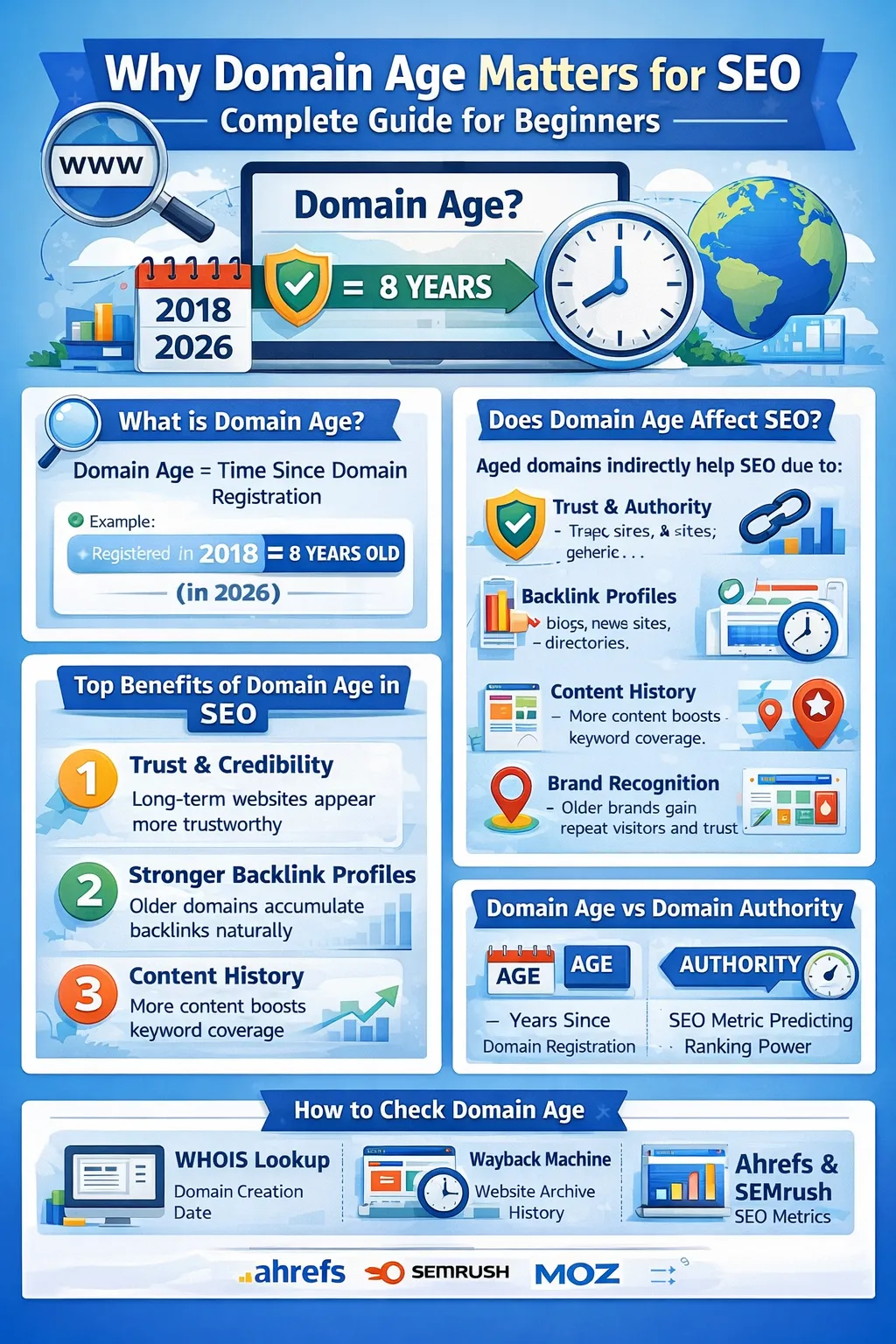
Domain age generally refers to how long a domain name has existed since its original registration.
For example, suppose:
-
Domain registered: 2018
-
Current year: 2026
The domain has existed for approximately 8 years.
However, there is an important distinction between:
Registration age
and
website history.
A domain may have been registered in 2010 but remain unused for several years.
Another domain may have been registered in 2018 and operated continuously as a real business website.
These two domains have the same broad registration-age concept but very different histories.
This is why domain age alone does not tell you everything about a website's SEO strength.
🕰️ Domain Registration Date vs Website Age
Beginners often assume that the registration date tells the complete story.
It does not.
Consider this example:
Domain A
Registered: 2012
Active website: 2012–2026

Domain B
Registered: 2012
Unused: 2012–2020
Website launched: 2021
Both domains may have an old registration date.
But Domain A has a much longer active website history.
This distinction becomes particularly important when evaluating expired domains.
An old domain that was inactive for many years should not automatically be treated as an established website.
🔍 How Can You Check Domain Age?
There are several ways to investigate a domain's age and history.
Common sources include:
-
WHOIS information
-
Domain registrar information
-
Historical DNS records
-
Internet Archive / Wayback Machine
-
SEO backlink databases
-
Search engine indexing
-
Historical content records
SEO tools can also provide additional information about:
-
Referring domains
-
Backlinks
-
Organic keywords
-
Historical traffic estimates
-
Lost links
-
Anchor text
-
Historical ranking visibility
However, no single tool provides a perfect picture of a domain's complete history.
For serious domain research, use multiple sources.
📅 Does Domain Age Directly Affect Google Rankings?
This is one of the most important questions.
The safest answer is:
Do not assume that the number of years since domain registration is a direct ranking advantage.
Google uses many systems and signals to determine which pages should appear in search results.
Domain age by itself should not be treated as a guaranteed ranking factor.
For example:
Old domain
≠
Automatically high rankings
And:
New domain
≠
Automatically poor rankings
A new website can rank if its content is useful, relevant, authoritative, technically accessible, and better suited to a particular search query.
Likewise, an old domain can perform poorly if its content is outdated, irrelevant, spammy, or technically weak.
🧠 Why Do Older Domains Often Perform Better?
If domain age itself is not a magic ranking factor, why do older websites often appear stronger?
The answer is accumulation.
A website that has been operating for many years has had more time to develop other useful SEO assets.
Think of domain age as time available for growth.
For example:
Year 1
→ Publish content

Year 2
→ Earn backlinks

Year 3
→ Build topical coverage

Year 4
→ Develop brand recognition

Year 5
→ Improve content

Year 6
→ Earn more references

Year 7
→ Build stronger authority

Year 8
→ Expand into related topics
The domain is not becoming powerful merely because its birthday increases.
It is becoming stronger because the business has had more time to build useful assets.
🔗 1. Older Domains May Have Stronger Backlink Profiles
One of the biggest potential advantages of an established domain is its backlink history.
A website that has been online for 10 years may have earned links from:
-
News websites
-
Industry publications
-
Blogs
-
Educational websites
-
Research resources
-
Business directories
-
Communities
-
Partner websites
-
Government or institutional websites
Not all backlinks are valuable.
Quality matters much more than raw quantity.
For example:
100 irrelevant spam links
are not necessarily better than:
10 relevant, trustworthy links
A website that has naturally earned high-quality references over many years may have a significant competitive advantage.
🔗 Backlink Accumulation Takes Time
Suppose a company publishes useful technical tutorials.
Over five years, those tutorials may be referenced by:
-
Developers
-
Bloggers
-
Universities
-
Industry websites
-
Documentation pages
Each useful reference can contribute to the site's broader authority and discoverability.
A brand-new website does not automatically have those relationships.
This is one reason an established website can sometimes rank faster.
But the advantage comes from the links and reputation, not simply from the registration date.
📚 2. Older Websites May Have More Content History
A website that has been publishing useful information for many years may have hundreds or thousands of pages.
This can create broad topical coverage.
For example, imagine a website focused on web development.
It may have articles about:
PHP
JavaScript
HTML
CSS
APIs
Databases
SEO
Web Security
WordPress
Hosting
Performance
Over time, the website can demonstrate expertise across related topics.
A new website may only have:
10 articles
while the established website has:
500 relevant articles
The second site may have a stronger content ecosystem.
Again, this does not mean:
500 pages = automatically better.
If 450 of those pages are thin, outdated, duplicated, or unhelpful, the advantage may disappear.
Quality and relevance still matter.
🎯 3. Topical Authority Can Develop Over Time
Topical authority refers broadly to how comprehensively a website covers a subject.
Suppose a website publishes one article about:
"What is Technical SEO?"
Another website publishes an interconnected collection covering:
-
Technical SEO
-
Crawling
-
Indexing
-
Robots.txt
-
XML sitemaps
-
Canonical URLs
-
Structured data
-
Core Web Vitals
-
JavaScript SEO
-
Internal linking
-
Log file analysis
The second website provides much broader coverage.
This can create a strong topical ecosystem.
An older website has simply had more time to build such an ecosystem.
🔄 4. Internal Linking Can Improve Over Time
Established websites often develop extensive internal linking structures.
For example:
SEO Guide
   ↓
Technical SEO
   ↓
Crawling Guide
   ↓
Robots.txt Guide
   ↓
XML Sitemap Guide
Good internal linking helps users discover related content and helps search engines understand relationships between pages.
A new site can build this structure too, but it takes planning and content development.
🏷️ 5. Older Websites May Have Stronger Brand Recognition
Brand recognition can become another indirect advantage.
Imagine someone searching for:
best web development tools
They may already recognize certain brands from previous experiences.
Users may:
-
Search for the brand name
-
Return directly to the site
-
Click familiar results
-
Mention the company elsewhere
-
Share content
-
Link to resources
Brand development takes time.
A website that has operated for many years may have had more opportunities to establish recognition.
📈 6. Search Visibility Can Accumulate
A successful website can rank for hundreds or thousands of queries.
Some pages may receive:
-
Impressions
-
Clicks
-
Links
-
Mentions
-
Returning visitors
Over time, the website develops a large organic search footprint.
A new website starts with little or no search history.
This is a natural advantage of being established, but it is not the same thing as saying:
"Google gives old domains a ranking bonus."
The distinction is important.
🧱 7. Older Businesses May Have More Real-World Authority
Domain age sometimes correlates with business age.
A company that has operated for 10 years may have:
-
Customer reviews
-
Press mentions
-
Industry references
-
Business partnerships
-
Social presence
-
Brand searches
-
Expert authors
-
Original research
-
Product history
These can contribute to a stronger overall web presence.
Again, the age of the domain is only one part of the story.
⚖️ Domain Age vs Domain Authority
These concepts are frequently confused.
They are not the same thing.
Domain Age
Domain age refers broadly to how long a domain has existed since registration.
Example:
Domain registered: 2016
Current year: 2026
Approximate age: 10 years
Domain Authority
Domain Authority (DA) is a third-party SEO metric created by Moz.
It is not a Google ranking score.
Other SEO platforms have their own metrics, such as:
-
Domain Rating
-
Authority Score
-
Trust Flow
-
Citation Flow
These metrics are useful for SEO analysis but should not be confused with Google's own ranking systems.
A domain can have:
Old age + low authority
or:
Young age + strong authority
🆚 New Domain vs Old Domain
Let's compare two hypothetical websites.
Website A: New Domain
Age:
6 months
Content:
100 excellent articles
Backlinks:
High-quality relevant links
Technical SEO:
Excellent
Brand:
Growing
Website B: Old Domain
Age:
15 years
Content:
Mostly outdated
Backlinks:
Many low-quality links
Technical SEO:
Poor
Brand:
Weak
Which one will rank?
There is no rule saying Website B must win.
The newer website may perform very well if its content is genuinely more useful and relevant.
🚫 Myth: Older Domains Always Rank Higher
This is one of the biggest SEO myths.
An old domain can fail because of:
-
Poor content
-
Bad technical SEO
-
Irrelevant backlinks
-
Spam history
-
Poor user experience
-
Outdated information
-
Lack of topical relevance
-
Weak search intent alignment
Age does not compensate for a fundamentally poor website.
🚫 Myth: A New Domain Cannot Rank
This is also false.
New websites can rank.
A new website can succeed by targeting:
-
Low-competition keywords
-
Long-tail queries
-
Specific audiences
-
Underserved topics
-
Fresh information
-
Strong product searches
For example, a new website focusing on a very specific programming library may outrank older general websites if it provides the best answer to a particular query.
🚫 Myth: Buying an Old Domain Automatically Gives You SEO Authority
This is another common misunderstanding.
Buying an aged domain does not mean you automatically inherit a strong SEO profile.
Before buying a domain, you need to investigate:
-
Previous website content
-
Backlinks
-
Anchor text
-
Historical ownership
-
Spam history
-
Search visibility
-
Manual actions if discoverable
-
Topic relevance
-
Link quality
-
Previous redirects
-
Periods of inactivity
An old domain with a terrible history can be worse than a clean new domain.
🕸️ What Is an Expired Domain?
An expired domain is a domain that was previously registered but was not renewed and became available again.
For example:
2012
Domain registered

2012–2021
Legitimate website

2022
Owner stops renewing

2023
Domain expires

2024
New person registers domain
The new owner may see the domain as an "aged domain."
But the domain's history needs careful investigation.
The previous website may have been:
-
A legitimate business
-
A blog
-
A community
-
A news website
-
An affiliate site
-
A spam network
-
A hacked website
-
A private blog network
-
An unrelated project
You need to know which one.
🔍 How to Check an Aged Domain Before Buying
If you are considering purchasing an aged or expired domain, perform a detailed investigation.
1. Check Historical Website Content
Use the Internet Archive / Wayback Machine to see what the website looked like in previous years.
Look for:
-
Topic consistency
-
Business history
-
Content quality
-
Spam pages
-
Gambling content
-
Adult content
-
Pharmaceutical spam
-
Automatically generated pages
-
Strange redirects
If the domain was previously about cooking and suddenly became a casino site, investigate further.
🔗 2. Analyze Backlinks
Use an established SEO platform to inspect:
-
Referring domains
-
Backlink count
-
Link quality
-
Anchor text
-
Lost links
-
New links
-
Follow/nofollow attributes
-
Relevance
Do not focus only on the number of backlinks.
For example:
Domain A
100,000 backlinks
Mostly spam

Domain B
500 backlinks
Highly relevant and authoritative
Domain B may be far more attractive.
📝 3. Check Anchor Text
Anchor text can reveal suspicious SEO activity.
Healthy examples might include:
DailyCodeTools
example.com
Unit Converter
PHP tutorial
Web development guide
Suspicious patterns might include large quantities of unrelated commercial keywords.
For example:
cheap casino
online betting
viagra
adult videos
on a domain that supposedly belongs to a programming company.
This can be a warning sign.
🌐 4. Check Topical Relevance
Suppose you run a technology website.
You find an aged domain with hundreds of backlinks.
But historically it was a:
Travel website
and most of its links came from:
Travel blogs
Tourism directories
Hotel websites
Those links may not be highly relevant to your technology website.
Domain history and topical relevance matter.
⚠️ 5. Check for Spam History
Look for evidence of:
-
Automated content
-
Doorway pages
-
Hidden text
-
Link networks
-
Malware
-
Hacked content
-
Gambling spam
-
Adult spam
-
Pharmaceutical spam
-
Fake directories
A domain with a long spam history should be treated carefully.
🔄 6. Check Ownership and Topic Changes
A domain can change owners many times.
For example:
2014–2018 → News website
2019–2021 → Expired
2022 → SEO project
2023 → Spam
2024 → Expired
2025 → New owner
The registration date alone does not tell this story.
Historical context is extremely important.
📉 7. Check Historical Organic Traffic
SEO tools can provide estimates of historical search visibility.
Look for:
-
Organic keywords
-
Ranking pages
-
Traffic trends
-
Major drops
-
Sudden spikes
-
Recovery patterns
A domain that had significant organic traffic and then suddenly lost nearly all visibility deserves further investigation.
A traffic decline can have many causes, so do not assume it automatically means a penalty.
🧭 Domain Age and Domain History Are Different
This distinction deserves special attention.
Domain Age
How long the domain has existed.
Domain History
What happened on the domain during that time.
A domain can be:
10 years old
+
10 years of legitimate use
which may be valuable.
Another domain can be:
10 years old
+
mostly parked or spammed
which may not provide the same benefit.
Therefore:
History can be more informative than age alone.
🏗️ Domain Age and New Website SEO
If you are starting a new website, you should not become obsessed with domain age.
A new domain gives you a clean opportunity to build your website correctly.
Focus on:
-
Search intent
-
Content quality
-
Topical coverage
-
Internal linking
-
Technical SEO
-
Page experience
-
Original information
-
Strong branding
-
Relevant backlinks
-
Consistent publishing
A six-month-old domain with excellent resources can become competitive.
🎯 Focus on Search Intent
Search intent is one of the most important concepts for SEO.
Before writing content, understand what the searcher wants.
For example:
"what is domain age"
is informational.
The user wants an explanation.
Meanwhile:
"check domain age"
may have a tool-oriented intent.
And:
"buy aged domain"
has a commercial intent.
Your content should satisfy the intent behind the query.
📝 Create Better Content Instead of More Content
New websites often make this mistake:
"We need 1,000 articles as quickly as possible."
Quantity is not the goal.
A better strategy is:
Research
↓
Create useful content
↓
Cover the topic thoroughly
↓
Add original value
↓
Connect related pages
↓
Update when necessary
Ten excellent pages can be more valuable than hundreds of low-quality pages.
🔗 Build Relevant Backlinks
A new domain needs to establish credibility.
One way to do this is by earning relevant references.
Potential methods include:
-
Original research
-
Useful tools
-
Expert contributions
-
Digital PR
-
Industry resources
-
Data studies
-
Helpful guides
-
Community participation
-
Partnerships
Avoid relying on spammy link-building networks.
The goal should be to create something worth referencing.
🧠 Build Topical Coverage
Instead of publishing random articles, create topic clusters.
For example, if your website is about SEO:
SEO
├── Technical SEO
│   ├── Crawling
│   ├── Indexing
│   ├── Robots.txt
│   └── XML Sitemaps
│
├── On-Page SEO
│   ├── Title Tags
│   ├── Meta Descriptions
│   └── Internal Linking
│
└── Off-Page SEO
    ├── Backlinks
    ├── Digital PR
    └── Link Building
This creates a more coherent website than publishing unrelated topics.
🔄 Update Existing Content
Older websites have one advantage that new websites can also develop:
content history.
But old content needs maintenance.
Review:
-
Statistics
-
Screenshots
-
Examples
-
Links
-
Search intent
-
Outdated information
-
Product information
-
Technical instructions
A 2018 article about SEO may need substantial updates in 2026.
Freshness matters particularly for topics where information changes quickly.
📊 Domain Age vs Content Freshness
There is an interesting balance between age and freshness.
An old article may have accumulated links.
But if the information is outdated, it may no longer satisfy users.
A better strategy is often:
Keep valuable URL
+
Improve content
+
Update outdated information
+
Preserve useful backlinks
This can be more effective than creating a completely new URL for every update.
🔄 Does Changing Website Content Reset Domain Age?
The domain's registration history does not simply disappear because you redesign the website.
However, changing a site's:
-
Topic
-
Ownership
-
Content
-
URL structure
-
Purpose
-
Backlink profile
can dramatically change how the website should be evaluated.
For example, converting:
Old technology website
into:
Unrelated casino website
does not magically transfer all of the old site's relevance to the new project.
SEO is not a simple domain-age inheritance system.
🔀 What About Domain Redirects?
Redirects can be useful when:
-
Rebranding
-
Consolidating duplicate pages
-
Moving to a new domain
-
Merging related websites
But redirects should not be viewed as a shortcut for transferring unrelated SEO authority.
A redirect should make sense for users and search engines.
If you buy a random old domain and redirect thousands of unrelated pages to your new website, you should not assume that the old domain's authority will simply transfer.
Relevance matters.
💡 When Can an Aged Domain Be Useful?
An aged domain may be worth considering when:
-
It has a legitimate history
-
Its topic is relevant
-
It has useful backlinks
-
Its history is clean
-
Its previous content is related
-
Its brand fits your project
-
You have a legitimate reason to acquire it
For example, buying an established technology publication whose owner is retiring could make sense if you intend to continue the same general topic and preserve the site's useful resources.
That is very different from buying a random expired domain purely because it is 15 years old.
⚠️ When Should You Avoid an Aged Domain?
Be cautious when:
-
The domain has obvious spam history
-
Backlinks are mostly irrelevant
-
Anchor text is suspicious
-
Previous content was unrelated
-
The domain changed topics repeatedly
-
The domain was used for manipulative SEO
-
Historical content shows malware or hacking
-
The backlink profile is artificial
-
You cannot explain why the domain is valuable
Sometimes a clean new domain is a better investment.
🧮 Is Domain Age More Important Than Backlinks?
Generally, you should not think of SEO as:
Domain Age > Backlinks
or:
Backlinks > Domain Age
These are different concepts.
Domain age is simply one historical characteristic.
Backlinks are external references that can contribute to a website's authority and discovery.
A domain with a strong relevant backlink profile may outperform an older domain with no useful links.
🏆 Is Domain Age More Important Than Content Quality?
No.
Content quality and relevance remain fundamental.
Consider:
Domain A
Age: 15 years
Content: Poor

Domain B
Age: 1 year
Content: Excellent
There is no universal rule that Domain A must rank higher.
Search engines aim to return useful results for searchers.
Therefore, new websites should focus on producing genuinely helpful content rather than waiting for their domain to become old.
🔍 Domain Age and E-E-A-T
SEO discussions often mention E-E-A-T:
-
Experience
-
Expertise
-
Authoritativeness
-
Trustworthiness
Domain age is not equivalent to E-E-A-T.
A domain being old does not automatically prove that its authors are experts.
A newer website can demonstrate expertise through:
-
Experienced authors
-
Original research
-
First-hand experience
-
Accurate information
-
Transparent authorship
-
Strong editorial standards
-
Useful references
Likewise, an old website can lose trust if its information becomes unreliable.
📱 User Experience Still Matters
An old domain with a terrible website can lose users quickly.
Consider:
-
Slow loading
-
Difficult navigation
-
Intrusive advertisements
-
Poor mobile experience
-
Broken links
-
Hard-to-read text
-
Aggressive popups
A new website that is:
-
Fast
-
Mobile-friendly
-
Easy to navigate
-
Clear
-
Accessible
-
Helpful
can create a much better experience.
Domain age should never become an excuse to ignore website quality.
🛠️ Technical SEO for New Domains
If your domain is new, technical SEO becomes especially important.
Make sure:
-
Pages can be crawled
-
Important pages are indexable
-
XML sitemap is available
-
Robots.txt is configured correctly
-
Canonical URLs are correct
-
HTTPS is enabled
-
Mobile layout works properly
-
Internal links are logical
-
Broken links are fixed
-
Redirects are correct
-
Structured data is appropriate
Technical problems can prevent excellent content from performing well.
📈 How Long Does It Take a New Domain to Rank?
There is no universal timeline.
A new website can see search impressions relatively quickly for some queries.
Competitive keywords can take much longer.
The timeline depends on:
-
Competition
-
Topic
-
Content quality
-
Search intent
-
Website authority
-
Backlinks
-
Technical health
-
Industry
-
Query type
-
Brand strength
Instead of asking:
"How old must my domain be?"
ask:
"What does my website need to become the best result for this query?"
That is a much more useful SEO question.
🗺️ A Practical SEO Plan for a New Domain
Month 1: Foundation
Focus on:
-
Technical SEO
-
Website structure
-
Search intent research
-
Core pages
-
Analytics
-
Search Console
-
Sitemap
-
Internal linking
Months 2–3: Content
Create:
-
Helpful guides
-
Topic clusters
-
Supporting articles
-
Commercial pages
-
FAQ content where useful
Months 3–6: Authority
Focus on:
-
Digital PR
-
Link earning
-
Original research
-
Partnerships
-
Content updates
Months 6–12: Optimization
Analyze:
-
Search impressions
-
Click-through rates
-
Ranking changes
-
Content gaps
-
Internal links
-
Conversion performance
The exact timeline will vary, but consistent execution is more important than simply waiting for the domain to become older.
📌 Common Domain Age SEO Myths
Myth 1: Google Gives Old Domains a Ranking Bonus
There is no reason to treat domain age as a guaranteed ranking bonus.
Myth 2: A 10-Year-Old Domain Automatically Has Authority
No.
Authority depends on many factors, and third-party authority metrics are not the same thing as Google's ranking systems.
Myth 3: Buying an Expired Domain Guarantees Faster SEO
No.
The domain's history, relevance, backlink quality, and previous use all matter.
Myth 4: New Domains Cannot Compete
They can.
Strong content and relevance can allow new websites to compete, especially in less competitive searches.
Myth 5: More Backlinks Always Mean a Better Aged Domain
No.
Backlink quality, relevance, naturalness, and context matter.
Myth 6: Domain Registration for 10 Years Improves Rankings
Simply registering a domain for many years should not be treated as a guaranteed SEO tactic.
🧠 Domain Age Should Be Viewed as a Supporting Factor
A useful mental model is:
Domain Age
     ↓
More Time Available
     ↓
Opportunity to Build
     ↓
Content + Links + Brand + Trust
     ↓
Potential SEO Strength
Not:
Old Domain
     ↓
Google Bonus
     ↓
High Rankings
The second model is too simplistic.
🏁 Final Thoughts
Domain age is one of the most misunderstood concepts in SEO.
An older domain is not automatically better than a new domain, and there is no reason to treat the number of years since registration as a magic ranking signal.
However, established websites often have advantages that naturally accumulate over time.
These may include:
-
Stronger backlink profiles
-
Larger content libraries
-
Broader topical coverage
-
Better internal linking
-
Brand recognition
-
Returning users
-
Industry relationships
-
Historical search visibility
-
More opportunities to earn references
That is why older websites can sometimes appear stronger in competitive search results.
But the real lesson for SEO beginners is simple:
Do not wait for your domain to become old. Build a website that deserves to rank.
If you are starting a new website in 2026, focus on:
-
Creating genuinely useful content
-
Understanding search intent
-
Building topical depth
-
Improving technical SEO
-
Earning relevant backlinks
-
Developing a recognizable brand
-
Providing a strong user experience
-
Updating important content
-
Maintaining a clean website history
-
Consistently improving the site
If you are considering an aged or expired domain, investigate the history, not just the registration date.
Check its previous content.
Analyze its backlinks.
Review its anchor text.
Look for spam.
Check whether the old topic is relevant to your new project.
Understand ownership and content changes.
An old domain with a clean, relevant history can sometimes provide a useful starting point, but buying an aged domain purely because of its age is not a reliable SEO strategy.
Ultimately, SEO is not a race between old and new domains.
It is a competition to provide the most useful, relevant, trustworthy, and technically accessible result for a searcher's query.
A domain registered yesterday can eventually become a strong website.
A domain registered fifteen years ago can still fail.
Age gives a website more time to build value—but it does not create that value by itself.
That is the key concept every SEO beginner should understand.
Quick Domain Age SEO Checklist
Before judging a website based on its age, check:
-
Original domain registration date
-
Historical website content
-
Periods of inactivity
-
Previous owners where available
-
Historical topics
-
Backlink quality
-
Referring domains
-
Anchor text
-
Organic search history
-
Spam history
-
Topical relevance
-
Current content quality
-
Technical SEO
-
Brand strength
-
User experience
And if you own a new domain:
-
Build useful content
-
Target realistic keywords
-
Create topic clusters
-
Improve internal linking
-
Earn relevant backlinks
-
Keep technical SEO clean
-
Update important pages
-
Build a real brand
-
Monitor search performance
-
Stay consistent
Domain age is a historical characteristic. Website quality is something you build.
For long-term SEO success, the second one matters far more than simply waiting for the calendar to add another year.
Your email address will not be published. Comments are moderated.
0 Comments on This Post
Leave a Reply
Comments (0)
Spread the Word!
Join Our Developer Community!
Get weekly coding tips, tool updates, and exclusive tutorials straight to your inbox.
Request a Tool
×