What Is Programming Language?
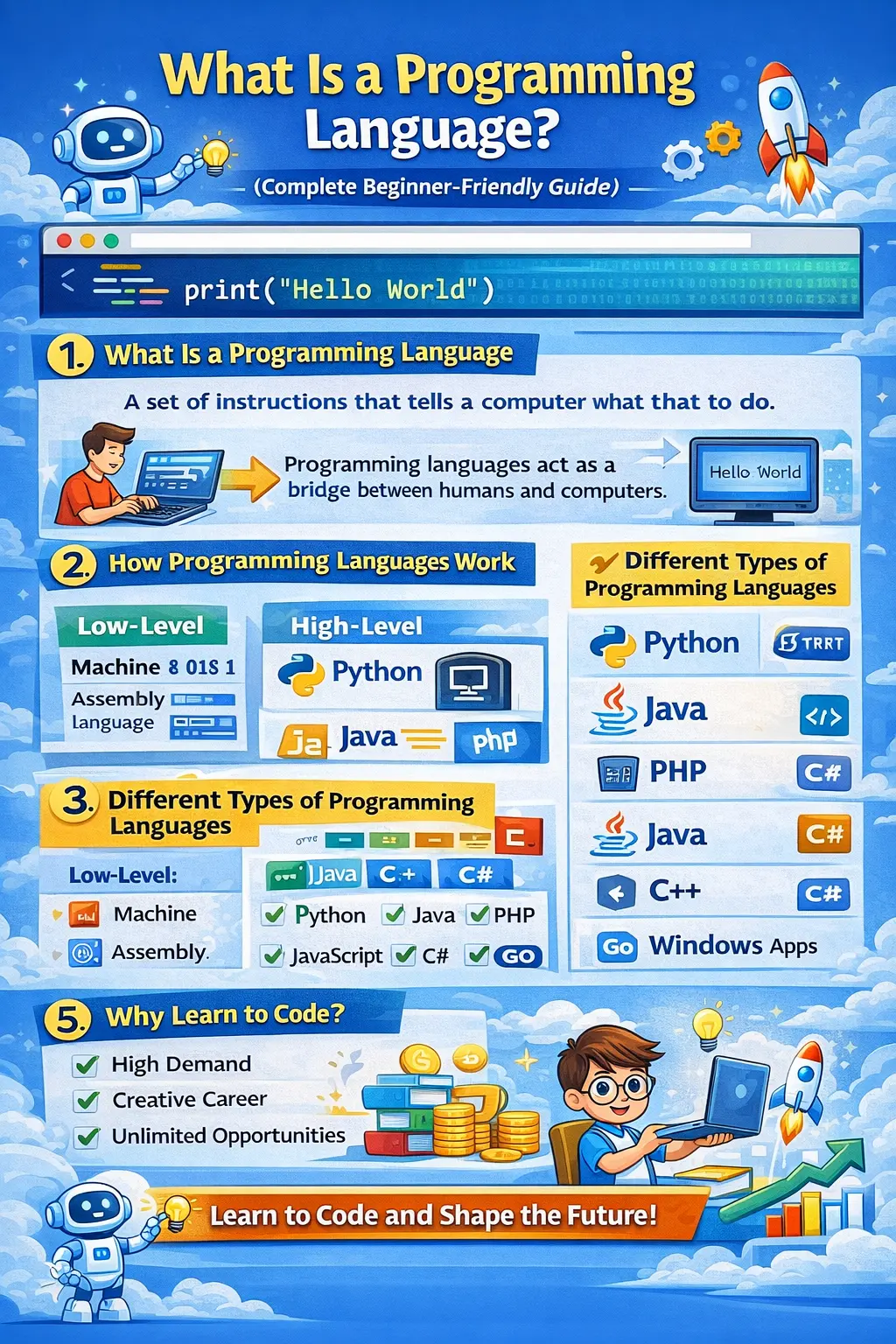
A programming language is the foundation of modern technology. From mobile apps and websites to software, games, and artificial intelligence — everything runs on programming languages.
If you’ve ever wondered what a programming language is, how it works, and why it is important, this guide will explain everything in simple language, even if you have zero technical background.
1️⃣ What Is a Programming Language?
A programming language is a set of instructions used to communicate with a computer.
👉 It allows humans to tell computers what to do and how to do it.
Computers do not understand human language. They only understand binary (0 and 1). Programming languages act as a bridge between humans and machines.
✅ Simple Definition
A programming language is a language used to write programs that computers can understand and execute.
2️⃣ Why Are Programming Languages Important?
Programming languages are important because they help us:
-
Create websites and web applications
-
Build mobile apps (Android & iOS)
-
Develop software and operating systems
-
Create games
-
Analyze data
-
Build AI and machine learning models
👉 Without programming languages, computers are useless machines.
3️⃣ How Programming Languages Work
Programming languages work in three main steps:
-
Write Code – Developer writes instructions
-
Translate Code – Compiler or interpreter converts code
-
Execute Code – Computer performs the task
🔹 Example:
You write:
print("Hello World")
The programming language translates it into machine language, and the computer displays:
Hello World
4️⃣ Types of Programming Languages
Programming languages are divided into different types based on usage and level.
5️⃣ Low-Level Programming Languages
Low-level languages are close to machine language.
🔹 Types:
-
Machine Language (0 and 1)
-
Assembly Language
🔹 Features:
-
Very fast
-
Hard to learn
-
Machine dependent
👉 Used in system-level programming.
6️⃣ High-Level Programming Languages
High-level languages are easy to read, write, and understand.
🔹 Examples:
-
Python
-
Java
-
PHP
-
JavaScript
-
C#
🔹 Features:
-
Beginner-friendly
-
Platform-independent
-
Easy to debug
👉 Most modern applications are built using high-level languages.
7️⃣ Procedural Programming Languages
These languages follow step-by-step instructions.
🔹 Examples:
-
C
-
Pascal
👉 Best for simple programs and system-level tasks.
8️⃣ Object-Oriented Programming Languages (OOP)
OOP languages organize code using objects and classes.
🔹 Examples:
-
Java
-
C++
-
Python
-
PHP
🔹 Benefits:
-
Code reusability
-
Easy maintenance
-
Better structure
👉 Most large applications use OOP.
9️⃣ Scripting Programming Languages
Scripting languages are used for automation and dynamic tasks.
🔹 Examples:
-
JavaScript
-
Python
-
PHP
-
Ruby
👉 Widely used in web development.
🔟 Popular Programming Languages & Their Uses
| Language | Used For |
|---|---|
| Python | AI, Data Science, Web |
| JavaScript | Frontend & Backend |
| PHP | Web Development |
| Java | Android Apps |
| C++ | Games & Software |
| C# | Windows Apps |
| Go | Cloud Applications |
1️⃣1️⃣ Which Programming Language Should You Learn First?
If you are a beginner:
✅ Best Choices:
-
Python (easy & powerful)
-
JavaScript (web development)
-
PHP (backend & tools websites)
👉 Choose based on your goal, not hype.
1️⃣2️⃣ Programming Language vs Markup Language
Many beginners confuse these two.
| Programming Language | Markup Language |
|---|---|
| Performs logic | Structures content |
| Uses conditions & loops | No logic |
| Example: Python | Example: HTML |
👉 HTML is not a programming language.
1️⃣3️⃣ Are Programming Languages Hard to Learn?
❌ No, if you learn step by step.
✔ Start with basics
✔ Practice daily
✔ Build small projects
Programming is a skill, not talent.
1️⃣4️⃣ Future of Programming Languages
Programming languages will:
-
Become simpler
-
Integrate with AI
-
Focus more on automation
But programmers will always be needed.
🔚 Final Thoughts
A programming language is the backbone of the digital world. Whether you want to build websites, apps, tools, or software — learning a programming language opens unlimited opportunities.
If you understand:
-
Basics
-
Logic
-
Problem-solving
👉 You can learn any programming language.
Your email address will not be published. Comments are moderated.
0 Comments on This Post
Leave a Reply
Comments (0)
Spread the Word!
Join Our Developer Community!
Get weekly coding tips, tool updates, and exclusive tutorials straight to your inbox.
Request a Tool
×